Skip to content

Month: October 2022

Roger Stone really wanted another pardon

He didn’t get it

I wrote a couple of weeks ago that the J6 Committee was planning to go after Roger Stone in the next hearing and I was wrong. They mentioned him almost in passing and that was it. But it appears that they were planning to feature him more heavily and decided against it. Get a load of this:

https://twitter.com/cguld/status/1580927465341747201

In new exclusive footage obtained by The Daily Beast, a yet-to-be-released documentary captured Stone’s meltdown after learning on President Joe Biden’s inauguration day that he wouldn’t be granted a second coveted legal protection, this time to shield from any Jan 6 legal fallout. (Trump issued a pardon to Stone in December 2020.)

“Jared Kushner has an IQ of 70. He’s coming to Miami. We will eject him from Miami very quickly; he will be leaving very quickly,” Stone said, while visibly shaking in anger. “Very quickly.”

Stone continued: “He has 100 security guards. I will have 5,000 security guards. You want to fight. Let’s fight. Fuck you.” (The filmmakers remain unsure of who Stone directed this remark towards.)

“Fuck you and your abortionist bitch daughter,” he concluded, referring to Ivanka Trump, according to the filmmaker Christoffer Guldbrandsen who said there was “no doubt” who Stone was ranting about.

According to the filmmakers, the video clip above was one of the few videos hand-selected by the Jan 6th Committee, but, in the end, the committee elected not to play the clip.

I guess they figured that focusing on Stone and the quest for pardons in the last days wasn’t as important as doing a thorough recap of the full story. But it almost certainly would have made Trump very angry. Calling Ivanka an abortionist probably wouldn’t have gone over well.

Danish filmmaker Christoffer Guldbrandsen—part of the team that captured the moment for his upcoming documentary A Storm Foretold—told The Daily Beast that the tense scene was from inauguration day on Jan. 20, 2021, and recorded in Fort Lauderdale.

“Roger Stone has been holding out for a pardon till the very last minute, he had first written up a memo, earlier on, after January 6th, with a plan about encouraging Trump to pardon the lawmakers who had voted against certifying, and Roger Stone, and some of his clients,” Guldbrandsen said.

But he says towards the end of the road, Stone — who was “increasingly frustrated” — pushed for just a pardon for himself and longtime pal Bernard Kerik, the filmmaker said.

Guldbrandsen added that upon Stone learning he wouldn’t receive a pardon on inauguration day, he became “very upset.”

“Aside from Donald Trump, he also held Jared Kusher responsible as being the guy who was the point man on the pardon,” he said.

I guess the question is what did Stone and Kerik do that they were so adamant about getting yet another pardon? (They had both been pardoned by Trump for earlier crimes already.) I don’t know if we’ll ever know but Stone certainly seems to believe he needed one.

Ron Johnson needs to go

Not only is he very, very dumb, he’s a terrible person

Apparently, some people really like that:

I guess I’m not surprised. There is a great market in our culture for dumb jerks. Ron Johnson certainly fits that bill.

Now, on to the next debate tonight between a human being and a stupid jerk: Warnock vs. Walker. The good news is that the new Quinnipiac poll shows that Warnock leads Walker by 7 points. The bad news is that similar to Wisconsin, young and Independent men, including Black men are rejecting Stacy Abrams. *sigh*

The J6 Committee laid it all out

Donald Trump planned the coup for months. As usual, he failed to execute it. Then he incited the insurrection.

The Jan. 6 committee’s final public hearing before the midterm election ended with a bang, not a whimper. At the conclusion of the hearing the committee’s nine members voted unanimously to subpoena former President Donald Trump to testify. After their two-and-a-half hour presentation, it’s hard to imagine how they ever could have contemplated doing otherwise. They presented a meticulously documented case which showed that Trump had a premeditated plan of many months to deny losing the election, plotted a coup to overturn the results if he did, incited a violent insurrection when that was thwarted, and then refused for hours to respond to the violence as he watched it unfold on television. Whether he will respond to the subpoena remains to be seen, but either way it’s another black mark on his uniquely corrupt and dishonest political career.

For most of us who closely followed events in real time, both on Jan. 6 and through the subsequent investigations and revelations, much of this was not news. But it’s been a while since we focused on some of these details, and to see it presented in narrative form, with so much video and documentary evidence, is still powerful. For instance, the fact that Trump had planned to contest the election if he lost was no secret. Indeed, he had signaled back in 2016 that he would never concede defeat, famously declaring in the days before that election, “I will totally accept the results of this great and historic presidential election — if I win.” For years after that victory he insisted that he’d actually won the popular vote but had been victimized by millions of immigrants illegally voting in California. He even convened something called the Presidential Advisory Commission on Election Integrity to try to prove that case. Even his hand-picked hacks couldn’t turn up any evidence, and the “commission” was quietly disbanded without even issuing a report.

As 2020 approached with Trump down in the polls and the pandemic wreaking havoc around world, he began to lay the groundwork for denying his loss once again. For months he railed against mail-in ballots — which were being instituted in many states in response to the pandemic — setting up a narrative that they were inherently fraudulent. He threatened to withhold federal funds from states that used mail-in voting and accused California of setting up massive fraud by sending out ballots to all registered voters. Trump’s 2020 campaign manager, Bill Stepien, told the committee that he couldn’t be talked out of his irrational opposition to voting by mail, even though there were numerous states where it would likely benefit him and Republicans in general.

Outside advisers and surrogates like Steve Bannon and Roger Stone publicly discussed the plan to claim victory regardless of the actual vote count. Most strikingly, the committee dug up a draft speech sent to Trump by right-wing activist Tom Fitton of Judicial Watch — now among his most influential advisers in the Mar-a-Lago documents case — proposing that Trump should declare victory on election night and declare that all votes not yet counted were illegitimate. Which is almost exactly what he did.

So he clearly planned to say the election was rigged long before the first votes were cast, and the coup plot in which Trump and his legal lackeys contested the results in numerous states was also planned well in advance. But those cases got thrown out of courts across the country, by Republican and Democratic judges alike, and as Thursday’s hearing revealed, this made Trump furious. Former White House aide Cassidy Hutchinson testified that after the Supreme Court refused to hear the crackpot lawsuit meant to overturn the results in several battleground states (which of course Trump saw as a personal betrayal), she ran into the president in a hallway where he was “raging” about the decision. Trump told chief of staff Mark Meadows, according to Hutchinson, that he didn’t want people to know they had lost the case, tasking Meadows with making sure they didn’t find out. That’s nuts, of course, but it’s also highly revealing.

Hutchinson also testified that during Trump’s diatribe to Meadows, he asked, “Why didn’t we make more calls?” That’s a curious thing to say, and raises the unanswered question of exactly who they were calling as the Supreme Court was considering the case. Is that how things work with the court’s conservative majority?

Since the committee finally got its hands on a considerable number of emails and other Jan. 6-related documents from the Secret Service — although not the missing and apparently erased text messages — there was some disturbing new information about what the agency knew ahead of time about the threats of violence. Something is deeply wrong with the Secret Service, it seems, and it doesn’t stop with them. Law enforcement in general appears to have ignored a mountain of incoming intelligence telegraphing the fact that pro-Trump extremists were highly agitated and violence was possible or even likely.

Something is deeply wrong with the Secret Service, and it doesn’t stop there. Law enforcement ignored a mountain of incoming intelligence indicating that pro-Trump extremists were highly agitated and violence was likely.

Trump knew that too. Jason Miller, the Trump campaign’s senior communications adviser, forwarded to Mark Meadows a link to a startling social media page that included such comments as “Gallows don’t require electricity” and “our lawmakers in Congress can leave one of two ways; one, in a body bag, two, after rightfully certifying Trump the winner.” Miller didn’t express alarm or concern; he boasted: “I got the base fired up.” (Miller claimed after the fact that he didn’t know about the more extreme comments.) 

As a result of law enforcement’s failure to prepare for Jan. 6, Congress was left vulnerable after Trump gave his big speech on the Ellipse, urging his rabid followers to march to the Capitol. (Some of them, in fact, were already there.) He wanted to go there too but his Secret Service detail refused to take him, leading to the purported fight between Trump and his agents in the presidential SUV. What he planned to do there we can only imagine — but now we know what the leaders of the House and Senate were doing during that time: responding to the crisis, which Trump refused to do.

While the president was sitting in the Oval Office dining room reveling in the images of his mob storming the Capitol and threatening to kill Nancy Pelosi and Mike Pence, congressional leaders had been taken to a secure location where they were working hard to get police and National Guard troops to the Capitol to put down the insurrection. As it happens, a documentary crew was on hand that day to record the historic vote and they captured Speaker Pelosi and Sen. Chuck Schumer (then the minority leader) taking charge, calmly reaching out to various government officials and trying to get Cabinet members, including the acting attorney general and acting defense secretary, to persuade Trump to call off the mob. It’s an impressive display of leadership, considering they knew they were being hunted like animals as it was happening.

The cumulative effect of all the Jan. 6 hearings, culminating in Thursday’s wrap-up of the central narrative, has made clear that Donald Trump set up the coup before the election, was personally involved in the various attempts to execute it, understood that violence was possible on Jan. 6, and incited the crowd to storm the Capitol and refused to take any action to stop them. Everything that happened came at his direction and was done in his name. 

Beyond that, Trump has turned the country upside down for two years and built an anti-democratic movement dedicated to destroying the right to vote and sabotaging elections, entirely in service to his injured ego and his refusal to admit that he could ever possibly lose. He is a damaged, destructive narcissist, beyond all help. But the really disturbing question now is why so many people are eager to believe his dangerous fantasies.

The cruelty knows no bounds

Another very young incest victim denied an abortion

This is just so sick:

A child who was the victim of incest was denied an abortion in Florida since the state instituted its 15-week ban in July, the local Planned Parenthood chapter told BuzzFeed News.

The GOP-controlled state legislature allowed exceptions to the 15-week ban in order to save the pregnant person’s life, prevent a serious injury, or if the fetus has a fatal abnormality. There are no exceptions for rape or incest, and violators of the law could face up to five years in prison.

Laura Goodhue, vice president of public policy for Planned Parenthood of South, East, and North Florida, did not disclose the patient’s exact age or the state they traveled to receive an abortion, but she told BuzzFeed News they were in middle school. Goodhue had initially said another middle schooler who experienced incest was denied an abortion in Florida, then on Thursday clarified to BuzzFeed News that the cause of the second patient’s pregnancy was not confirmed.

In order to obtain the procedure, both of the young patients had to travel “at least two, three states away,” she said. Planned Parenthood helped arrange their travel, and they were accompanied by family members.

“The cruelty of forcing a very young person, who has already survived a horrible case of violence, to give birth, it just takes away their rights to bodily autonomy, and it is really turning a blind eye to what is happening in our society,” she said.

Democrats in Florida had tried to add exceptions for rape, incest, and human trafficking into the bill before the ban was in effect, but that effort was rejected by the Republican lawmakers in February.

Florida Republicans say they care a lot about zygotes, but they don’t give a damn about kids. With this and the “don’t say gay” stuff and the assault on trans kids we are seeing nothing short of institutional child abuse. It’s horrifying.

You have to wonder how much of this is happening around the country. Probably a lot more than we hear about.

You’ll wish Nancy had … without the pink boxing gloves

TGIF, y’all

The day Speaker Nancy Pelosi became president, she was itching for a piece of Donald Trump.

Kudos to “The Late Show” staff.

Do we dare hope that Democrats are finally getting their messaging act together?

Michigan Gov. Gretchen Whitmer shows how it’s done.

https://twitter.com/MollyJongFast/status/1580722093137666048?s=20&t=a-oW011ymb-GLU0FBDORfg

● ● ● ● ● ● ● ●

Request a copy of For The Win, 4th Edition, my free, countywide get-out-the-vote planning guide for county committees at ForTheWin.us

Something rotten

Did law enforcement miss the Jan. 6 warnings or ignore them?

Press critic Dan Froomkin asks again why the press shies from addressing evidence that law enforcement in the Capitol ignored warnings of violence planned for Jan. 6.

The January 6th Committee in what may be its final hearing on Thursday revealed a series of messages uncovered in Secret Service communications. The Service infamously deleted texts from Jan. 6 that (per public knowledge) have never been recovered. However, the Committee did obtain nearly one million other communications agents sent from the period leading up to Jan. 6.

Presenting some of the evidence Thursday, Rep. Adam Schiff (D-Calif.) displayed multiple examples of messages demonstrating that President Trump, the White House, the Secret Service and other law enforcement agencies had advance warning of violence planned against the Capitol for Jan. 6.

“Days before January 6, the President’s senior advisers at the Department of Justice and FBI, for example, received an intelligence summary that included material indicating that certain people traveling to Washington were making plans to attack the Capitol,” Schiff said.

Another email showed that the Secret Service had been alerted “more than 10 days beforehand regarding the Proud Boys’ planning for January 6,” Schiff continued.

“On a call with President Trump’s White House national security staff in early January 2021, Deputy Secretary of Defense David Norquist had warned about the potential that the Capitol would be the target of the attack,” Schiff said, adding:

In fact, as we have seen, the Secret Service and other agencies knew of the prospect of violence well in advance of the president’s speech at the Ellipse. Despite this, certain White House and Secret Service witnesses previously testified that they had received no intelligence about violence that could have potentially threatened any of the protectees on January 6th, including the vice president.

Evidence strongly suggests that this testimony is not credible …

The Committee may recall those witnesses and afford them a chance to “amend” their previous testimony, plead the 5th Amendment, or cooperate.

A Washington Post report observed:

The evidence presented at the hearing adds the Secret Service to a long list of national security agencies who received prescient warnings about the assault protesters planned for Jan. 6, yet failed to respond with urgency or cohesion to prevent the insurrection.

The question still unaddressed, Froomkin asks, is why.

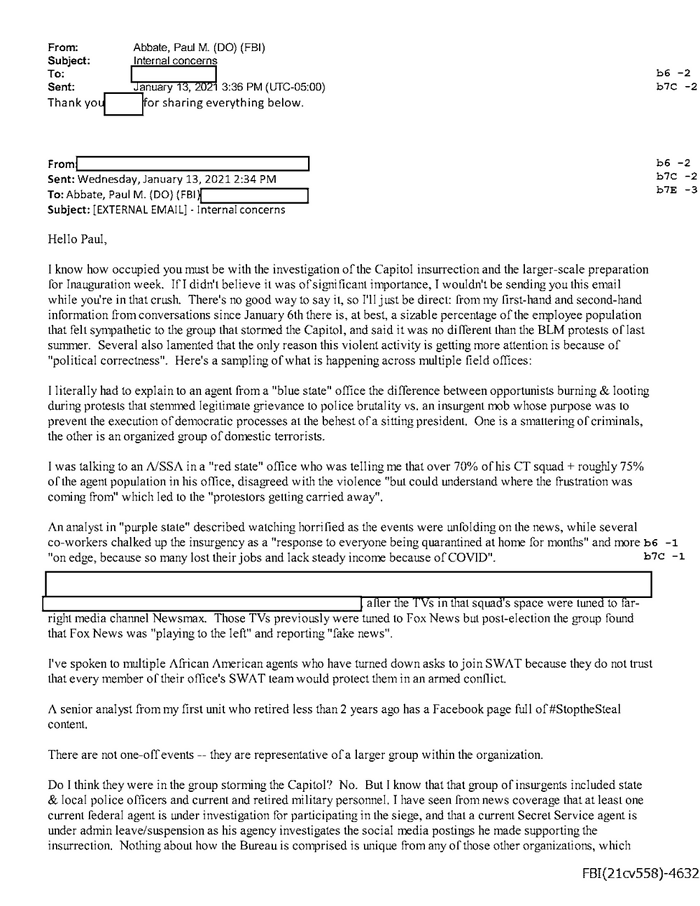
One hint may lie in an email NBC News obtained that was sent to FBI Deputy Director Paul Abbate on Jan. 13 regarding agency reaction to the riot (Esquire):

“a sizable percentage of the employee population that felt sympathetic to the group that stormed the Capitol, and said it was no different than the BLM protests of last summer. Several also lamented that the only reason this violent activity is getting more attention is because of “political correctness”. Here’s a sampling of what is happening across multiple field offices: I literally had to explain to an agent from a “blue state” office the difference between opportunists burning & looting during protests that stemmed legitimate grievance to police brutality vs. an insurgent mob whose purpose was to prevent the execution of democratic processes at the behest of a sitting president. One is a smattering of criminals, the other is an organized group of domestic terrorists. I was talking to an A/SSA in a “red state” office who was telling me that over 70% of his CT squad + roughly 75% of the agent population in his office, disagreed with the violence “but could understand where the frustration was coming from” which led to the “protestors getting carried away”. An analyst in “purple state” described watching horrified as the events were unfolding on the news, while several co-workers chalked up the insurgency as a “response to everyone being quarantined at home for months and more on edge, because so many lost their jobs and lack steady income because of COVID.”

That email presaged the most chilling aspect of Thursday’s hearing, namely, the barely concealed subtext that agents of the FBI and Secret Service may have been complicit in the violence of January 6, if only by standing back and letting it happen, or by ignoring or slow-walking intelligence they had in advance of the riot. (Two Secret Service agents were practically accused of having lied to the committee.) One particular tip to the Secret Service stood out for its plaintive appeal for someone to do something. People were coming to the Capitol armed, the tipster said, adding, “Please take this tip seriously and investigate further.” It’s unclear whether anyone ever did. If anyone had a worse day on Capitol Hill Thursday than the former president* did, it was FBI Director Christopher Wray and the upper echelons of the Secret Service.

Froomkin wrote in May:

The newest GAO report requested by the House committee investigating the Jan. 6 insurrection adds to a mountain of evidence that federal law enforcement agencies didn’t miss signs of a violent attack on the Capitol, they ignored them.

Why they ignored them remains one of the biggest unanswered questions related to the day’s events.

Actually, it’s worse than an unanswered question, it’s also a largely unasked question. Media coverage of this particular issue has been shockingly weak, and has produced no credible explanation.

It’s a strange blind spot for the reporters who have so assiduously examined seemingly every other factor in the insurrection. My conclusion, after 16 months of trying to get them to pay attention to it, is that they are too squeamish to confront this issue head-on.

We don’t want to be seen as not supporting law enforcement. Even when law enforcement does not support us.

Update: Just found the Harwood tweet.

● ● ● ● ● ● ● ●

Request a copy of For The Win, 4th Edition, my free, countywide get-out-the-vote planning guide for county committees at ForTheWin.us

About that rapid withdrawal from Afghanistan

The committee revealed testimony that Trump knew he had lost because he issued the order to be done before January 6th

This actually wasn’t new. Jonathan Swan published an account of this in his after-action reporting for Axios in the spring of 2021:

John McEntee, one of Donald Trump’s most-favored aides, handed retired Army Col. Douglas Macgregor a piece of paper with a few notes scribbled on it. He explained: “This is what the president wants you to do.”

1. Get us out of Afghanistan.

2. Get us out of Iraq and Syria.

3. Complete the withdrawal from Germany.

4. Get us out of Africa.

It was Nov. 9, 2020 — days after Trump lost his re-election bid, 10 weeks before the end of his presidency and just moments after Macgregor was offered a post as senior adviser to acting Defense Secretary Christopher Miller.

As head of the powerful Presidential Personnel Office, McEntee had Trump’s ear. Even so, Macgregor was astonished. He told McEntee he doubted they could do all of these things before Jan. 20.

“Then do as much as you can,” McEntee replied.

In Macgregor’s opinion, Miller probably couldn’t act on his own authority to execute a total withdrawal of U.S. military forces from Afghanistan because he was serving in an acting capacity. If this was for real, Macgregor told McEntee, then it was going to need an order from the president.

The one-page memo was delivered by courier to Christopher Miller’s office two days later, on the afternoon of Nov. 11. The order arrived seemingly out of nowhere, and its instructions, signed by Trump, were stunning: All U.S. military forces were to be withdrawn from Somalia by Dec. 31, 2020. All U.S. forces were to be withdrawn from Afghanistan by Jan. 15, 2021.

What the fuck is this? Miller wondered.

A former Green Beret, Miller had directed the National Counterterrorism Center and was accustomed to following process. Trump had tapped him to run the Pentagon after his unceremonious firing-by-tweet of Mark Esper. It was Miller’s third day on the job.

News of the memo spread quickly throughout the Pentagon. Top military brass, including Joint Chiefs of Staff Chairman Gen. Mark Milley, were appalled. This was not the way to conduct policy — with no consultation, no input, no process for gaming out consequences or offering alternatives.

A call was quickly placed to White House Counsel Pat Cipollone. In turn, Cipollone notified the national security adviser, Robert O’Brien. Neither Cipollone nor O’Brien had any idea what the order was or where it had come from.

Neither did the office of the staff secretary — whose job it was to vet all the paper that reached the president’s desk. Yet the paper bore Trump’s distinctive Sharpie signature.

The U.S. government’s top national security leaders soon realized they were dealing with an off-the-books operation by the commander in chief himself.

Many would rally to push back — sometimes openly and in coordination, at other times so discreetly that top Trump administration officials had to turn to classified intercepts from the National Security Agency for clues.

Trump’s instincts should have come as little surprise. He was frantically trying to salvage his own legacy while simultaneously trying to overturn the election results and block Biden’s transition to power. The result was chaos.

[…]

On the afternoon of Nov. 9, 2020, Douglas Macgregor, a decorated but highly controversial combat veteran, walked into the Presidential Personnel Office in the Eisenhower Executive Office Building, a historic and flamboyant building in the Second Empire style that once housed the U.S. Department of War.

It was six days after the election and two days since the networks had called the race for Biden.

Some staff had gone home early, while others had left to look for new jobs. Those who were still there were mostly Trump acolytes, remaining in a holding pattern as the president and his allies continued their ill-fated quest to overturn the results of the election.

Macgregor, 68, whose views on foreign policy and social issues had seen him excommunicated from the military establishment, had come to meet McEntee, who had become a controversial figure for his role in purging government officials deemed insufficiently loyal to Trump.

At 31, McEntee was a former college football quarterback who had worked as Trump’s body man. He arrived about 10 minutes after Macgregor, having come straight from the West Wing. He ushered Macgregor into his office and closed the door behind them.

It was a spacious, light-filled room adorned with Trump campaign memorabilia. McEntee swung a chair around his desk to sit directly in front of Macgregor. “Colonel, the president wants to know if you’ll come in and be senior adviser to the acting secretary of defense,” McEntee said.

“Why is that?” Macgregor asked.

“The president thinks that you can help extricate us from Afghanistan, Iraq, Syria and potentially other places,” McEntee replied.

Macgregor, a fluent German speaker, was at that point Trump’s nominee to be ambassador to Berlin. It was a position he would never hold because of the election loss, not to mention his long history of incendiary remarks, which included advocating martial law at the U.S.-Mexico border and criticizing Germany for giving welfare benefits to “millions of unwanted Muslim invaders.”

He had met Trump for the first time at an hour-long Oval Office meeting in April 2020. The two men bonded instantly. When the meeting ended, Trump told Macgregor, “I want you working for me. We will find a way.”

Trump had warmed to Macgregor through his frequent appearances on Fox News, where the colonel blasted the U.S. military’s presence overseas, called congressional leaders “idiots,” and ridiculed Pentagon policies on diversity and transgender troops.

Appointing Macgregor to a senior Pentagon position would be like rolling a grenade into the building — particularly as Milley and Macgregor held each other in contempt.

“Only met him once, but he was arguably the least impressive in a series of underwhelming Army Chiefs of Staff since 1991,” Macgregor told Axios about Milley. A source close to Milley said that Milley considered Macgregor “irrational edging on all-out lunacy.”

It didn’t take long for Macgregor to agree to McEntee’s offer to come onboard. It was then that McEntee handed Macgregor the paper with Trump’s electrifying instructions.

The article goes on to discuss Trump’s erratic decision making about the wars being pulled an pushed by the military leadership, going back and forth between his isolationism and hardcore authoritarian impulses, clearly out of his depth. It’s rather chilling…

After the election they knew he had lost and decided to work overtime to accomplish their goals before he left:

As the reality set in that Biden’s election victory would not be overturned, McEntee accelerated his push to install people supportive of Trump’s agenda at the top of the Pentagon.

They included Macgregor as Miller’s senior adviser, former Devin Nunes aide Kash Patel as chief of staff, and Anthony Tata as acting under secretary of defense for policy. Former senior NSC intelligence official Ezra Cohen, who was chief of special operations under Esper, was promoted to acting under secretary of defense for intelligence and security.

For all the feverish media speculation about the president’s secret agenda at the Pentagon, the ultimate goal was simple: Steamroll the generals and extract America from its foreign engagements, leaving behind a done deal that could not be easily reversed by the next administration.

As the new senior adviser to the new acting defense secretary, Douglas Macgregor was prepared for anything amid the fetid psychodramas of those post-election weeks. 

He arrived to chaos at the Pentagon. His own decision to seek a presidential order for an immediate Afghanistan withdrawal had set off a bizarre round of bureaucratic make-it-up-as-you-go.

Late on Nov. 10, one of McEntee’s subordinates drafting the memo for the president called Macgregor to say they didn’t know how to do it: “We’re trying to put this together but we don’t have a model for this and we want to get the language straight.”

Macgregor responded: “Go in and get a presidential decision memorandum out of the file cabinet, and that’s what you model it on, and it will have all the authorities you need and the people specifically to whom the order has to go.”

“Let’s stick first with Afghanistan,” he continued. “I think it should be midnight, 31 December 2020.” In Macgregor’s opinion this allowed Trump to fulfill a promise made when he ran for election: to get out of Afghanistan.

Macgregor heard nothing more from the White House and was astonished when he discovered two days later that the memo had not only been immediately signed by Trump on Nov. 11, but it had also been redrafted somewhere along the way.

The date for the Afghanistan withdrawal had been switched — either by accident or design — from Dec. 31 to Jan. 15.

Likewise a date included in the order for disengagement from Somalia — a smaller piece of Trump’s demand to “get out of Africa” — had been changed from Jan. 15 to Dec. 31. Both dates were designed to get U.S. troops out of both countries before Trump left office on Jan. 20.

The memo did not contain instructions for Iraq and Syria — or Germany — aspirations that Macgregor concluded were unachievable in time.

The memo Macgregor asked for had been drafted by a staffer from PPO, brought to the president, signed, and then delivered to Miller within 48 hours. On it hung the future of Afghanistan.

So why didn’t it happen?

Christopher Miller summoned Macgregor to his office and told him he had been fielding furious phone calls from officials who had gotten wind of the order, including an incandescent Senate Majority Leader Mitch McConnell.

Miller instantly suspected Macgregor had a hand in this back-channel scheme. He respected it as a slick bureaucratic play — and considered himself a full-throated supporter of getting out of Iraq, Syria, and Afghanistan — but also believed the order was dead on arrival.

He saw the timeline as logistically impossible and thought it risked leaving the incoming Biden administration with a dangerous situation. Relations between Miller and Macgregor would be cool for the brief remainder of Trump’s term.

Over at the White House, it didn’t take long for McEntee to be fingered as the main culprit of the scheme. McEntee played dumb and suggested he was just doing what Macgregor had instructed him to do.

Cipollone, the White House counsel, and O’Brien, the national security adviser whose reaction one source described as “torqued,” marched in to see Trump — and put an immediate halt to the plan. They convinced him to wait to hold a full meeting with his national security team, which took place in the Oval Office within 48 hours.

There, O’Brien, Miller, and Milley all aligned against the plan. They painted a vivid picture of Kabul falling to the Taliban if U.S. forces withdrew precipitously in the final days of the Trump presidency.

In previous conversations with Trump, they had raised the specter of Saigon in 1975, where images of American helicopters evacuating people from rooftops as the North Vietnamese took control of the capital city would become engraved in the historical record of the Vietnam War. The unsubtle warning: This would be Trump’s legacy if he rushed to the exit.

And, in a recent interview with Axios, Trump pointed out he also had concerns about leaving behind billions of dollars of equipment during a rushed, logistically complex withdrawal. “You remember those scenes [in Vietnam] with the helicopters, right, with people grabbing onto the gear? You don’t want that. And I wouldn’t have that,” he said. Still, Trump had signed the extraordinary ‘withdrawal in eight weeks’ order.

In the Oval Office meeting, O’Brien reminded Trump that they’d already agreed on a more modest plan to reduce the number of troops in Afghanistan to 2,500 by the beginning of 2021.

(When O’Brien had announced this in a speech back in October, Milley had set off a mild media controversy by suggesting that the national security adviser was merely “speculating.” Senior Pentagon officials had been privately arguing it was unwise and unsafe to go below 4,500 troops. O’Brien shot back to Milley that when he spoke in public, he spoke for the president.)

Had Milley not resisted the initial 2,500 plan, Trump might not have felt the need to sign the back-channel order. In the view of Trump’s mistrusting inner circle, this was typical of Pentagon leadership: Delay key decisions by disputing that strategic meetings had led to consensus, insist the process was still ongoing, and leak apocalyptic scenarios to the media.

These were the tactics Trump allies believed military leaders had perfected to obstruct presidents over the course of decades.

Now — in the face of the Macgregor alternative — the drawdown plan Milley had once scorned was looking like a godsend to the generals. In addition to the 2,500 U.S. troops, there would be thousands of additional U.S. contractors, NATO troops and NATO contractors all remaining in Afghanistan, which was seen as a sufficient force to maintain counterterrorism capabilities.

O’Brien told the president that drawing down to 2,500 troops in Afghanistan was the closest Trump could come to fulfilling his campaign promise while protecting U.S. interests and maintaining leverage in peace negotiations with the Taliban. And he was putting the U.S. on the path to ending the forever war.

And with that, Trump folded on total withdrawal for the last time as president.

Of course. And it allowed him to lie profusely about his previous plans, suggest that he would never have left the bases they had in the country (which meant leaving troops in the country, of course) and condemn Joe Biden for following the original Trump timeline for withdrawal.

This should be better known because of all the grief Biden took for his withdrawal. I’m glad the committee highlighted it.

Leadership

While Trump was sitting in the Oval office dining room enjoying the show on TV and guzzling Diet Cokes, the rest of the government took the bull by the horns and dealt with the insurrection.

Trump was AWOL. Do we really need to know anything else?

Republicans plan to turn election day into a circus

What could go wrong?

Inside the El Paso County clerk’s office in Colorado, where officials had gathered in July to recount votes in a Republican nominating contest for this year’s midterms, dozens of angry election watchers pounded on the windows, at times yelling at workers and recording them with cell phones.

In the hallway a group prayed for “evil to descend” on the “election team,” said the county’s Republican clerk Chuck Broerman. “It’s astonishing to me to hear something like that.” The election watchers had showed up to observe a five-day recount of votes for four Republican candidates who claimed the primary was fraudulent in a contest where they faced other Republicans.

Protesters had mobilized outside the clerk’s office, holding signs with the signature “Stop the Steal” slogan of former President Donald Trump and demanding the county get rid of its voting machines.

As the United States enters the final stretch to November’s midterm elections, Reuters documented multiple incidents of intimidation involving an expanding army of election observers, many of them recruited by prominent Republican Party figures and activists echoing Trump’s false theories about election fraud. The widespread voter fraud in the 2020 election as alleged by Trump and his supporters was never proven.

Interviews with more than two dozen election officials as well as representatives of groups driven by false theories about election fraud, and an examination of poll-watching training materials, revealed an intensifying grassroots effort to recruit activists. This has heightened alarm that disturbances in this year’s primary contests could foreshadow problems in November’s local, state and national races.

Officials and experts worry the campaign will deepen the distrust about America’s election process and lead to further harassment and threats to already besieged election workers.

Election officials in three other states — North Carolina, Arizona and Nevada — reported similar incidents. In 16 North Carolina counties alone, officials noted unusually aggressive observers during May’s primary elections, according to a state election board survey. Some attempted to take photographs of sensitive voting equipment or intimidated voters at polling places, in violation of North Carolina’s election laws.

During early voting in Arizona’s Pima County, an election observer was told to put away binoculars; another was caught looking at private voter data, and another was asked to stop making comments about “fraudulent elections,” according to a September report by the county recorder’s office reviewed by Reuters. State law forbids voter intimidation and obstructing election workers.

Pima county recorder Gabriella Cazares-Kelly said her election staff received multiple complaints from voters that individuals were shouting at them from outside the 75-foot circumference around polling stations, where interaction with voters is banned. “The concern is it makes them feel unwelcome,” said Cazares-Kelly.

In Nevada’s Washoe County, people with night vision goggles stood outside the registrar’s building and aimed their cameras at election workers counting votes on primary night in June, two Washoe County officials told Reuters.

Groups that question the legitimacy of the 2020 vote have helped recruit thousands of observers who support dramatic changes to how Americans vote, including doing away with voting machines and returning to hand-counted paper ballots.

Officials say they are concerned observers intent on rooting out so-called voter fraud could cause unnecessary disruptions and long lines at polling places on Election Day.

“It’s a real concern,” said Al Schmidt, a former Philadelphia city commissioner who received death threats after the 2020 election for refuting false claims of voter fraud. “If these people show up to the polls with the intention of disrupting voting from taking place, then I can’t imagine a worse threat to democracy than that.”

Hopefully this doesn’t materialize. But apparently, they’ve got thousands of people signing up and I don’t think they know (or care) that voting isn’t like a town hall meeting where you can storm the place and start screaming at people. I’ll be shocked if this doesn’t happen at least in some places.

No it is NOT unprecedented

A sitting president has testified before congress

The January 6th Committee voted to subpoena Donald Trump today. He won’t show, of course. He’s a sore loser and a coward. But I’m hearing all these wingnuts screeching that subpoenaing a former president is an unprecedented assault on the presidency blah, blah, blah. Not true. They subpoenaed Jefferson, Nixon and Clinton. Nixon resigned and Clinton testified. So did Gerald Ford, who volunteered to testify about the Nixon pardon. And that was no picnic. But then he wasn’t a chickenshit loser like Trump.