On US peace negotiations between Israel and Gaza: “The reporting is that former President Trump is on the phone with the PM of Israel urging him not to cut a deal right now because it’s believed that would help the Harris campaign.” pic.twitter.com/IbJQXPurbO
Trump denied doing that, asserting that Netanyahu “knows what he’s doing.”
“I did encourage him to get this over with. You want to get it over with fast. Have victory, get your victory, and get it over with. It has to stop, the killing has to stop,” Trump added.
“From the start, Harris has worked to tie Israel’s hand behind its back, demanding an immediate ceasefire, always demanding ceasefire,” Trump said at the event just a few hours after his press conference, adding that it “would only give Hamas time to regroup and launch a new October 7 style attack.”
“I will give Israel the support that it needs to win but I do want them to win fast,” Trump added.
Yeah. 14 months later and tens of thousands more dead, Trump takes his victory lap.
Over the past ten years we’ve seen countless letters signed by experts and former officials decrying something President Donald Trump has said or done. Whether it’s scientists, economists, national security and intelligence veterans or doctors, just to name a few, thousands of people with impeccable credentials and decades of experience have put their reputations on the line by publicly sounding the alarm about the Trump administration’s illiberal, destructive policies. None of it has seemed to make any difference.
But those five-alarm warnings are still important and necessary, if only to maintain an historical record of dissent should we manage to emerge from this dark time with some shell of our nation intact. Legal scholars, former judges and law professors are having a collective heart attack over what the administration, particularly the Justice Department and Supreme Court, are doing to the rule of law and the Constitution. Right now, the only bulwark appears to be the lower courts.
Before the 2024 election, the New York Times interviewed fifty highly respected members of the legal establishment. Both parties were evenly represented; those interviewed had held essential jobs in every presidential administration since Ronald Reagan. Most told the Times they were concerned about a second Trump term based on what he had done in the first.
Even so, some who had previously worked with Trump vouched for the Justice Department’s inherent integrity, stressing that, given the department’s structure, it would be very difficult for its employees to act in bad faith. And since Trump preferred appointees with elite credentials, they assumed he would only hire qualified and experienced people. When the Times recently caught up with these former officials, their hair was on fire.
“Eight months into his second term,” they reported, “Trump has taken a wrecking ball to those beliefs. ‘What’s happening is anathema to everything we’ve ever stood for in the Department of Justice,’ said another former official who served in both Democratic and Republican administrations, including Trump’s first term… The responses captured almost universal fear and anguish over the transformation of the Justice Department into a tool of the White House.”
The story noted that, this time, many more refused to speak on the record because they feared retribution from the White House, which is chilling in itself, if unsurprising. For every political elite who has the guts to speak out right now, there are five more who have been cowed into silence.
Remember, this group includes half Republicans, quite a few of whom worked for Trump in the first term. And yet “all but one of the respondents rated Trump’s second term as a greater or much greater threat to the rule of law than his first term. They consistently characterized the president’s abuses of power — wielding the law to justify his wishes — as being far worse than they imagined before his re-election.”
Ahead of Trump’s inauguration in January, we knew congressional Republicans would rubber stamp everything the president wanted, so there’s no surprise there. And it was no secret that the administration would be prepared to push the envelope beyond anything from Trump’s first term. Nevertheless, I didn’t think Trump would appoint internet trolls and far-right agitators, such as Kash Patel and Dan Bongino — who became the director and deputy director of the FBI — to such important roles. Even loyalists like Attorney General Pam Bondi and Homeland Security Secretary Kristi Noem, I expected, would be concerned about maintaining a face of seriousness and professionalism.
The Times pointed out that in Trump’s first term, especially toward the end, the system held mainly because even sympathetic loyalists like former Attorney General Bill Barr and Deputy Attorney General Jeffrey Rosen refused to go along with the president’s bogus election claims. This time around, the former officials know that will not happen: “‘No one in the room now will say no,’” said the Justice Department official from Trump’s first term. The lesson Trump drew from his first term, the former official continued, is that the lawyers who talked him out of ‘bad ideas’ were the wrong kind of lawyers.”
These former insiders were apparently unable to see just how radicalized Trump and his accomplices had become once having learned how to maneuver the levers of power. No one is more responsible for that than the Supreme Court.
The court’s immunity decision alone gave Trump the green light to do whatever he wanted and let everyone else pick up the pieces. Coupled with the misuse and abuse of the court’s emergency — or “shadow” — docket, the conservative majority has only reinforced the idea that the president is to be given total latitude without constitutional restraint.
A number of lower court judges have expressed concern about the high court’s terse orders on these shadow docket rulings, most of which have overturned their judgments to favor the president’s position — and leaving them vulnerable to threats from right-wing commentators, and even the White House. White House deputy chief of staff Stephen Miller recently posted on X that judges who rule against the president are committing “legal insurrection” and claimed: “There is a large and growing movement of left-wing terrorism in this country. It is well organized and funded and it is shielded by far-left judges, prosecutors and attorneys general. The only remedy is to use legitimate state power to dismantle terrorism and terror networks.”
It takes courage to maintain integrity in the face of comments like that by someone with such power.
Justices Samuel Alito, Neil Gorsuch and Brett Kavanaugh have all issued rebukes to lower courts that deigned to question their reasoning. Justice Amy Coney Barrett, appearing on Fox News over the weekend, explained that the court didn’t want to provide reasoning for using the shadow docket to overturn these lower court rulings — many of which actually upheld established precedent in denying Trump’s radical power grabs — because the justices might change their minds later. Meanwhile, the author of the immunity decision, Chief Justice John Roberts, has appeared so blind to the consequence and destruction the court has wreaked that leading legal scholars have compared him to Roger Taney, the chief justice whose illustrious reputation was forever defiled by his Dred Scott opinion.
Some have suggested that all this adds up to a constitutional crisis. Justice Barrett had insisted it does not. But there can be little doubt we are in the midst of an historic legal emergency — and, so far, the only people who appear to be preventing our system of justice from crumbling entirely are the states and lower federal courts. May they have the fortitude to hold out, or things will get much worse.
Honestly, I loaded the NYT front page this morning and instantly thought that the man on the left was ICE until I saw the AK. The cutline identifies him as a “Hamas gunman.” The man on the right is from CBP/ICE.
Candidate Donald Trump urged his 2016 rally crowds to “knock the crap out of” protesters. Of another protester, he said, “I’d like to punch him in the face, I’ll tell you.” He made no secret of his desire to bust heads to keep people in line. (Actually, to have others bust heads on the coward’s behalf.) Americans elected him anyway. And again in 2024 after he’d incited a violent insurrection over losing the 2020 election. What you see is what you get with Trump. A majority of Americans who routinely pledge allegiance to our democratic republic see an autocrat and voted for him.
Trump reaffirmed his desire to rule a police state since retaking the White House. He’s remodeled the Oval Office to look more like a Saddam Hussein palace. His family and several aides are raking in crypto cash from Persian Gulf states, allege Sens. Elizabeth Warren (D-Mass.) and Elissa Slotkin (D-MI). Trump accepted a tricked-out 747 from Qatar, a state he once decried as “a funder of terrorism at a very high level.” Now all is forgiven, and Qatar is “a steadfast ally in pursuit of peace, stability, and prosperity, both in the Middle East and abroad.”
Like treasure-hunter Jack Colton (Michael Douglas) in Romancing the Stone (1984), Trump ain’t cheap, but he can be had.
In Egypt celebrating the historic ceasefire between Israel and Hamas, Trump rhapsodized about how little crime there is in the autocracy run by Egyptian strong man Abdel Fattah el-Sisi.*
Trump on Egypt: "They have very little crime. Because they don't play games. That's why. Like we do in the United States with governors that have no idea what they're doing." pic.twitter.com/at7ceM6fI8
“They have very little crime, because they don’t play games, that’s why. They don’t play games like we do, in the United States, with governors that have no idea what they’re doing,” Trump said. “But they don’t have crime. I ask about crime, and they almost don’t even know what I’m talking about.” Because autocracies bust dissident heads, that’s why. And worse.
Egypt is categorized as “not free” by an analysis from Freedom House, a democracy advocacy organization that formed to rally the world against the threat of Nazi Germany nearly a century ago. Political opposition in Egypt is nearly nonexistent. Civil liberties that are currently taken for granted in the U.S., such as the right to protest or the freedom of the press, are choked by the tight fist of the Egyptian government, which has been dominated by the military since a 2013 coup.
“Most of Egypt’s provincial governors are former military or police commanders,” Freedom House assessed.
Trump’s ongoing project to turn the U.S.A. into his own police state puts him at odds not only with blue-state governors where he seeks to deploy troops, but the chair of the National Governor’s Association, Kevin Stitt (R) of Oklahoma.
“Oklahomans would lose their mind if Pritzker in Illinois sent troops down to Oklahoma during the Biden administration,” Stitt told The New York Times.
This is insane!
Don Lemon interviews an American citizen who was rounded up by ICE and thrown in the back of a moving truck with 40 other people.
The Trump administration offers a bad-faith rationale for deploying federalized National Guard troops to Chicago and Portland. Protests there against brutal and seemingly random roundups by ICE have sparked loud protests. Talking Point Memo observes:
Judge April Perry, a Biden appointee, blocked Guard deployment in Illinois from the bench Thursday, calling the administration’s characterization of protests as “rebellions” — terminology the law requires in order to trigger the power to deploy troops — “audacious.”
She mentioned, when the Justice Department lawyer brought up threats to federal officers, that “mine started about 10 minutes after I got this case.”
Shorter Perry: Put a sock in it.
Still, the Trump administration and its allies are so confident that they’ll ultimately prevail in the courts that Trump has kept on the shelf a backup plan to invoke the Insurrection Act, which gives the president extremely broad latitude to deploy the military for law enforcement activities, per multiplereports.
Read: “Knock the crap out of” anyone who refuses to bow.
In Portland, an ambulance was summoned to the ICE office to treat an injured protester (not clear how he was injured). But when the patient was loaded inside, ICE officers refused to let the ambulance leave and threatened to shoot the ambulance driver: https://t.co/flnNSv7ce4
Trump and his pet psychopath, Stephen Miller, are asking Americans to accept the dismantling the U.S. Constitution turning their “land of the free” into an autocratic police state under the promise of illusory safety and crime reduction. Benjamin Franklin had scornful words for any people who would do accept that.
The New Republic spotlights attorneys forsaking big money to take on bigger bad guys.
The NYU School of Law currently is tracking 434 legal challenges to the Trump administration’s hollowing out of the Constitution. Those challenges, Matthew Wollin notices, involve a certain kind of lawyer, “Big Law” attorneys willing to give up big bucks to fight legal battles worth waging.
Trump 2.0 made a point of targeting those most able to restrain his grab for power and to defend the targets of his retribution campaign. Initially, many kowtowed to threats he issued by executive order. Paul Weiss and Skadden Arps went down early. “Then came Wilkie Farr, then Millbank; and then the rest of them began to fall like dominoes—including Kirkland & Ellis, which is the largest law firm not just in the United States but in the whole world.” Eleven of the country’s most presigious law firms capitulated and cut deals.
But some attorneys from those firms quit in disgust, giving up six- and seven-figure salaries to fight to preserve democracy. Imagine.
This movement of lawyers away from the capitulating law firms was highly directed, with many of them ending up at organizations that were expressly devoted to fighting the fights that their former firms wouldn’t. This included not only existing firms but brand-new organizations devoted to defending the rule of law—organizations that are now handling much of this new wave of litigation on behalf of high-profile public servants suing Trump over their jobs.
Lowell & Associates is one such organization. It is a firm that was launched this past May, headed by a veteran Washington lawyer. Lowell quickly scooped up two of the aforementioned Skadden associates (Cohen and Frey) who publicly quit in protest. The firm’s self-stated mission? “The provision of pro bono and public interest representation in matters that defend the integrity of the legal system and protect individuals and institutions from government overreach and other threats to fundamental rights.” They are currently representing Lisa Cook, three senior FBI agents who were fired for improper political reasons, and Susan Monarez, the former director of the Centers for Disease Control and Prevention, among others.
The Washington Litigation Group is another firm that emerged in the months following Big Law’s Big Capitulation. It is a new “boutique non-profit firm” that was launched this past August, and whose stated mission is to “represent individuals and institutions who have been unlawfully targeted for exercising their rights.” It hired Nathaniel Zelinsky, an associate who left Milbank in the aftermath of the deal, and is currently representing three members of the Financial Oversight Management Board who were improperly relieved of their positions; Tara Twomey, who was ousted from her position as the director of the Executive Office for U.S. Trustees; and Cathy Harris, a former member of the Merit Systems Protection Board who was removed by Trump from her post, among others.
Wollin cites other attorneys and firms who made public that they placed their dedication to the law above Big Law’s commitment to profit. Rapidly shifting focus to defending democracy is a “striking devlopment,” Wallin believes, “particularly in an industry that is not exactly known for its rapid innovation.” Young attorneys not yet jaded by their profession now sort 850 prospective employers into “Caved to Administration,” “Complying in Advance,” “Other Negative Action,” “Stood Up Against Administration’s Attacks” and “No Response.”
It is difficult to say with certainty if it is the existence of these new organizations that has enabled so many public servants like Lisa Cook and Rebecca Slaughter to affirmatively take their fight to Trump, or whether these firms are simply good at being in the right place at the right time. But the degree to which this particular type of litigation has increased in tandem with these new organizations’ involvement certainly suggests that there is some correlation.
[…]
In short, by doing something so blatantly unconstitutional that nobody else ever dared to do it—attack lawyers for representing his political opponents—Trump inadvertently may have managed to do the one thing no one else thought possible: make highly paid lawyers stand up for what they believe in.
These heroes are not household names. If America survives Trump 2.0 perhaps Hollywood movies and TV shows will change that.
On October 9th, 2020, then-President Trump issued an official Columbus Day Proclamation, which read in part:
Sadly, in recent years, radical activists have sought to undermine Christopher Columbus’s legacy. These extremists seek to replace discussion of his vast contributions with talk of failings, his discoveries with atrocities, and his achievements with transgressions. Rather than learn from our history, this radical ideology and its adherents seek to revise it, deprive it of any splendor, and mark it as inherently sinister. They seek to squash any dissent from their orthodoxy. We must not give in to these tactics or consent to such a bleak view of our history. We must teach future generations about our storied heritage, starting with the protection of monuments to our intrepid heroes like Columbus. This June, I signed an Executive Order to ensure that any person or group destroying or vandalizing a Federal monument, memorial, or statue is prosecuted to the fullest extent of the law.
I have also taken steps to ensure that we preserve our Nation’s history and promote patriotic education. In July, I signed another Executive Order to build and rebuild monuments to iconic American figures in a National Garden of American Heroes. In September, I announced the creation of the 1776 Commission, which will encourage our educators to teach our children about the miracle of American history and honor our founding. In addition, last month I signed an Executive Order to root out the teaching of racially divisive concepts from the Federal workplace, many of which are grounded in the same type of revisionist history that is trying to erase Christopher Columbus from our national heritage. Together, we must safeguard our history and stop this new wave of iconoclasm by standing against those who spread hate and division.
On Indigenous Peoples’ Day, we honor Indigenous peoples’ strength, courage, and resilience. We celebrate the vast contributions of Indigenous communities to the world. And we recommit to respecting Tribal sovereignty and self-determination and working to usher in a new era of our Nation-to-Nation relationships.
The history of America’s Indigenous peoples is marked by perseverance, survival, and a deep commitment to and pride in their heritage, right to self-governance, and ways of life. Since time immemorial, Indigenous peoples have built and sustained powerful Tribal Nations, cultivated rich cultures, and established vibrant communities. And their discoveries and knowledge still benefit us today. But because of our Nation’s failed policies of the past, generations of Native peoples have faced cruelty, violence, and intimidation. They were forced to leave their homelands, prohibited from speaking their own languages and practicing their sacred traditions, and forced into assimilation. Indigenous lives were lost, livelihoods were ripped away, and communities were fundamentally altered. Despite the trauma and turmoil, Indigenous peoples have persisted and survived. Their stories are testaments to the bravery and resolve of generations to preserve their heritage, cultures, and identities for those to come after them.
Today, Indigenous peoples lead in every way, share their histories, and strengthen their communities. They are also stewarding lands and waters, growing our shared prosperity, and celebrating the good of our Nation while pushing us to tell the full truth of our history. Indigenous peoples have long served in the United States military, fighting for democracy. And Indigenous communities continue to be an integral part of the fabric of the United States, contributing so much to our shared prosperity. […]
From day one, I have worked to include Indigenous voices at the table in all we do. I have appointed Native Americans to lead across the Federal Government, including the Secretary of the Interior, Deb Haaland — America’s first Native American Cabinet secretary — and so many others serving in key roles in my Administration. I was proud to re-establish the White House Council on Native American Affairs to help coordinate policy. Together, we have taken historic steps to improve the consultation process between Federal agencies and Tribal Nations. […]
When my Administration reauthorized the Violence Against Women Act in 2022, we included historic provisions to reaffirm Tribal sovereignty and expand Tribal jurisdiction in cases where outside perpetrators harm members of their Nation. And recognizing the ties of Indigenous peoples across North America, I supported a Trilateral Working Group with Canada and Mexico to ensure Indigenous women and girls in all three countries can live free from violence.
My Administration is also preserving important ancestral Tribal lands and waters. I have protected and conserved more than 42 million acres of our Nation’s lands and waters. I established, expanded, or restored 11 national monuments. […]
On Indigenous Peoples’ Day, we recognize that it is hard work to heal the wrongs of the past and to change course and move forward, but together, nothing is beyond our capacity. May we take pride in the progress we have made to establish a new era of Tribal sovereignty and Indigenous self-determination — one grounded in dignity, respect, and friendship.
NOW, THEREFORE, I, JOSEPH R. BIDEN JR., President of the United States of America, by virtue of the authority vested in me by the Constitution and the laws of the United States, do hereby proclaim October 14, 2024, as Indigenous Peoples’ Day. I call upon the people of the United States to observe this day with appropriate ceremonies and activities. I also direct that the flag of the United States be displayed on all public buildings on the appointed day in honor of our diverse history and the Indigenous peoples who contribute to shaping this Nation.
Today [October 13, 2025] our Nation honors the legendary Christopher Columbus — the original American hero, a giant of Western civilization, and one of the most gallant and visionary men to ever walk the face of the earth. This Columbus Day, we honor his life with reverence and gratitude, and we pledge to reclaim his extraordinary legacy of faith, courage, perseverance, and virtue from the left-wing arsonists who have sought to destroy his name and dishonor his memory. […]
Commissioned by Ferdinand and Isabella of Spain, Columbus and his crew boarded three small ships — the Niña, Pinta, and Santa Maria — to set sail on a perilous voyage across the Atlantic. He was guided by a noble mission: to discover a new trade route to Asia, bring glory to Spain, and spread the Gospel of Jesus Christ to distant lands. […]
Guided by steadfast prayer and unwavering fortitude and resolve, Columbus’s journey carried thousands of years of wisdom, philosophy, reason, and culture across the Atlantic into the Americas — paving the way for the ultimate triumph of Western civilization less than three centuries later on July 4, 1776.
Outrageously, in recent years, Christopher Columbus has been a prime target of a vicious and merciless campaign to erase our history, slander our heroes, and attack our heritage. Before our very eyes, left-wing radicals toppled his statues, vandalized his monuments, tarnished his character, and sought to exile him from our public spaces. Under my leadership, those days are finally over — and our Nation will now abide by a simple truth: Christopher Columbus was a true American hero, and every citizen is eternally indebted to his relentless determination. […]
Oh…did I mention that missive came from The Resolute Desk of (returning) President Donald J. Trump? Unlike his Oval Office predecessor, he has not issued a companion proclamation that also acknowledges Indigenous Peoples’ Day. Perhaps that is because Trump’s illustrious Secretary of, uh…”War” has already made this administration’s stance regarding the history of America’s Indigenous people quite clear:
Defense Secretary Pete Hegseth announced in a video post [this past September] that soldiers who participated in the 1890 massacre of more than 250 women, men, and children at Wounded Knee will keep Medals of Honor that many have said should be rescinded.
On December 29, 1890, some 500 troops of the U.S. 7th Cavalry Regiment surrounded a group of Lakota people who were camped at Wounded Knee Creek on the Pine Ridge Reservation in South Dakota.
The Lakota had been forced to march to Pine Ridge from the Standing Rock Indian Reservation after U.S. Indian Agency Police killed Lakota Chief Sitting Bull, who led his people during years of resistance to U.S. government policies that forcibly relocated Indigenous people from their homes to reservations.
The troops entered the camp to disarm the Lakota. During a brief scuffle between a soldier and a Lakota man who refused to surrender his weapon, the rifle fired, alarming the rest of the troops. The soldiers began firing on the Lakota, many of whom tried to flee the assault. The attack left more than 250 Lakota dead; over half of those killed were women, children, and elderly tribal members, and most of the dead were unarmed.
Despite the extreme cruelty and the killing of so many innocent people, Medals of Honor were given to 19 soldiers for their actions and conduct. For generations, Native American groups, including the Cheyenne River Sioux Tribe and the National Congress of American Indians, advocates, state lawmakers from South Dakota, and members of Congress have called for the awards to be rescinded.
A century after the massacre, Congress apologized to the descendants of the people killed at Wounded Knee, but did not revoke the awards, AP reported. […]
“We’re making it clear that (the soldiers) deserve those medals,” Hegseth said, before adding that “their place in our nation’s history is no longer up for debate.”
“We salute their memory,” he said in closing. “We honor their service, and we will never forget what they did.”
Even a stopped clock…
I actually agree with the Secretary on that last part: we should never forget what they did.
At any rate…in honor of this Indigenous Peoples’ Day, I’ve selected 10 related films that are well worth your time.
Arctic Son — I first saw this documentary (not to be confused with the unrelated 2013 film Arctic Son: Fulfilling the Dream) at the 2006 Seattle International Film Festival. Andrew Walton’s film is a classic “city mouse-country mouse” story centering on a First Nations father and son who are reunited after a 25-year estrangement. Stanley, Jr. was raised in Washington State by his single mom. Consequently, he is more plugged in to hip-hop and video games than to his native Gwich’in culture. Troubled by her son’s substance abuse, Stanley’s mother packs him off for an extended visit with Stanley Sr., who lives a traditional subsistence lifestyle in the Yukon Territories. The initially wary young man gradually warms to both the unplugged lifestyle and his long-estranged father. Affecting and heartwarming.
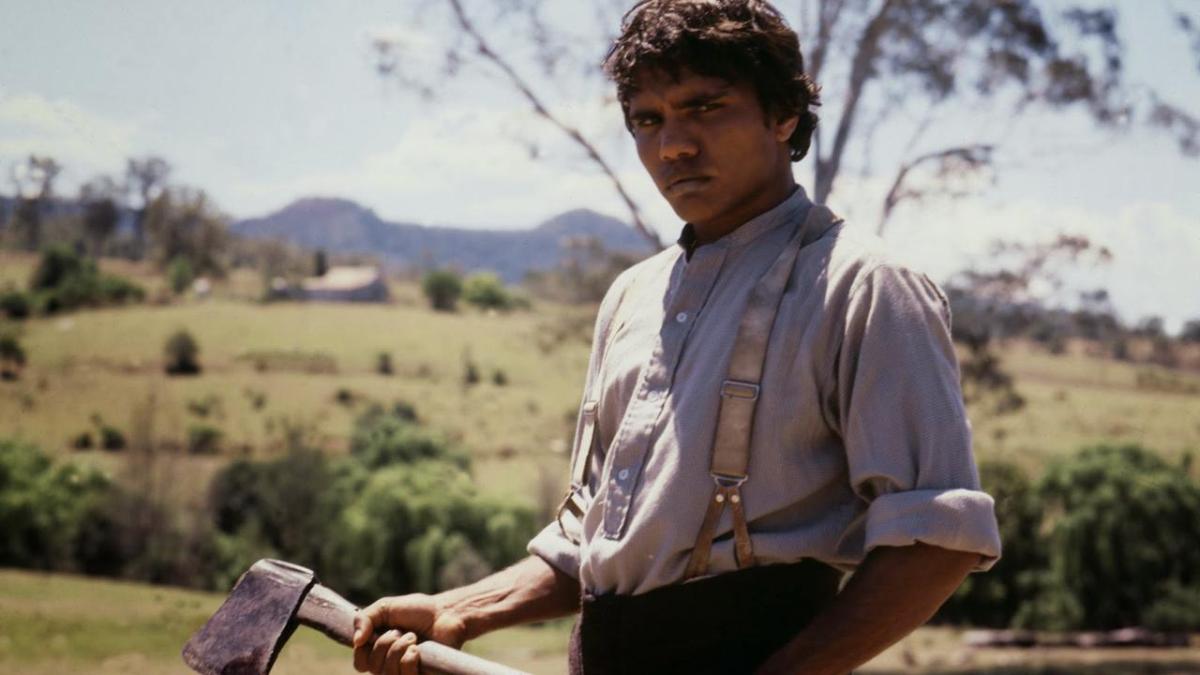
The Chant of Jimmie Blacksmith — One of the highlights of the “Australian New Wave” that flourished in the 70s and 80s, writer-director Fred Schepsi’s 1978 drama (adapted from Thomas Keneally’s novel, which is loosely based on a true story) is set in Australia at the turn of the 20th Century.
Jimmie Blacksmith (Tommy Lewis) is a half-caste Aboriginal who goes out into the world to make his own way after being raised by a white minister and his wife. Unfortunately, the “world” he is entering from the relative protective bubble of his upbringing is that of a society fraught with systemic racism; one that sees him only as a young black man ripe for exploitation.
While Jimmie is inherently altruistic, every person has their limit, and over time the escalating degradation and daily humiliations lead to a shocking explosion of cathartic violence that turns him into a wanted fugitive. An unblinking look at a dark period of Australian history; powerful and affecting.
Dead Man — Rhymes with: “deadpan”. Then again, that could describe any film directed by the idiosyncratic Jim Jarmusch. As far as Kafkaesque westerns go, you could do worse than this 1995 offering (beautifully photographed by the late Robby Müller).
Johnny Depp plays mild-mannered accountant and city slicker William Blake (yes, I know) who travels West by train to the rustic town of Machine, where he has accepted a job. Or so he assumes. Getting shooed out of his would-be employer’s office at gunpoint (a great cameo by Robert Mitchum) turns out to be the least of his problems, which rapidly escalate. Soon, he’s a reluctant fugitive on the lam. Once he crosses paths with an enigmatic Native American named Nobody (the wonderful Gary Farmer), his journey takes on a mythic quality. Surreal, darkly funny, and poetic.
The Emerald Forest — Although it may initially seem a heavy-handed (if well-meaning) “save the rain forest” polemic, John Boorman’s underrated 1985 adventure (a cross between The Searchers and Greystoke: The Legend of Tarzan) goes much deeper.
Powers Boothe plays an American construction engineer working on a dam project in Brazil. One day, while his wife and young son are visiting the job site on the edge of the rain forest, the boy is abducted and adopted by an indigenous tribe who call themselves “The Invisible People”, touching off an obsessive decade-long search by the father. By the time he is finally reunited with his now-teenage son (Charley Boorman), the challenge becomes a matter of how he and his wife (Meg Foster) are going to coax the young man back into “civilization”.
Tautly directed, lushly photographed (by Philippe Rousselot) and well-acted. Rosco Pallenberg scripted (he also adapted the screenplay for Boorman’s 1981 film Excalibur).
The Gods Must Be Crazy — Writer-director Jamie Uys’ 1984 cult favorite is a spot-on allegory regarding First World/Third World culture clash. The premise is simple: A wandering Kalahari Bushman named Xi (N!xau) happens upon a discarded Coke bottle that has been carelessly tossed from a small plane. Having no idea what the object is or how it got there, Xi spirits it back to his village for a confab on what it may portend. Concerned over the uproar and unsavory behavioral changes the empty Coke bottle ignites within the normally peaceful community, Xi treks to “the edge of the world” to give the troublesome object back to the gods. Uys overdoes the slapstick at times, but drives his point home in an endearing fashion.
The Last Wave —Peter Weir’s enigmatic 1977 courtroom drama/psychological thriller concerns a Sydney-based defense lawyer (Richard Chamberlain) who takes on five clients (all Aboriginals) who are accused of conspiring in a ritualistic murder. As he prepares his case, he begins to experience haunting visions and dreams related to age-old Aboriginal prophesies. A truly unique film, at once compelling, and unsettling; beautifully photographed by Russel Boyd. Lurking just beneath the supernatural, metaphysical and mystical elements are insightful observations on how indigenous people struggle to reconcile venerable superstitions and traditions while retaining a strong cultural identity in the modern world.
Mekko — Director Sterlin Harjo’s tough, lean, and realistic character study is set in Tulsa, Oklahoma. Rod Rondeaux (Meek’s Cutoff) is outstanding in the lead, as a Muscogee Indian who gets out of jail after 19 years. Bereft of funds and family support, he finds tenuous shelter among the rough-and-tumble “street chief” community of homeless Native Americans as he sorts out how he’s going to get back on his feet. Harjo coaxes naturalistic performances from his entire cast. There’s a lot more going on here than initially meets the eye; namely, a deeper examination of Native American identity,
Powwow Highway — A Native American road movie from 1989 that eschews stereotypes and tells its story with a blend of social and magical realism. Gary Farmer (who resembles the young Jonathan Winters) plays Philbert, a hulking Cheyenne with a gentle soul who wolfs down cheeseburgers and chocolate malts with the countenance of a beatific Buddha. He has decided that it is time to “become a warrior” and leave the res on a quest to “gather power”.
After choosing a “war pony” for his journey (a rusted-out beater that he trades for with a bag of weed), he sets off and is waylaid by his childhood friend (A. Martinez) an A.I.M. activist who needs a lift to Santa Fe to bail out his sister, framed by the Feds on a possession beef. Funny, poignant, uplifting and richly rewarding. Director Jonathan Wacks and screenwriters Janey Heaney and Jean Stawarz keep it real. Look for cameos from Wes Studi and Graham Greene.
This May Be the Last Time — Did you know that the eponymous Rolling Stones song shares the same roots with a venerable Native-American tribal hymn, that is still sung in Seminole and Muscogee churches to this day? While that’s far from the main thrust of Sterlin Harjo’s documentary, it’s but one of its surprises.
Harjo investigates a family story concerning the disappearance of his Oklahoman Seminole grandfather in 1962. After a perfunctory search by local authorities turned up nothing, tribal members pooled their resources and continued to look. Some members of the search party kept up spirits by singing traditional Seminole and Muscogee hymns…which inform the second level of Harjo’s film.
Through interviews with tribal members and musicologists, he traces the roots of this unique genre, connecting the dots between the hymns, African-American spirituals, Scottish and Appalachian music. The film doubles as both history lesson and a moving personal journey.
Walkabout — Nicholas Roeg’s 1971 adventure/culture clash drama introduced audiences to charismatic Aboriginal actor David Gulpilil (who also appears in another film on my list, The Last Wave). Gulpilil is an Aboriginal teenager (“Black Boy” in the credits) who unexpectedly encounters a teenage “Girl” (Jenny Agutter) and “White Boy” (the Girl’s little brother, played by Luc Roeg) while he is on a solo “walkabout” in the Australian Outback. The sun-stroked and severely dehydrated siblings have become stranded as the result of a family outing gone terribly (and disturbingly) awry. Without making any promises, the Aboriginal boy allows them to tag along; teaching them his survival techniques as they struggle to communicate as best as they can. Like many of my selections here, Roeg’s film challenges us to rethink the definition of “civilization”, especially as it pertains to indigenous cultural identity.
The course of America’s future, and therefore the fate of the world, now rests on how much one perversely aristocratic old man is or isn’t yelling at his TV at any given moment. We were cursed to keep living out this reality as soon as Donald J. Trump was reelected last year.
The idea that world events and life-or-death political decisions should turn on what one elderly US citizen sees on a television set sounds like it should be the premise for a dystopian satire written in the 1970s by the most hysterical, screeching Marxist novelist seeking to magnify the moral rot and decadence of a declining American global empire. In late 2025, though, it’s just how the country does business.
The president of the United States is invading multiple US cities and liberal strongholds, in troop deployments that are now the primary component of his vast, lawless, smash-and-grab efforts to shred the nation’s constitutional and democratic order, all in the service of his personality cult. And his enthusiasm for doing so is partially, and meaningfully, fueled by how mad he gets while binge-watching hours and hours of TV, current and former Trump advisers tell Zeteo.
There is nothing more important in understanding what fuels Trump and his henchmen than this. it’s a feedback loop. They feed him, he feeds MAGA and back again.
Read the whole thing. Zeteo is the new media outfit run by Mehdi Hassan and he’s hired some of the best writers like Suebsaeng. This is an important observation and he does a great job breaking it down.
If you can’t bring yourself to read all the boring reporting, think this Punchbowl News summary of what’s happening with the shutdown will catch you up just fine. The House is still in recess and here’s why:
House GOP lawmakers passed a “clean” CR that would keep federal agencies open until Nov. 21. Senate Democrats have repeatedly blocked that measure, which led to this shutdown. Democrats are demanding a vote on their own proposal to permanently extend expiring Obamacare premium credits, a rollback in massive Medicaid cuts in the One Big Beautiful Bill Act and the end of unilateral spending rescissions.
Yet the House’s absence makes it easier for the shutdown to continue. Part of what ends shutdowns is anxiety building among the rank-and-file. Members are home, so there’s limited pressure on House GOP leaders to do anything. House Minority Leader Hakeem Jeffries and dozens of Democrats have been in D.C. throughout the shutdown.
More importantly, Johnson has emerged as the “face” of the shutdown for House Republicans. He’s doing daily press conferences and more media interviews, putting himself in the center of the fracas. A C-SPAN caller begging Johnson to bring the House back last week went viral. So did Johnson’s hallway confrontation with Arizona Democratic Sens. Ruben Gallego and Mark Kelly over Johnson’s refusal to swear in Rep.-elect Adelita Grijalva, a move that has infuriated Democrats.
Grivalja would be the 218th signature for a discharge petition mandating a floor vote on releasing the Jeffrey Epstein files. House GOP leaders think Trump will be furious if the discharge petition gets that vote, mainly because it will be viewed as Rep. Thomas Massie (R-Ky.) besting the president. The petition will fail in the Senate and Trump will never sign it. But the symbolism is important.
Johnson sent the House home early in July because of an internal House GOP rebellion over the Epstein case, and months later, it remains a problem for Johnson and the White House.
Here’s something I hadn’t heard before:
The reality is that since the OBBB passed on July 3, the House has been checked out. A virtual non-entity for more than three months. And this is the off-year, when Congress is supposed to be busy.
Since July 3, the House has only been in session for 20 days (out of more than 100 calendar days.) Even accounting for the normal August break — which began early because of the Epstein mess – the House has been AWOL.
There have been just over 90 floor votes during this period. A lot of these were amendment votes or votes on non-controversial suspension bills. Several were partisan FY2026 spending bills that have no chance of passage. All in all, very little of substance has been taken up. But as Johnson will remind you, the House did pass a CR.
[…]
If you see it, don’t say it. House Republicans have done virtually no oversight on the Trump administration, rolling over on a number of issues that their predecessors would have screamed loudly about. It’s true that House Democrats did little or nothing to rein in President Joe Biden when they controlled the House. But Trump has gone far beyond Biden in using executive authority. “Inside the White House, top advisers joke that they are ruling Congress with an ‘iron fist,’” the Wall Street Journal reported.
For an institution that has complained for years about the need to claw back power from the executive branch, it’s a sad state of affairs. And it shows no sign of ending soon.
I don’t know what House Democrats were supposed to do to “rein in” Biden but whatever. Both sides dontcha know. But the rest is quite right.
They aren’t working because they have no job. Trump calls the shots and they march along like the tiny little lemmings they are. It’s not a sad state of affairs. It’s a crisis.
This is from the man who won the Nobel Prize for his work on new trade theory and new economic geography, Paul Krugman. I think he knows what he’s talking about:
Six months ago Donald Trump announced his Liberation Day tariffs — huge tariffs imposed on just about every nation. As everyone noted, this announcement suddenly brought average tariffs back to 1934 levels. Less widely noted was the fact that the long decline in tariff rates over the previous 90 years had been achieved through many rounds of international negotiations, in which the U.S. and other nations solemnly agreed not to backtrack on past tariff reductions. So Liberation Day was, among other things, a massive betrayal of the world’s trust.
Now Trump is learning, to his obvious shock, that other nations can also play trade hardball. His reaction to China’s new export controls on rare earths, which are crucial to digital technology, would be comical if the stakes weren’t so high:
Krugman dryly quips: “Gosh. Aggressive unilateral trade action is a “moral disgrace.” Who knew?”
And as he points out, China has the upper hand in all this because it’s economy is bigger than the U.S:
He continues:
Furthermore, while our economies are interdependent, America is more vulnerable to a rupture than China is. True, Chinese industry has relied to an important degree on sales to the United States. But the U.S. economy is dependent on China for critical inputs, above all those rare earths. And here’s the thing: China can quickly compensate, at least in part, for the loss of the U.S. export market by stimulating domestic demand. Given time, America could wean itself from dependence on Chinese inputs — but doing so would take years.
He points out that until a year ago we still had some important advantages over China, number one being the fact that our world class universities and research institutions attracted the best talent from all over the world. We also had many allies which China did not. Not anymore.
Krugman goes on to lay out the particulars and the terrible consequences of Trump’s destruction in those areas. He concludes:
So we may be entering into an all-out trade war with China having destroyed the non-trade advantages America used to have in the form of scientific leadership and major allies. As a result, it’s just a question of which nation can do the most damage to the other. And if those are the terms on which a trade war is fought, it’s clear who is in the stronger position. China wants access to the U.S. market, but America needs Chinese rare earths and other inputs. America is going to lose this conflict.
… America will take a bigger hit than China, both to its economy and to its reputation. It’s bad when the world sees you as a bully; it’s worse when the world also sees you as weak. The man who promised to make America great again has probably ended our position of global leadership for the foreseeable future.
For all his strutting around on the world stage today and getting his crown polished by everyone, Trump has done incalculable damage to this country and the world. And he’s just getting started.
Trump on Orban: "Where's Viktor? Viktor, Viktor, we love Viktor. You are fantastic, alright? I know a lot of people don't agree with me, but I'm the only one that matters. You are fantastic. He's a great leader. I endorsed him the last election he had and he won by 28 points.… pic.twitter.com/LXgVR5gwoX
I don’t think anyone can be upset that there is at least the prospect of peace or even a respite in the war in Gaza. The hostages exchange is a godsend. That night mare is over. Good for the Trump administration for doing whatever they did to make it happen. And you have to give Trump credit because his corruption is the key.
if anybody is good at lip reading or can isolate the audio, I'd be very curious to learn more about what these two were talking about here. it certainly didn't sound on the level. https://t.co/jy3MikUK6U
The key here is Trump’s extremely close relationships with the Gulf princes and his relationship with Israel and the Israeli right, especially Benjamin Netanyahu. The first (the relationship with the princes) is based on a mutual love of authoritarianism and corruption. More generously we might say it’s a shared vision of the future of the global economy and billionairedom — stated succinctly, the billionaires run the world. But for Trump, specifically, it’s about corruption. He and his family have now become genuine high rollers because of those relationships, which are all based on his political power in the United States. He monetized MAGA and made himself the billionaire he always dreamed of being.
That’s all very dark. But for the moment let’s set that aside. Because for present purposes the origins and bases of the relationship matter much less than the reality of it. Trump cares very, very much about what the princes want and what they think. They are also very dependent on the international system and the kind of U.S. government Trump is trying to create. He wants what they want. And they need to want what he wants. Not only was Joe Biden never in anything remotely like this position with the Gulf princes. No previous US president was either. The bond of authoritarianism and corruption was not there. The kind of U.S. government where this could be possible did not exist.
Trump is being as nasty and crude as usual as he struts across the world state today. He’s slamming Obama and Biden calling them stupid and inept for failing to achieve world peace as he has done. (Someone should send a memo to Vlad because he didn’t get it.) But the truth is that they just weren’t rich and corrupt enough to do what Trump has done.
It’s hard to believe that this will work out perfectly in the long run. I suppose you never know. But for today the short run is good enough. Hostages are exchanged, food is coming into Gaza and the bombing and killing has stopped. That’s all that matters. We can deal with the eventual political fallout later.
Humble as always and eager to share the credit, Trump knows that Peace Prize is his next year:
Trump to Israeli Knesset: “As you know, we decisively won World War 1. We decisively won World War 2, decisively, and everything in between and everything before it. We won everything and then they had the brilliant idea of changing the name from ‘war’ to ‘defense.’ And with that went a certain thinking. We fought in a very politically correct way after that. We always had the strongest military and now we have a stronger military than we ever had before. But we have settled 8 wars in 8 months. I’m now including this one, by the way. They may say, ‘Well, that was quick,’ but yesterday I was saying 7 but now I can say 8. The hostages are back.”
Trump to Israeli Knesset: "As you know, we decisively won World War 1. We decisively won World War 2, decisively, and everything in between and everything before it. We won everything and then they had the brilliant idea of changing the name from 'war' to 'defense.' And with that… pic.twitter.com/5xc7nwmW0e
Shortly after he was unexpectedly elected speaker of the House in October 2023, Louisiana Republican Mike Johnson appeared before the awards gala of the National Association of Christian Lawmakers, a far-right group, and revealed that God had spoken to him personally and called him to be prepared for a “Red Sea moment.”
Johnson said he understood that God would be choosing a new Moses to serve as the new speaker. Because he was an obscure functionary, the lawmaker assumed that he would be an Aaron, Moses’ brother and supporter. But over the course of three weeks, as candidate after candidate was vanquished by the sharply divided Republican caucus, God woke him up in the middle of the night and said, “Wait, wait, wait.” Finally, Johnson was told to “now step forward.”
“Me?” Johnson said. “I’m supposed to be Aaron.”
“No,” the Lord replied, “step forward.”
Johnson had presumably been anointed by the man upstairs to be an American Moses — and to lead us to the Promised Land. But two years later, you have to wonder if God has stopped by the speaker’s hideaway office in the Capitol to chat lately and, if so, whether he’s pleased with what his chosen one has done since he assumed the mantle of prophet.
Johnson was little known to the public when he won the speakership after California Rep. Kevin McCarthy’s dramatic defenestration. The Louisiana Republican’s reputation in Washington, D.C., was that of a very pious, ultra conservative Christian culture warrior with an unusually bland personality and a raging ambition; few expected him to be anything more than a placeholder. Many predicted he wouldn’t last long. But for two years he’s managed to do the unthinkable — to keep his notoriously fractious caucus together, despite the razor-thin margins he’s been dealt. As most GOP speakers of the last couple of decades can attest, that is no mean feat.
But it may be about to change. As various factions within the Republican party have begun to chafe under President Donald Trump’s reckless agenda — and have started to consider a post-MAGA future — Johnson’s hold over his caucus may be slipping. On top of that, he has been caught in the cover-up of the worst sex scandal in American political history.
The power that Johnson wields over House Republicans has largely been due to the fact that he doesn’t really have any power at all. The president is the de facto speaker, just as he is the de facto majority leader in the Senate. Trump would rule Capitol Hill from 1600 Pennsylvania Avenue with an iron fist if he had to — but he doesn’t, since congressional Republicans have shown themselves to be all too happy to do exactly as he decrees.
As it happened, Johnson had proven himself to be a loyal Trumper long before he put in his bid for speaker. He vocally supported Trump during both of the president’s impeachments, and he provided legal arguments justifying Trump’s attempts to overturn the 2020 election. Even though he was out of office, when Johnson’s name finally emerged among House Republicans as an option in October 2023, Trump posted on Truth Social, “My strong SUGGESTION is to go with the leading candidate, Mike Johnson, & GET IT DONE, FAST!” Johnson won the vote the next day.
One might think that Johnson’s loyalty to Trump, a notorious hypocrite who has mocked (and continues to manipulate) Christian evangelicals, would have cast some doubt on the sincerity of his call to be the new Moses. But Johnson, like so many other conservative Christians, is so consumed by his fear and loathing of America’s liberal culture that he gladly embraced the felonious libertine. The enemy of his enemy became his friend, and now Johnson is an eager accomplice to Trump’s agenda.
Does he truly admire Trump though? Not likely, and not because he is affronted by his lies and criminal behavior. It’s because he’s a slick politician for whom all of this is in service to his ambition. Back when he was first elected to the speakership, David Kirkpatrick of the New Yorker interviewed Johnson and shared this anecdote, which illustrates how he operates:
I first met Johnson two years ago, in a small office in the Cannon House Office Building, to ask him about Trump’s claims that enormous fraud had robbed him of victory in 2020. “He believes that to his core today, you know,” Johnson told me then. He sounded sympathetic. But Johnson was also discreetly clarifying that he himself had never fallen for Trump’s outlandish claims.
As vice chair of the House Republican Conference, Johnson led the amicus brief signed by more than 100 House Republicans that sought to overturn the 2020 election results in Georgia, Michigan, Pennsylvania and Wisconsin. If he didn’t actually believe that Trump had won the election, our new Moses broke the ninth commandment about bearing false witness (along with several secular laws as well.)
Until now, all of this has worked out pretty well for Johnson. He proved to be a fast learner; he’s gotten especially good at evading tough questions about all the horrific policies Trump is enacting in his second term. “It’s not in my lane,” he has taken to saying, and “I haven’t seen that tweet.”
But his evasions are getting harder to maintain. By trying to excuse Republicans’ grotesque assaults on health care and suggesting they are actually trying to preserve it, Johnson is outright lying now. (Rep. Marjorie Taylor Greene, R-Ga., publicly broke with him last week, complaining to CNN that the party is being “destroyed” on the issue.) But Johnson is really being tied up in knots for his stonewalling over the Jeffrey Epstein files.
The speaker’s own caucus is starting to rebel over the fact that he adjourned the House during the ongoing federal government shutdown. He has declined to even call members back to vote on some stand-alone bills like pay for the troops and other essential workers. Democrats are furious that Johnson has refused to swear in Adelita Grijalva, the newly elected Democratic representative from Arizona who has pledged to provide the winning vote for the discharge petition to release the Epstein documents — even though he’s gone out of his way to do so for Republicans in similar circumstances.
Those two issues are tied together. Once he swears in Grijalva and calls the House into session, Johnson knows there will be enough votes to force the release of the Epstein files. It’s clear he is doing everything in his power to prevent that from happening for as long as possible.
Nothing exposes Johnson’s rank hypocrisy more than this one issue, and it’s destroying any shred of credibility he had left. According to a recent Marist Poll, 84% of Democrats, 67% of Republicans and 83% of independents want all of the files released.
You know the old saying: it’s not the crime, it’s the cover up — and Mike Johnson is right in the middle of it. What would Moses do?