Skip to content

Category: Saturday Night at the Movies

Bringing the war back home: A Top 10 list

Now a note to the President, and the Government, and the Judges of this place
We’re still waiting for you to bring our troops home, clean up that mess you made
Cuz it smells of blood and money and oil across the Iraqi land
But it seems so easy here to blind us with your “United We Stand”

And it ain’t hard to see that this Country ain’t free

– from “Crash This Train”, by Joshua James

Well…this shouldn’t be happening:

As Veterans Day approaches on November 11, more than 1 million US veterans could lose access to food assistance under the Supplemental Nutrition Assistance Program (SNAP), as the federal government shutdown drags into its 35th day, tying the record for the longest shutdown in American history.

According to House committee of veteran affairs, 1.2 million veterans and 22,000 active-duty military families currently rely on SNAP. Studies have shown that veterans are also more likely than non-veterans to experience food insecurity. SNAP, which provides food-purchasing assistance to Americans in low-income or no-income households, currently supports 42 million people across the country.

The situation intensified Tuesday morning when President Donald Trump wrote on Truth Social that SNAP benefits will not be distributed until the shutdown ends.

“SNAP BENEFITS … will be given only when the Radical Left Democrats open up government, which they can easily do, and not before!” Trump wrote in a post on Truth Social, that was also reposted on X by the White House.

Thank you for your lip service, Mr. President.

While we’re waiting for Godot the government to reopen, there are resources available for veterans in need of food assistance. Here are some tips via the ElderLawAnswers website:

Check official messages from your state SNAP office and local area agency on aging. State agencies may post the latest guidance on delays, emergency plans, and whether the state will cover benefits. Keep contact information current so agencies can reach you.

Contact your local Veterans Administration (VA) and veterans service organizations. The Veterans Administration and groups like the American Legion, Veterans of Foreign Wars (VFW), or county veterans’ services may be able to point veterans to veteran-specific emergency food resources or help with applications for other benefits.

Reach out to local meal-delivery programs. Meal-delivery programs, such as Meals on Wheels, can often expand emergency deliveries or connect you to local pantry and transportation help.

Locate nearby food banks and pantry delivery options. Many food banks have increased delivery or drive-through distributions during emergencies, and some may prioritize seniors and those with mobility issues. Check United Way or local nonprofit portals. Keep documentation ready for SNAP appeals or retroactive claims. If benefits are later restored or issued retroactively, having records of communications and missed purchases may help resolve individual issues.

As Mr. Rogers said, “Look for the helpers. You will always find people who are helping.”

And to those who actually have served…thank you for your service.

I am re-posting the following piece in observance of Veteran’s Day. -DH

(Originally posted on Digby’s Hullabaloo on November 11, 2021)

Dress me up for battle
When all I want is peace
Those of us who pay the price
Come home with the least

–from “Harvest for the World”, by the Isley Brothers

Earlier today, my brother posted this on Facebook:

While going through my father’s stuff after his passing we found a large stack of envelopes. They turned out to be letters from junior high students thanking him for the talk he gave the students on Veteran’s Day. It turned out there were over 14 packed envelopes. One for every Veteran’s Day he spoke with the students. My brothers and I were very close to throwing these out with many of the other miscellaneous papers in my Dad’s cabinets but, without even looking at the contents I decided to keep them. I finally opened them up today and started going through them.

I used to kid my late father about being a pack rat but I am grateful that he was. I recall him telling me about giving classroom talks as part of his work with a local Vietnam Veteran’s group, but today was the first time I have ever seen one of those letters. I remember listening to those cassettes he sent us during his tour of duty in Vietnam.

That mention of the Secret Service refers to the 1968 Presidential campaign. Our family was stationed near Dayton, Ohio that year. For the first 17 years of his military service, my dad was an E.O.D. (Explosive Ordinance Detachment) specialist. Whenever presidential candidates came through the area, members of his unit would work with the Secret Service to help sweep venues for explosive devices in preparation for rallies and speeches.

I remember that he helped prepare for appearances by Hubert Humphrey and George Wallace. I remember him showing me a special pin that he had to wear, which would indicate to Secret Service agents that he had security clearance (I’m sure they are still stashed away in one of those boxes).

Today happens to be Veteran’s Day, but every day is Veteran’s Day for those who have been there and back. In honor of the holiday, here are my top 10 picks for films that deal with the aftermath of war.

Americana – David Carradine and Barabara Hershey star in this unique, no-budget 1973 character study (released in 1981). Carradine, who also directed and co-produced, plays a Vietnam vet who drifts into a small Kansas town, and for his own enigmatic reasons, decides to restore an abandoned merry-go-round. The reaction from the clannish townsfolk ranges from bemused to spiteful.

It’s part Rambo, part Billy Jack (although nowhere near as violent), and a genre curio in the sense that none of the violence depicted is perpetrated by its war-damaged protagonist. Carradine also composed and performed the song that plays in the closing credits. It’s worth noting that Americana predates Deer Hunter and Coming Home, which are generally credited as the “first” narrative films to deal with Vietnam vets.

https://static01.nyt.com/images/2016/11/29/watching/the-best-years-of-our-lives-watching-recommendation/the-best-years-of-our-lives-watching-recommendation-videoSixteenByNineJumbo1600.jpg

The Best Years of Our Lives – William Wyler’s 1946 drama set the standard for the “coming home” genre. Robert E. Sherwood adapted the screenplay from a novella by former war correspondent MacKinlay Kantor.

The story centers on three WW2 vets (Fredric March, Dana Andrews, and Harold Russell), each from a different branch of military service who meet while returning home to the same small Midwestern town. While they all came from different social stratum in civilian life, the film demonstrates how war is the great equalizer, as we observe how the three men face similar difficulties in returning to normalcy.

Well-written and directed, and wonderfully acted. Real-life WW 2 vet Russell (the only non-actor in the cast) picked up a Best Supporting Actor Oscar; one of 7 the film earned that year. Also starring Myrna Loy, Teresa Wright, and Virginia Mayo.

11/08/25 NOTE: “The Best Years of Our Lives” airs on TCM this upcoming Tuesday, November 11th at 2pm (PST).

https://cals.org/wp-content/uploads/2020/10/cals-cominghome.jpg

Coming Home – Hal Ashby’s 1978 drama was one of the first major studio films to tackle the plight of Vietnam vets. Jane Fonda stars as a Marine wife whose husband (Bruce Dern) has deployed to Vietnam. She volunteers at a VA hospital, where she is surprised to recognize a former high-school acquaintance (Jon Voight) who is now an embittered, paraplegic war vet.

While they have opposing political views on the war, Fonda and Voight form a friendship, which blossoms into a romantic relationship once the wheelchair-bound vet is released from assisted care and begins the laborious transition to becoming self-reliant.

The film’s penultimate scene, involving a confrontation between Dern (who has returned from his tour of duty with severe PTSD), Fonda and Voight is one of the most affecting and emotionally shattering pieces of ensemble acting I have seen in any film; Voight’s moving monologue in the denouement is on an equal par.

Voight and Fonda each won an Oscar (Dern was nominated in the Best Supporting Actor category), as did co-writers Waldo Salt, Robert C. Jones and Nancy Dowd for their screenplay.

https://miro.medium.com/max/3740/1*jBeC1huAsiaTaQjQr0KLkQ.png

The Deer Hunter – “If anything happens…don’t leave me over there. You gotta promise me that, Mike.” 1978 was a pivotal year for American films dealing head on with the country’s deep scars (social, political and emotional) from the nightmare of the war in Vietnam; that one year alone saw the release of The Boys in Company C, Go Tell the Spartans, Coming Home, and writer-director Michael Cimino’s shattering drama.

Cimino’s sprawling 3 hour film is a character study about three blue collar buddies (Robert De Niro, Christopher Walken and Jon Savage) hailing from a Pennsylvania steel town who enlist in the military, share a harrowing POW experience in Vietnam, and suffer through PTSD (each in their own fashion).

Uniformly excellent performances from the entire cast, which includes Meryl Streep, John Cazale, Chuck Aspegren and George Dzundza.

I remember the first time I saw this film in a theater. I sat through the end credits, and continued sitting for at least five minutes, absolutely stunned. I literally had to “collect myself” before I could leave the theater. No film has ever affected me quite like that.
https://a.ltrbxd.com/resized/sm/upload/u2/8l/nf/6w/manchurian-candidate-1200-1200-675-675-crop-000000.jpg?k=21d24bcf83

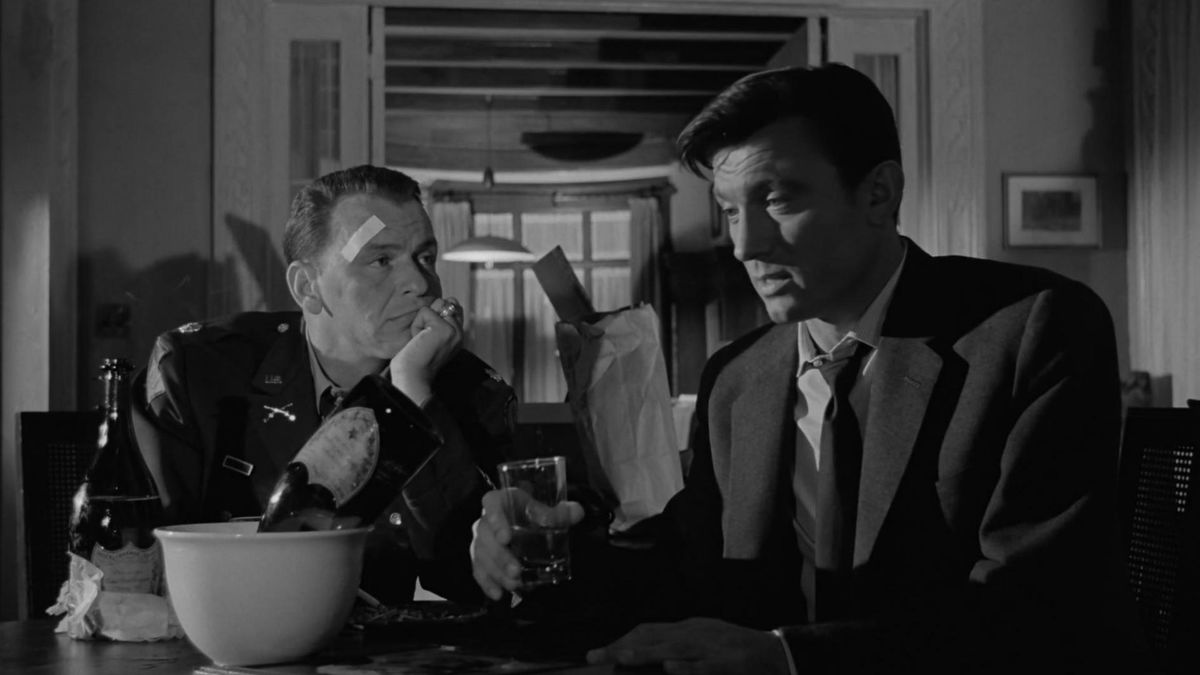
The Manchurian Candidate (1962) – John Frankenheimer’s 1962 Cold War thriller (with a screenplay adapted from Richard Condon’s novel by George Axelrod) stars Frank Sinatra as Korean War veteran and former POW Major Bennett Marco. Marco and his platoon were captured by the Soviets and transported to Manchuria for a period, then released. Consequently, Marco suffers PTSD, in the form of recurring nightmares.

Marco’s memories of the captivity are hazy; but he suspects his dreams hold the key. His suspicions are confirmed when he hears from several fellow POWs, who all share very specific and disconcerting details in their dreams involving the platoon’s sergeant, Raymond Shaw (Laurence Harvey, in a great performance). As the mystery unfolds, a byzantine conspiracy is uncovered, involving brainwashing, subterfuge and assassination.

I’ve watched this film maybe 15 or 20 times over the years, and it has held up remarkably well, despite a few dated trappings. It works on a number of levels; as a conspiracy thriller, political satire, and a perverse family melodrama. Over time I’ve come to view it more as a black comedy; largely attributable to its prescience regarding our current political climate.…which now makes it a closer cousin to Dr. Strangelove and Network). (Full review)

https://static.rogerebert.com/uploads/review/primary_image/reviews/sir-no-sir-2006/EB20060608REVIEWS606080304AR.jpg

Sir! No Sir! – Most people who have seen Oliver Stone’s Born On The Fourth Of July were likely left with the impression that paralyzed Vietnam vet and activist Ron Kovic was the main impetus and focus of the G.I. veterans and active-duty anti-war movement, but Kovic’s story was in fact only one of thousands. Director David Zeigler combines present-day interviews with archival footage to good effect in this well-paced documentary about members of the armed forces who openly opposed the Vietnam war.

While the aforementioned Kovic received a certain amount of media attention at the time, the full extent and history of the involvement by military personnel has been suppressed from public knowledge for a number of years, and that is the focus of Zeigler’s 2006 film.

All the present-day interviewees (military vets) have interesting (and at times emotionally wrenching) stories to share. Jane Fonda speaks candidly about her infamous “FTA” (“Fuck the Army”) shows that she organized for troops as an alternative to the more traditionally gung-ho Bob Hope U.S.O. tours. Eye-opening and well worth your time.

https://s3.amazonaws.com/loa-production-23ffs35gui41a/article_images/images/000/000/778/big/170531_Slaughterhouse_Five_banner.jpg?1495746464

Slaughterhouse-Five – Film adaptations of Kurt Vonnegut stories have a checkered history; from downright awful (Slapstick of Another Kind) or campy misfires (Breakfast of Champions) to passable time killers (Happy Birthday, Wanda June and Mother Night). For my money, your best bets are Jonathan Demme’s 1982 PBS American Playhouse short Who Am I This Time? and this 1974 feature film  by director George Roy Hill.

Michael Sacks stars as milquetoast daydreamer Billy Pilgrim, a WW2 vet who weathers the devastating Allied firebombing of Dresden as a POW. After the war, he marries his sweetheart, fathers a son and daughter and settles into a comfortable middle-class life, making a living as an optometrist.

A standard all-American postwar scenario…except for the part where a UFO lands on his nice manicured lawn and spirits him off to the planet Tralfamadore, after which he becomes permanently “unstuck” in time; i.e., begins living (and re-living) his life in random order. Great performances from Valerie Perrine and Ron Leibman. Stephen Geller adapted the script.

https://fergalcasey.files.wordpress.com/2018/05/iymll7d.png

Stop-Loss – This powerful and heartfelt 2008 drama is from Boys Don’t Cry director Kimberly Peirce. Co-written by the director along with Mark Richard, it was one of the first substantive films to address the plight of Iraq war vets.

As the film opens, we meet Sgt. Brandon King (Ryan Phillippe), an infantry squad leader leading his men in hot pursuit of a carload of heavily armed insurgents through the streets of Tikrit. The chase ends in a harrowing ambush, with the squad suffering heavy casualties.

Brandon is wounded in the skirmish, as are two of his lifelong buddies, Steve (Channing Tatum) and Tommy (Joseph Gordon-Levitt). They return to their small Texas hometown to receive Purple Hearts and a hero’s welcome, infusing the battle-weary vets with a brief euphoria that inevitably gives way to varying degrees of PTSD for the trio. A road trip that drives the film’s third act becomes a metaphorical journey through the zeitgeist of the modern-day American veteran.

Peirce and her co-writer (largely) avoid clichés and remain low-key on political subtext; this is ultimately a soldier’s story. Regardless of your political stance on the Iraq War(s), anyone with an ounce of compassion will find this film both heart wrenching and moving. (Full review)

https://i.pinimg.com/originals/82/65/5c/82655c5de0186bee508aadc73c2ba2d2.jpg

Waltz With Bashir – In this animated film, writer-director Ari Forman mixes the hallucinatory expressionism of Apocalypse Now with personal sense memories of his own experiences as an Israeli soldier serving in the 1982 conflict in Lebanon to paint a searing portrait of the horrors of war and its devastating psychic aftermath. A true visual wonder, the film is comprised of equal parts documentary, war diary and bad acid trip.

The director generally steers clear of polemics; this is more of a “soldier’s story”, a grunt’s-eye view of the confusion and madness of war, in which none are really to blame, yet all remain complicit. This dichotomy, I think, lies at the heart of the matter when attempting to understand what snaps inside the mind of those who carry their war experiences home.

The film begs a question or two that knows no borders: How do we help them? How do we help them help themselves? I think these questions are more important than ever, for a whole new generation of psychically damaged men and women all over the world.  (Full review)

A War – This powerful 2015 Oscar-nominated drama is from writer-director Tobias Lindholm. Pilou Aesbaek stars as a Danish military company commander serving in Afghanistan . After one of his units is demoralized by the loss of a man to a Taliban sniper, the commander bolsters morale by personally leading a patrol, which gets pinned down during an intense firefight. Faced with a split-second decision, the commander requests air support, resulting in a “fog of war” misstep. He is ordered home to face charges of murdering civilians.

For the first two-thirds of the film Lindholm intersperses the commander’s front line travails with those of his family back home, as his wife (Yuva Novotny) struggles to keep heart and soul together while maintaining as much “normalcy” she can muster for the sake their three kids. The home front and the war front are both played “for real” (aside from the obvious fact that it’s a Danish production, this is a refreshingly “un-Hollywoodized” war movie).

Some may be dismayed by the moral and ethical ambivalence of the denouement. Then again, there are few tidy endings in life…particularly in war, which (to quote Bertrand Russell) never determines who is “right”, but who is left. Is that a tired trope? Perhaps; but it’s one that bears repeating…until that very last bullet on Earth gets fired in anger. (Full review)

To learn how you can help vets, visit the Department of Veteran’s Affairs site .

For my father: Robert A. Hartley 1933-2018 (Served in Vietnam 1969-1970)

Previous posts with related themes:

Lest we forget: Films (and thoughts) for Holocaust Remembrance Day

The Kill Team

The Messenger

The Wind Rises & Generation War

City of Life and Death

Le Grande Illusion

Paths of Glory

Tangerines

King of Hearts

More reviews at Den of Cinema

Dennis Hartley


The Top 25 Films of the last 20 years

Time keeps on slippin’, slippin’. I can’t believe I’m entering my 20th year contributing to Hullabaloo. Technically, it was 19 years ago that my pal Digby graciously offered me a crayon, a sippy cup and weekly play date on her otherwise grownup site so I can do my little scribbles about pop culture (to be precise, my first review was published November 18, 2006). That’s a lot of sticky floors and buckets of stale popcorn under my belt, so for giggles I thought I’d comb through the archives and pick the top 25 from the (estimated) 600 first-run films I’ve reviewed since 2006. As per usual-not ranked, but presented alphabetically.

Roll film!

Another Earth (2011) – Writer-director Mike Cahill’s auspicious narrative feature debut concerns an M.I.T.-bound young woman (co-scripter Brit Marling) who makes a fateful decision to get behind the wheel after a few belts. The resultant tragedy kills two people, and leaves the life of the survivor, a music composer (William Mapother) in shambles.After serving prison time, the guilt-wracked young woman, determined to do penance, ingratiates herself into the widower’s life (he doesn’t realize who she is). Complications ensue.

Another Earth is a “sci-fi” film mostly in the academic sense; don’t expect to see CGI aliens in 3-D. Orbiting somewhere in proximity of Andrei Tarkovsky’s Solaris, its concerns are more metaphysical than astrophysical. And not unlike a Tarkovsky film, it demands your full and undivided attention. Prepare to have your mind blown.

After the Storm (2017) – This elegant family drama from writer-director Hirokazu Kore-eda is a wise, quietly observant and at times genuinely witty take on the prodigal son story. All the performances are beautifully nuanced; particularly when star Hiroshi Abe and scene-stealer Kirin Kiki are onscreen. Kudos as well to DP Yutaka Yamazaki’s painterly cinematography, and Hanargumi’s lovely soundtrack. Granted, some could find the proceedings too nuanced and “painterly”, but those with patience will be richly rewarded. Full review

Applause (2009) – Paprika Steen delivers a searing performance in this Danish import, directed and co-written (with Anders Frithiof August) by Martin Zandvliet. Technically, Steen is giving two searing performances; one as an embittered, middle-aged alcoholic stage actress named Thea Barfoed, and another as the embittered, middle-aged alcoholic “Martha”, as in “George and Martha”, the venomous, bickering couple who fuel Edward Albee’s classic play, Who’s Afraid of Virginia Woolf.

As you might guess, the clever theatrical allusions abound throughout, with interwoven vignettes of Thea’s nightly performances as “Martha” serving a Greek Chorus for her concurrent real-life travails. While she continues to wow adoring fans with her stagecraft, the acid-tongued Thea makes a less-than-glowing impression on the people she encounters in her off-stage life (mostly due to the fact that she’s usually half in the bag by lunchtime).

While I’ve seen this story before, it’s been some time since I’ve seen it played with the fierce commitment Steen brings to  it. Thea’s shame spiral binges evoke Patty Duke’s Neely O’Hara in Valley of the Dolls at times, but I felt Steen’s overall performance (and the writing and directing ) strongly recallsJohn Cassavetes’ Opening Night. In that 1977 film, Gena Rowlands plays, well, an insecure, middle-aged alcoholic stage actress, who is starring in a play that mirrors her real life angst. And just like the late, great Rowlands, Steen is a force of nature; a joy to watch. She is fearless, compassionate and 100% convincing. After all…she is an actress. (Full review)

Blade Runner 2049 (2017) – So many films passing themselves off as “sci-fi” these days are needlessly loud and jarringly flash-cut. Not this one. Which is to say that Blade Runner 2049 is leisurely paced. The story is not as deep or complex as the film makers want you to think. The narrative is essentially a 90 minute script (by original Blade Runner co-screenwriter Hampton Fancher and Michael Green), stretched to a 164-minute run time.

So why is it on my list? Well, for one thing, the “language” of film being two-fold (aural and visual), the visual language of Blade Runner 2049 is mesmerizing and immersive. I imagine the most burning question you have about Denis Villeneuve’s film is: “Are the ‘big’ questions that were left dangling at the end of Ridley Scott’s 1982 original answered?” Don’t ask me. I just do eyes. You may not find the answers you seek, but you may find yourself still thinking about this film long after the credits roll. Full review

Certified Copy (2010) – Just when you’re being lulled into thinking this is going to be one of those brainy, talky, yet pleasantly diverting romantic romps where you and your date can amuse yourselves by placing bets on “will they or won’t they-that is, if they can both shut up long enough to get down to business before the credits roll” propositions, Iranian director Abbas Kiarostami throws you a curve-ball.

Then again, maybe this film isn’t so much about “thinking”, as it is about “perceiving”. Because if it’s true that a “film” is merely (if I may quote Orson Welles) “a ribbon of dreams”-then Certified Copy, like any true work of art, is simply what you perceive it to be-nothing more, nothing less. Even if it leaves you scratching your head, you get to revel in the luminosity of Juliette Binoche’s amazing performance; there’s pure poetry in every glance, every gesture. (Full review)

Computer Chess (2013) – The most original sci-fi film of 2013 proved you don’t need a $300 million budget and 3-D technology to blow people’s minds. For his retro 80s-style mockumentary, Andrew Bujalski finds verisimilitude via a vintage B&W video camera (which makes it seem as if you’re watching events unfold on a slightly fuzzy closed-circuit TV), and “documents” a tournament where nerdy computer chess programmers from all over North America assemble once a year to match algorithmic prowess. Not unlike a Christopher Guest satire, Bujalski throws idiosyncratic characters into a jar, and then steps back to watch. Just when you think you’ve got the film sussed as a gentle satirical jab at computer geek culture, things get weird…then weirder. Dig that final shot! (Full review)

The Grand Budapest Hotel (2014) – In the interest of upholding my credo to be forthright with my readers (all three of you), I will confess that, with the exception of his engaging 1996 directing debut, Bottle Rocket, and the fitfully amusing Rushmore, I have been somewhat immune to the charms of  writer-director Wes Anderson. To me, “a Wes Anderson film” is the cinematic equivalent to Wonder Bread…bland product, whimsically wrapped.

At the risk of making your head explode, I now have a second confession. I kind of enjoyed The Grand Budapest Hotel. I can’t adequately explain what happened. The film is not dissimilar to Anderson’s previous work; in that it is akin to a live action cartoon, drenched in whimsy, expressed in bold primary colors, populated by quirky characters (who would never exist outside of the strange Andersonian universe they live in) caught up in a quirky narrative with quirky twists and turns (I believe the operative word here, is “quirky”). So why did I like it? I cannot really say. My conundrum (if I may paraphrase one of my favorite lines from The Producers) would be this: “Where did he go so right?” (Full review)

The Guilty (2018) – Essentially a chamber piece set in a police station call center, this 2018 thriller is a “one night in the life of…” character study of a Danish cop (Jakob Cedergren) who has been busted down to emergency dispatcher. Demonstratively glum about pulling administrative duties, the tightly wound officer resigns himself to another dull shift manning the phones.

However, if he was hoping for something exciting to break the monotony, he’s about to fulfill the old adage “be careful what you wish for” once he takes a call from a frantic woman who has been kidnapped. Before he gets enough details to pinpoint her location, she hangs up. As he’s no longer authorized to respond in person, he resolves to redeem himself with his superiors by MacGyvering a way to save her as he races a ticking clock.

Considering the “action” is limited to the confines of a police station and largely dependent on a leading man who must find 101 interesting ways to emote while yakking on a phone for 80 minutes, writer-director Gustav Möller and his star perform nothing short of a minor miracle turning this scenario into anything but another dull night at the movies. Packed with nail-biting tension, Rashomon-style twists, and bereft of explosions, CGI effects or elaborate stunts, this terrific thriller renews your faith in the power of a story well-told. I haven’t seen the 2021 U.S. remake…but I don’t see how you could improve on perfection. (Full review)

Happy Go Lucky (2008) –  The lead character in British director Mike Leigh’s dramedy appears to exist in a perpetually cheerful state of being. Her name is Poppy, and her improbably infectious giddiness is brought to life in an amazing performance by Sally Hawkins. Poppy is a single and carefree 30 year old primary school teacher. She breezes around London on her bicycle, exuding “young, colorful and kooky” like Lynn Redgrave in Georgy Girl. She is nothing, if not perky. Some might say she is insufferably perky, but all she really wants is for everybody else to be happy, too.

Now, before you think this is heading in the direction of a whimsical fable, a la Amelie, you have to remember, this is  Mike Leigh, and he generally doesn’t do “whimsical”. Through a string of compassionate, astutely observed and beautifully acted films about contemporary British life (High Hopes, Life is Sweet, Career Girls, Naked and Secrets and Lies) Leigh has proven himself a fearless storyteller when it comes to plumbing the well of real, raw human emotion. This “Leigh-ness” comes into play with the introduction of a character that will test the limits of Poppy’s sunny optimism and faith in humanity.

When all is said and done, I venture to say that Leigh is actually making a somewhat revolutionary political statement for this cynical, post-ironic age of rampant smugness and self-absorption; suggesting that Poppy’s brand of bubbly, unflagging enthusiasm for wishing nothing but happiness unto others defines not just the root of true compassion, but could be the antidote to societal ills like xenophobia, child abuse and homelessness. See it and decide for yourself. (Full review)

In the Loop (2009) – Political satire is not dead; it’s just been sort of resting …at least since Wag the Dog sped in and out of theaters in 1997. Armando Iannucci and co-writers Jesse Armstrong, Simon Blackwell, Ian Martin and Tony Roche (much of the team responsible for the BBC series The Thick of It) mined the headlines and produced a nugget of satirical gold with In the Loop, recalling the days of Terry Southern and Paddy Chayefsky, whose sharp, barb-tongued screenplays ripped the body politic with savage aplomb.The filmmakers take aim at multiple targets, and hit the bull’s eye nearly every time with creatively honed insults delivered in deliciously profane pentameter by all members of a fine cast that includes Peter Capaldi, Tom Hollander, David Rasche, Mimi Kennedy, and James Gandolfini. (Full review)

The Irishman (2019) – If I didn’t know better, I’d wager Martin Scorsese’s epic crime drama was partially intended to be a black comedy. That’s because I thought a lot of it was so funny. “Funny” how? It’s funny, y’know, the …the story. OK, the story isn’t “ha-ha” funny; there’s all these mob guys, and there’s a lot of stealing and extorting and shooting and garroting. It’s just, y’know, it’s … the way Scorsese tells the story and everything.

I know this sounds weird, but there’s something oddly reassuring about tucking into a Scorsese film that features some of the most seasoned veterans of his “mob movie repertory” like Robert De Niro, Joe Pesci and Harvey Keitel; akin to putting on your most well-worn pair of comfy slippers. And with the addition of Al Pacino …fuhgeddaboudit!  (Full review)

Killer Joe (2012) – This is a blackly funny and deliriously nasty piece of work from veteran director William Friedkin. Jim Thompson meets Sam Shepherd (with a whiff of Tennessee Williams) in this dysfunctional trailer trash-strewn tale of avarice, perversion and murder-for-hire, adapted for the screen by Tracy Letts from his own play.

While the noir tropes in the narrative holds few surprises, the squeamish are forewarned that, even at 76, the late Friedkin still had a formidable ability to startle unsuspecting viewers; proving you’re never too old to earn an NC-17 rating. How startling? The real litmus test occurs during the film’s climactic scene, which is so Grand Guignol that (depending on your sense of humor) you’ll either cringe and cover your eyes…or laugh yourself sick. (Full review)

Love and Mercy (2014) – Paul Dano’s Oscar-worthy performance in this film as the 1960s era Brian Wilson is a revelation, capturing the duality of a troubled genius/sweet man-child to a tee. If this were a conventional biopic, this would be “good enough” as is. But director Bill Pohlad (and screenwriters Oren Moverman and Michael A. Lerner) make this one go to “11”, by interpolating Brian’s peak period with his bleak period…the Dr. Eugene Landy years (early 80s through the early 90s). This “version” of Brian is played by John Cusack, who has rarely been better; this is a real comeback performance for him. There are no bad performances in this film, down to the smallest parts. I usually try to avoid hyperbole, but I’ll say it: This is one of the best rock’n’roll biopics I’ve seen in years. (Full review)

Man on Wire (2008) – Late in the summer of 1974, a diminutive Frenchman named Philippe Petit took a casual morning stroll across a ¾” steel cable, stretched between the two towers of the then-unfinished World Trade Center. On the surface, this may appear to be a straightforward documentary about this eccentric high wire artist who was either incredibly brave, or incredibly stupid. In actuality, it is one of the best suspense/heist movies of the decade, although no guns are drawn and nothing gets stolen. It is also very romantic, although it is not a traditional love story. Like Petit’s sky-high walk itself, James Marsh’s film is ultimately an act of pure aesthetic grace, and deeply profound. (Full review)

The Master (2012) – As Inspector Clouseau once ruminated, “Well you know, there are leaders…and there are followers.” At its most rudimentary level, Paul Thomas Anderson’s film is a two-character study about a leader and a follower (and metaphorically, all leaders and followers). It’s also a story about a complex surrogate father-son relationship (a recurring theme in the director’s oeuvre). And yes, there are some who feel the film is a thinly disguised take-down of Church of Scientology founder L. Ron Hubbard. I found it to be a thought-provoking and startlingly original examination of why human beings in general are so prone to kowtow to a burning bush, or an emperor with no clothes; a film that begs repeated viewings. One thing’s for sure- the late Philip Seymour Hoffman and Joaquin Phoenix deliver a pair of knockout performances. Like all of Anderson’s films, it’s audacious, sometimes baffling, but never dull. (Full review)

Moonage Daydream (2022) – David Bowie invented the idea of “re-invention”. It’s also possible that he invented a working time machine because he was always ahead of the curve (or leading the herd). He was the poster boy for “postmodern”. Space rock? Meet Major Tom. Glam rock? Meet Ziggy Stardust. Doom rock? Meet the Diamond Dog. Neo soul? Meet the Thin White Duke. Electronica? Ich bin ein Berliner. New Romantic? We all know Major Tom’s a junkie

Of all his personas, “David Jones” is the most enigmatic; perhaps, as suggested in Brett Morgen’s trippy film, even to Bowie himself. More On the Road than on the records, Morgen’s kaleidoscopic thesis is a globe-trotting odyssey of an artist in search of himself. This is anything but a traditional, linear biography. Morgen doesn’t tell you everything about Bowie’s life, he simply shows you. Even if David Jones remains elusive as credits roll, the journey itself is absorbing and ultimately moving. Think of it as the Koyaanisqatsi of rock docs. (Full review)

Never, Rarely, Sometimes, Always (2020) – Writer-director Eliza Hittman’s timely drama centers on 17-year old Autumn (Sidney Flanigan) , a young woman in a quandary over an unwanted pregnancy who has only one real confidant; her cousin, BFF and schoolmate Skylar (Talia Ryder). They both work part-time as grocery clerks in rural Pennsylvania (a state where the parent of a minor must consent before an abortion is provided). After a decidedly unhelpful visit to her local “crisis pregnancy center” and a harrowing failed attempt to self-induce an abortion, Autumn and Skylar scrape together funds and hop a bus to New York City.

Hittman really gets inside the heads of her two main characters; helped immensely by wonderful, naturalistic performances from Flanigan and Ryder. Hittman has made a film that is quietly observant, compassionate, and non-judgmental. She does not proselytize one way or the other about the ever-thorny right-to-life debate. This is not an allegory in the vein of The Handmaid’s Tale, because it doesn’t have to be; it is a straightforward and realistic story of one young woman’s personal journey. The reason it works so well on a personal level is because of its universality; it could easily be any young woman’s story in the here and now.(Full review)

No Country for Old Men (2007) – The bodies pile up faster than you can say Blood Simple in Joel and Ethan Coen’s masterfully constructed 2007 neo-noir (which earned them a shared Best Director trophy). The brothers’ Oscar-winning screenplay (adapted from the Cormac McCarthy novel) is rich in characterization and thankfully devoid of the self-conscious quirkiness that has left some of their latter-day films teetering on self-parody.

The story is set among the sagebrush and desert heat of the Tex-Mex border, where the deer and the antelope play. One day, good ol’ boy Llewelyn (Josh Brolin) is shootin’ at some food (the playful antelope) when he encounters a grievously wounded pit bull. The blood trail leads to discovery of the aftermath of a shootout. As this is Coen country…that twisty trail does lead to a twisty tale.

Tommy Lee Jones gives a wonderful low-key performance as an old-school, Gary Cooper-ish lawman who (you guessed it) comes from a long line of lawmen. Jones’ face is a craggy, world-weary road map of someone who has reluctantly borne witness to every inhumanity man is capable of, and is counting down the days to imminent retirement (‘cos it’s becoming no country for old men…).

The cast is outstanding. Javier Bardem picked up a Best Supporting Actor statue for his turn as a psychotic hit man. His performance is understated, yet menacing, made all the more unsettling by his Peter Tork haircut. Kelly McDonald and Woody Harrelson are standouts as well. Curiously, Roger Deakins wasn’t nominated for his cinematography, but his work on this film ranks among his best. (Full review)

The Old Oak (2024) – The bookend of a triptych of working-class dramas set in Northeast England (preceded by I, Daniel Blake in 2016 and Sorry We Missed You! in 2019), The Old Oak marks 87-year-old director Ken Loach’s 28th film.

The story (scripted by Paul Laverty) is set in an economically depressed “pit town” on the Northeast coast of England in 2016 (which was 2 years into the implementation of the UK’s Syrian Vulnerable Persons Resettlement Scheme), and centers on TJ (Dave Turner), a former labor organizer barely making ends meet as owner and proprietor of “The Old Oak” pub.

One day, a busload of Syrian refugees appears and disembarks in the center of town. Unfortunately, not all the locals appear willing to roll out the welcome wagon. When xenophobic catcalling escalates into a scuffle that results in a young Syrian woman’s camera getting damaged, TJ intervenes and defuses the situation.

What ensues is rife with Loach’s trademarks; not the least of which is giving his cast plenty of room to breathe. The ensemble (which ranges from first-time film actors to veteran players) delivers uniformly naturalistic performances. Hovering somewhere between Do the Right Thing and Ikuru, The Old Oak is raw, uncompromising, and genuinely moving (rare at the multiplex nowadays), with an uplifting message of hope and reconciliation. If this is indeed its director’s swan song-what a lovely, compassionate note to go out on. (Full review)

Once Upon a Time in Hollywood (2019) – “Surely (you’re thinking), a film involving the Manson Family and directed by Quentin Tarantino must feature a cathartic orgy of blood and viscera…amirite?” Sir or madam, all I can tell you is that I am unaware of any such activity or operation… nor would I be disposed to discuss such an operation if it did in fact exist, sir or madam. What I am prepared to share is this: Leonardo DiCaprio and Brad Pitt have rarely been better, Margot Robbie is radiant and angelic as Sharon Tate, and 9-year-old moppet Julia Butters nearly steals the film. Los Angeles gives a fabulous and convincing performance as 1969 Los Angeles. Oh, and Once Upon a Time in Hollywood is now my favorite “grown-up” Quentin Tarantino film (after Jackie Brown). (Full review)

Rampart (2011) – In a published interview, hard-boiled scribe James Ellroy once said of his (typical) protagonists “…I want to see these bad, bad, bad, bad men come to grips with their humanity.”  Later in the interview, Ellroy confided that he “…would like to provide ambiguous responses in my readers.” If those were his primary intentions in the screenplay that drives Oren Moverman’s gripping and unsettling 2011 film (co-written with the director), I would say that he has succeeded mightily on both counts.

If you’re seeking car chases, shootouts and a neatly wrapped ending tied with a bow-look elsewhere. Not unlike one of those classic 1970s character studies, this film just sort of…starts, shit happens, and then it sort of…stops. But don’t let that put you off-it’s what’s inside this sandwich that matters, namely the fearless and outstanding performance from a gaunt and haunted Woody Harrelson, so good here as a bad, bad, bad, bad L.A. cop. (Full review)

Samsara (2011) – Whether you see Ron Fricke’s film as a deep treatise on the cyclic nature of the Omniverse, or merely as an assemblage of pretty pictures, doesn’t amount to a hill of beans in this crazy world. The man who gave us the similar cinematic tone poems Chronos and Baraka drops a clue early on in his latest film, as we observe a group of Buddhist monks painstakingly creating a sand mandala (it must take days). At the very end of the film, we revisit the artists, who now sit in silent contemplation of their lovely creation. This (literal) Moment of Zen turns out to be the preface to the monks’ next project-the ritualistic de-construction of the painting (which I assume must take an equal amount of time). Yes, it is a very simple metaphor for the transitory nature of beauty, life, the universe and everything. But, as they say, there’s beauty in simplicity. (Full review)

Skyfall (2012) – Assembled with great intelligence and verve by American Beauty director Sam Mendes, this tough, spare and relatively gadget-free 2012 Bond caper harkens back to the gritty, straightforward approach of From Russia with Love (the best of the early films).

That being said, Mendes hasn’t forgotten his obligation to fulfill the franchise’s tradition of delivering a slam-bang, pull out all the stops opening sequence, which I daresay outdoes all previous. Interestingly, the film’s narrative owes more to Howard Hawks than it does to Ian Fleming; I gleaned a healthy infusion of Rio Bravo in Neal Purvis, Robert Wade and John Logan’s screenplay.

Star Daniel Craig finally settled comfortably into the character with this entry; his Bond feels a little more “lived in” than in the previous installments, where he was a little stiff and unsure about where he should be at times.

This is one of the most beautifully photographed Bond films in recent memory, thanks to DP Roger Deakins (one particularly memorable fight scene, staged in a darkened high rise suite and silhouetted against the backdrop of Shanghai’s myriad neon lights, approaches high art). Bond geeks will be pleased; and anyone up for pure popcorn escapism will not be disappointed. Any way you look at it, this is a terrific entertainment. (Full review)

Weathering With You (2020) – It was a marvelously gloomy, stormy Sunday afternoon in late January of 2020 when I ventured out to see Japanese anime master Makato Shinkai’s newest film. Little did I suspect that it would come to hold such a special place in my memory…for reasons outside of the film itself. I’ll admit I had some problems with the narrative, which may bring into question why it’s in my top 25 . That said, I concluded my review thusly:

Still, there’s a lot to like about “Weathering  With You”, especially in the visual department. The Tokyo city-scapes are breathtakingly done; overall the animation is state-of-the-art. I could see it again. Besides, there are worse ways to while away a rainy Seattle afternoon.

I have since seen it again, twice (I bought the Blu-ray). Like many of Shinkai’s films, it improves with subsequent viewings. Besides, there’s no law against modifying your initial impression of a movie. That’s my modified opinion, and I’m sticking to it. (Full review)

Won’t You Be My Neighbor? (2018) – In his affable portrait of the publicly sweet, gentle, and compassionate TV host Fred Rogers, director Morgan Neville serves up a mélange of archival footage and present-day comments by friends, family, and colleagues to reveal (wait for it) a privately sweet, gentle, compassionate man. In other words, don’t expect revelations about drunken rages, aberrant behavior, or rap sheets (sorry to disappoint anyone who feels life’s greatest pleasure is speaking ill of the dead).

That is not to deny that Rogers did have a few…eccentricities; some are mentioned, others implied. The bulk of the film focuses on the long-running PBS series, Mr. Rogers’ Neighborhood, which debuted in 1968. With apologies to Howard Beale, I don’t have to tell you things are bad. I think this documentary may be what the doctor ordered, as a reminder people like Fred Rogers once strode the Earth (and hopefully still do). I wasn’t one of your kids, Mr. Rogers, but (pardon my French) we sure as shit could use you now. (Full review)

Explore the archives at Den of Cinema

Dennis Hartley

Mask season: 25 movies for Halloween!

I know what you’re thinking-we’re still a week out from Halloween, but ’tis the season. Besides, “Halloween” is practically a 4th-quarter long celebration, considering its proximity to All Saints Day, All Souls Day, All Hallows’ Eve, El Dia de los Muertos, Ghost Festival, Guy Fawkes Night, Mischief/Devil’s/Hell’s Night and Samhain. With that in mind (and apologies to Rod Serling for my paraphrasing) …Good evening, and welcome to a private showing of 25 films. Each is a collector’s item in its own way—not because of any special artistic quality, but because each captures on a celluloid canvas, streaming in time and space, a frozen moment of a nightmare. And …Happy Halloween!

https://s.wsj.net/public/resources/images/PJ-CF379_coctea_P_20160222152222.jpg

Beauty and the Beast (1946)– Out of myriad movie adaptations of Mme. Leprince de Beaumont’s fairy tale, Jean Cocteau’s 1946 version remains the most soulful and poetic. This probably had something to do with the fact that it was made by a director who literally had the soul of a poet (Cocteau’s day job, in case you didn’t know). The film is a triumph of production design, with inventive visuals (photographed by Henri Alekan).

Jean Marais is affecting as The Beast, paralyzed by unrequited passion for beautiful Belle (Josette Day). This version is a surreal fairy tale not necessarily made with the kids in mind (especially with all the psycho-sexual subtexts). The timeless moral of the original tale, however, is still simple enough for a child to grasp: It’s what’s inside that counts.

The Blair Witch Project – Love it or hate it, there is no denying the impact of this cleverly marketed horror flick. In the event that you spent 1999 in a coma, this is the one where a crew of amateur actors were turned loose in dark and scary woods, armed with camping gear, video cameras and a plot point or two provided by filmmakers Daniel Myrick and Eduardo Sanchez, who then proceeded to play creepy, “gotcha” mind games with their young troupe.

The result was surprisingly effective; after all, it’s the perception that “something” in the woods is out to get you that fuels nightmares-not a stunt man in a rubber monster suit lurching about in front of the camera. Arguably, you could cite The Last Broadcast (1998) or relatively more obscure 1980 cult flick Cannibal Holocaust as the progenitors of the “found footage” genre, but The Blair Witch Project took it to a an entirely new level.

Bubba Ho-Tep – This 2002 tongue-in-cheek shocker from Don “Phantasm” Coscarelli could have been “ripped from the headlines”…if those headlines were from The Weekly World News. In order to enjoy this romp, you must unlearn what you have learned. JFK (Ossie Davis) is still alive (long story)…he’s now an elderly African-American gentleman (even longer story). He resides at a decrepit nursing home in Texas, along with Elvis Presley (midnight movie icon Bruce Campbell).

The King and the President join wheelchairs to rid the facility of its formidable pest…a reanimated Egyptian mummy (with a ten-gallon hat) who’s been lurking about waiting for residents to pass on so he can suck out their souls. Lots of laughs, yet despite the over-the-top premise, both Campbell and Davis’ portrayals are respectful; even poignant at times.

https://www.midnightonly.com/wp-content/uploads/2020/04/Captain-Kronos-7-1024x554.png

Captain Kronos, Vampire Hunter – “What he doesn’t know about vampires wouldn’t even fill a flea’s codpiece!” This unusually droll Hammer entry from 1974 benefits from assured direction and a clever script by Brian Clemens (co-creator of The Avengers TV series). Captain Kronos (Horst Janson) and his stalwart consultant, Professor Hieronymus Grost (John Cater) assist a physician in investigating a mysterious malady befalling the residents of a sleepy hamlet…rapidly accelerating aging.

The professor suspects a youth-sucking vampire may be involved…and the game is afoot. Along the way, the Captain finds romance with the village babe, played by lovely Caroline Munro. The film was released at the tail end of Hammer’s classic period; possibly explaining why Clemens seems to be doing a parody of “a Hammer film”.

Delicatessen– Love is in the air…along with the butcher’s cleaver in this seriocomic vision of a food-scarce, dystopian “near-future” along the lines of Soylent Green, directed with trademark surrealist touches by co-directors Jean-Pierre Jeunet and Marc Caro (The City of Lost Children). The pair’s favorite leading man, Dominique Pinon (sort of a sawed-off Robin Williams) plays a circus performer who moves into an apartment building with a butcher shop downstairs.

The shop’s proprietor seems to be appraising the new tenant with a “professional” eye. In Jeunet and Caro’s bizarre universe, it’s all par for the course (and just wait ‘til you get a load of the vegan “troglodytes” who live under the city). One memorable sequence, a comically choreographed lovemaking scene, is a masterclass in film and sound editing.

https://mafab.hu/static/2017t/17/22/44123_1484773575.7532.jpg

Don’t Look Now – This is a difficult film to describe without risking spoilers, so I’ll be brief. Based on a Daphne du Maurier story, this haunting, one-of-a-kind 1974 psychological thriller from Nicholas Roeg (Walkabout, The Man Who Fell to Earth) stars Donald Sutherland and Julie Christie as a couple who are coming to grips with the tragic death of their little girl. Roeg slowly percolates an ever-creeping sense of impending doom, drenched in the Gothic atmosphere of Venice.

Eating Raoul– The late great Paul Bartel directed and co-wrote this twisted and hilarious social satire. Bartel and his frequent screen partner Mary Waronov play Paul and Mary Bland, a prudish, buttoned-down couple who are horrified to discover that their apartment complex is home to an enclave of “swingers”. Paul is even more shocked when he comes home from his wine store job one day and discovers Mary struggling to escape the clutches of a swinger’s party guest who has mistakenly strayed into the Bland’s apartment.

Paul beans him with a frying pan, inadvertently killing Mary’s overeager groper. When the couple discovers a sizable wad of money on the body, a light bulb goes off-and the Blands come up with a unique plan for financing the restaurant that they have always dreamed of opening (and helping rid the world of those icky swingers!). Things get complicated, however when a burglar (Robert Beltran) ingratiates himself into their scheme. Yes, it’s sick…but in a good way.

Ed Wood – Director Tim Burton and his favorite leading man Johnny Depp have worked together on so many films over the last several decades that they are surely joined at the hip by now. For my money, this affectionate 1994 biopic about the man who directed “the worst film of all time” remains their best collaboration. It’s also unique in Burton’s canon in that it is somewhat grounded in reality.

Depp gives a brilliant performance as Edward D. Wood, Jr., who unleashed the infamously inept yet 100% certified cult classic, Plan 9 from Outer Space on an unsuspecting movie-going public in the late 50s. While there are lots of belly laughs, there’s no punching downward at Wood and his decidedly off-beat collaborators; in a way the film is a love letter to outsider film makers. Martin Landau steals his scenes with a droll, Oscar-winning turn as Bela Lugosi. Also with Bill Murray, Sarah Jessica Parker, Patricia Arquette and Jeffrey Jones.

Forbidden Zone – Picture if you will: an artistic marriage between John Waters, Max Fleischer, Busby Berkeley and Peter Greenaway. Now, imagine the wedding night (I’ll give you a sec). As for the “plot”, well, it’s about this indescribably twisty family who discovers a portal to a pan-dimensional…oh, never mind. Suffice it to say, any film that features Herve Villechaize as the King of the Sixth Dimension, Susan Tyrrell as his Queen and soundtrack composer Danny Elfman channeling Cab Calloway (via Satan), is a dream for some; a nightmare for others. Directed by Danny’s brother Richard.

https://media.vanityfair.com/photos/59f730258f85857e9bf608c1/5:3/w_1440,h_864,c_limit/I-Married-a-Witch-Anniversary%202.jpg

I Married a Witch– Clocking in at 77 minutes, Rene Clair’s breezy 1942 romantic fantasy packs in more wit, sophistication and fun than any ten modern “comedies” you’d care to name put together. I’ll tell you what else holds up pretty well after 80 years…Veronica Lake’s allure and pixie charm. Lake is a riot as a witch who re-materializes 300 years after putting a curse on all male descendants of a Puritan who sent her to the stake.

She and her equally mischievous father (Cecil Kellaway) wreak havoc on the most recent descendant (Fredric March), a politician considering a run for governor. Lake decides to muck up his relationship with his fiancé (Susan Hayward) by making him fall in love with his tormentor. All she needs to do is slip him a little love potion, but her plan fizzes after she accidentally ingests it herself. And yes, hilarity ensues.

J-Men Forever!– Woody Allen may have done it first (What’s Up, Tiger Lily?) and the Mystery Science Theater 3000 troupe has since run the concept into the ground, but Firesign Theater veterans Phil Proctor and Peter Bergman did it best with J-Men Forever.

I am referring to the concept of re-appropriating footage from corny, no-budget B-films and re-dubbing the soundtrack with comic dialogue. I’ve been a devotee of this film since it aired on the USA Network’s after hours cult show Night Flight back in the 80s (alright, raise your bong if you remember that one).

The creators had a sizable archive from the old Republic serials to cull from, so they were not restricted by the narrative structure of one specific film. As a result, Proctor and Bergman’s wonderfully silly concoction about saving Earth from a nefarious alien mastermind called “The Lightning Bug” benefits from quick-cut editing, synced with their trademark barrage of one-liners, puns and double entendre, all set to a rock ‘n’ roll soundtrack. “Schtay high!”

Mulholland Drive – David Lynch’s nightmarish, yet mordantly droll twist on the Hollywood dream makes The Day of the Locust seem like an upbeat romp. Naomi Watts stars as a fresh-faced ingénue with high hopes who blows into La-la Land from Somewhere in Middle America to (wait for it) become a star. Those plans get, shall we say, put on hold…once she crosses paths with a voluptuous and mysterious amnesiac (Laura Harring).

What ensues is the usual Lynch mind fuck, and if you buy the ticket, you better be ready to take the ride, because this is one of his more fun ones (or as close as one gets to having “fun” watching a Lynch film). This one grew on me; by the third or fourth time I’d seen it I decided that it’s one of the iconoclastic director’s finest efforts. Peter Deming’s cinematography is stunning. The truly fascinating cast includes Justin Theroux, Ann Miller, Michael J. Anderson, Robert Forster, Lee Grant, Chad Everett, Dan Hedaya, and, erm, Billy Ray Cyrus.

Multiple Maniacs – Warning: This 1970 trash classic from czar of bad taste John Waters is definitely not for the pious, easily offended or the faint of heart. The one and only Divine heads the cast who became Waters’ faithful “Dreamland” repertory (Edith Massey, Mink Stole, David Lochary, etc.) in a tale of mayhem, filth and blasphemy too shocking to discuss in mixed company (you’ll never see a Passion Play the same way).

Watching this recently for the first time in several decades, I was suddenly struck by the similarities with the contemporaneous films of Rainier Werner Fassbinder (Love is Colder than Death and Gods of the Plague in particular). Once you get past its inherent shock value, Multiple Maniacs is very much an American art film.

The Mystery of the Wax Museum (1933) – “Images of wax that throbbed with human passion!” Get your mind out of the gutter…I’m merely quoting the purple prose that graced the original posters for this 1933 horror thriller, directed by the eclectic Michael Curtiz (Adventures of Robin Hood, The Sea Hawk, Yankee Doodle Dandy, Casablanca, Mildred Pierce, King Creole, et.al.).

Beautiful (and busy) Fay Wray (who starred in King Kong the same year) captures the eye of a disturbed wax sculptor (a hammy Lionel Atwill) for reasons that are ah…more “professional” than personal. Wray is great eye candy, but it is her co-star Glenda Farrell who steals the show as a wisecracking reporter (are there any other kind of reporters in 30s films?). Farrell’s comedy chops add just the right amount of levity to this genuinely creepy tale. A classic.

Night of the Hunter – Is it a film noir? A horror movie? A black comedy? A haunting American folk tale? The answer would be yes. The man responsible for this tough-to-categorize 1957 film was one of the greatest acting hams of the 20th century, Charles Laughton, who began and ended his directorial career with this effort. Like a great many films now regarded as “cult classics”, this one was savaged by critics and tanked at the box office upon its initial release (enough to spook Laughton from ever returning to the director’s chair).

Robert Mitchum is brilliant (and genuinely scary) as a knife-wielding religious zealot who does considerably more “preying” than praying. Before his condemned cell mate (Peter Graves) meets the hangman, he talks in his sleep about $10,000 in loot  stashed on his property. When the “preacher” gets out of the slam, he makes a beeline for the widow (Shelly Winters) and her two young’uns. A disturbing tale unfolds. The great Lillian Gish is on board as well. It’s artfully directed by Laughton and beautifully shot by DP Stanley Cortez.

No Such Thing– Director Hal Hartley’s arch, deadpan observations on the human condition either grab you or leave you cold, and this modern Beauty and the Beast tale is no exception. TV news intern Beatrice (Sarah Polley) is sent to Iceland to get an exclusive on a real-life “monster” (Robert Burke), an immortal nihilist who kills boredom by drinking heavily and terrorizing whomsoever is handy.

After her plane goes down en route, her cynical boss (Helen Mirren) smells an even bigger story when Beatrice becomes the “miracle survivor” of the crash. The Monster agrees to come back to N.Y.C. if Beatrice helps him track down the one scientist in the world who can put him out of his misery.

The pacing in the first half is leisurely; dominated by the Monster’s morose, raving monologues, set against the stark, moody Icelandic backdrop (I was reminded of David Thewlis’ raging, darkly funny harangues in Naked). Once the story heads for New York, however, the movie turns into a satire of the art world (a la John Waters’ Pecker), as the couple quickly become celebrities du jour with the trendy Downtown crowd.

Psycho – Bad, bad Norman. Such a disappointment to his mother. “MOTHERRRR!!!” Poor, poor Janet Leigh. No sooner had she recovered from her bad motel experience in Touch of Evil than she found herself checking in to the Bates and having a late dinner in a dimly lit office, surrounded by Norman’s unsettling taxidermy collection. And this is only the warm up to what Alfred Hitchcock has in store for her later that evening (anyone for a shower?).

This brilliant thriller has spawned so many imitations, I’ve lost count. While tame by today’s standards, several key scenes still have the power to shock. Twitchy Tony Perkins sets the bar for future movie psycho killers. Joseph Stefano adapted the spare screenplay from Robert Bloch’s novel. Also in the cast: Vera Miles, John Gavin, Martin Balsalm, and Simon Oakland.

https://denofcinema.com/wp-content/uploads/2021/10/rockyhorror.5907774-1024x512.jpg

The Rocky Horror Picture Show – Speaking of Fay Wray…50 years of midnight showings have not diminished the cult status of Jim Sharman’s film adaptation of Richard O’Brien’s stage musical about a hapless young couple (Barry Bostwick and Susan Sarandon) who have the misfortune of stumbling into the lair of one Dr. Frank-N-Furter (Tim Curry) one dark and stormy night. O’Brien co-stars as the mad doctor’s hunchbacked assistant, Riff-Raff.

Much singing, dancing, cross-dressing, axe-murdering, cannibalism and hot sex ensues-with broad theatrical nods to everything from Metropolis, King Kong and Frankenstein to cheesy 1950s sci-fi, Bob Fosse musicals, 70s glam-rock and everything in between. Runs out of steam a bit in the third act, but the knockout musical numbers in the first hour or so makes it worth repeated viewings.

Rosemary’s Baby“He has his father’s eyes!” Roman Polanski put the “goth” back in “gothic” in this devilish 1968 metropolitan horror classic.  A New York actor (John Cassavetes) and his young, socially phobic wife Rosemary (Mia Farrow) move into a somewhat dark and foreboding Manhattan apartment building (the famed Dakota, John Lennon’s final residence), hoping to start a family. A busybody neighbor (Ruth Gordon) quickly gloms onto Rosemary with an unhealthy zest (to Rosemary’s chagrin). Her nightmare is only beginning. No axe murders, no gore, and barely a drop of blood…but thanks to Polanski’s impeccable craft, this will scare the bejesus out of you and continue to creep you out after credits roll. Polanski adapted the screenplay from Ira Levin’s novel.

The Shining “Hello, Danny.” It has been said that Stephen King hated Stanley Kubrick’s adaptation of his sprawling novel about a family of three who hole up in an isolated Rocky Mountain hotel for the winter. Well-that’s his personal problem. I think this is the greatest “psychological” horror film ever made…period (OK that’s a bit hyperbolic-perhaps we can call it “a draw” with Polanski’s Repulsion).

Anyway…Jack Nicholson discovers that all work and no play make Jack a dull boy. Jack Nicholson discovers that all work and no play make Jack a dull boy. Jack Nicholson discovers that all work and no play make Jack a dull boy. Jack Nicholson discovers that all work and no play make Jack a dull boy, etc.

The Shout – This unsettling 1978 sleeper was adapted from a Robert Graves story by Michal Austin and its director, Jerzy Skolimowski. The late John Hurt is excellent as a mild-mannered avant-garde musician who lives in a sleepy English hamlet with his wife (Susannah York). When an enigmatic vagabond (Alan Bates) blows into town, their quiet country life begins to go…elsewhere. This is a genre-defying film; somewhere between psychological horror and culture clash drama. I’ll put it this way-if you like Peter Weir’s The Last Wave (which would make a great double-bill) this one is in your wheelhouse.

https://1.bp.blogspot.com/-uUFfgg_gRsM/Xn0dNimP5XI/AAAAAAAA9f8/XJcbn_4dGnAz_MiWtSmER4zuRiNil5CsgCLcBGAsYHQ/s640/Screenshot%2B%25286833%2529.png

Siesta – Depending on who you ask, Mary Lambert’s 1987 thriller is either a compelling riddle, wrapped in a mystery, inside an enigma…or an unfinished film in search of a narrative. It was not well received by critics, but has a modest cult following, of which I am a card-carrying member.

Ellen Barkin stars as an American daredevil who wakes up on a deserted runway in Spain, dazed, bruised and confused. As she wanders about getting her bearings, pieces of her memory return. She encounters assorted characters in increasingly weird scenarios. The film lies somewhere between Carnival of Souls and Memento.

Also with Gabriel Byrne, Julian Sands, Isabella Rossellini, Martin Sheen, Grace Jones, and Jodie Foster. Patricia Louisiana Knop (9½ Weeks) adapted the screenplay from Patrice Chaplin’s novel. Atmospheric score by Miles Davis. Long out-of-print on DVD, this is a film begging for a Blu-ray release (should any reissue label folks be reading this…hint, hint!).

Trollhunter – Like previous entries in horror’s “found footage” sub-genre,  Trollhunter features an unremarkable, no-name cast; but then again you don’t really require the services of an Olivier when most of the dialog is along the lines of “Where ARE you!?”, “Jesus, look at the size of that fucking thing!”, “RUN!!!” or the ever popular “AieEEE!”.

Seriously, though- what I like about Andre Ovredal’s film (aside from the convincing monsters) is the way he cleverly weaves commentary on religion and politics into his narrative. The story concerns three Norwegian film students who initially set off to do an expose on illegal bear poaching, but become embroiled with a clandestine government program to rid Norway of trolls who have been terrorizing the remote areas of the country (you’ll have to suspend your disbelief as to how the government has been able to “cover up” 200 foot tall monsters rampaging about). The “trollhunter” himself is quite a character. And always remember: while hunting trolls…it’s best to leave the Christians at home!

https://www.classicartfilms.com/wp-content/uploads/2012/08/Ugetsu-3.png

Ugetsu Monogatari – Kenji Mizoguchi’s eerie 1953 ghost story/morality tale was adapted from several short stories by 18th-Century writer and poet Ueda Akinari.

The story is set in 16th-Century Japan, in the midst of one of the civil wars of the era. A potter of modest means and grandiose financial schemes (Masayuki Mori) and his n’er do well brother (Eitaro Ozawa) who fantasizes about becoming a renowned samurai warrior ignore the dire warnings of a local sage and allow their greed and ambition to take full hold, which leads to tragic consequences for their abandoned wives (Mitsuko Mito and Kinuyo Tanaka).

Beautifully acted; particularly strong performances by the three female leads (Mito, Tanaka, and the great Machiko Kyo as the sorceress Lady Wakasa). It’s a slow-burning tale, but if you just give it time the emotional wallop of the denouement will floor you.

https://cms-assets.theasc.com/Young-Frankenstein-Featured.jpg?mtime=20170913165451

Young Frankenstein – Writer-director Mel Brooks’ 1974 film transgresses the limitations of the “spoof” genre to create something wholly original. Brooks goofs on elements from James Whale’s original 1931 version of Frankenstein, his 1935 sequel, Bride of Frankenstein, and Rowland V. Lee’s 1939 spinoff, Son of Frankenstein.

Gene Wilder heads a marvelous cast as Dr. Frederick Frankenstein (pronounced, “Franken-schteen”) the grandson of the “infamous” mad scientist who liked to play around with dead things. Despite his propensity for distancing himself from that legacy, a notice of inheritance precipitates a visit to the family estate in Transylvania, where the discovery of his grandfather’s “secret” laboratory awakens his dark side.

Wilder is quite funny (as always), but he plays it relatively straight, making a perfect foil for the comedic juggernaut of Madeline Khan, Marty Feldman, Peter Boyle, Cloris Leachman (“Blucher!”), Terri Garr and Kenneth Mars, who are all at the top of their game. The scene featuring a non-billed Gene Hackman (as an old blind hermit) is a classic.

This is also Brooks’ most technically accomplished film; the meticulous replication of Dr. Frankenstein’s laboratory (utilizing props from the 1931 original), Gerald Hirschfeld’s gorgeous B & W photography and Dale Hennesy’s production design all combine to create an effective (and affectionate) homage to the heyday of Universal monster movies.

More tales from the crypt:

13 Songs the Lord Never Taught Us: A Mixtape

The Docu-horror Picture Show: Top 13 Documentaries for Halloween

Creepy Lodgers and Seedy Inns: Top 10 Worst Places to Stay at the Movies

Fright Night at the Art House: A Top 10 List

Invasion of the Body Snatchers (1956)

Dog of God

Chain Reactions

Restless

The Passenger (2022)

Smoke and Mirrors

John Carpenter’s The Fog

The Wolfman (2010 version)

Peeping Tom

Gothic

The Lure

Thale

More reviews at Den of Cinema

Dennis Hartley

Beds Are Burning: Top 10 Films for Indigenous Peoples’ Day

https://offscreen.com/images/made/images/articles/_resized/Review_271_Photo_6_-_The_Last_Wave_(Peter_Weir,_1977)_630_355_90.jpg

What a difference an administration can make.

On October 9th, 2020, then-President Trump issued an official Columbus Day Proclamation, which read in part:

Sadly, in recent years, radical activists have sought to undermine Christopher Columbus’s legacy. These extremists seek to replace discussion of his vast contributions with talk of failings, his discoveries with atrocities, and his achievements with transgressions. Rather than learn from our history, this radical ideology and its adherents seek to revise it, deprive it of any splendor, and mark it as inherently sinister. They seek to squash any dissent from their orthodoxy. We must not give in to these tactics or consent to such a bleak view of our history. We must teach future generations about our storied heritage, starting with the protection of monuments to our intrepid heroes like Columbus. This June, I signed an Executive Order to ensure that any person or group destroying or vandalizing a Federal monument, memorial, or statue is prosecuted to the fullest extent of the law.

I have also taken steps to ensure that we preserve our Nation’s history and promote patriotic education. In July, I signed another Executive Order to build and rebuild monuments to iconic American figures in a National Garden of American Heroes. In September, I announced the creation of the 1776 Commission, which will encourage our educators to teach our children about the miracle of American history and honor our founding. In addition, last month I signed an Executive Order to root out the teaching of racially divisive concepts from the Federal workplace, many of which are grounded in the same type of revisionist history that is trying to erase Christopher Columbus from our national heritage. Together, we must safeguard our history and stop this new wave of iconoclasm by standing against those who spread hate and division.

Fast-forward to one year ago (feels like decades)…On October 11th, 2024 (and for the 4th year in a row), in addition to an official Columbus Day Proclamation, then-President Biden issued an official Indigenous Peoples’ Day Proclamation , which read in part:

On Indigenous Peoples’ Day, we honor Indigenous peoples’ strength, courage, and resilience.  We celebrate the vast contributions of Indigenous communities to the world.  And we recommit to respecting Tribal sovereignty and self-determination and working to usher in a new era of our Nation-to-Nation relationships.

The history of America’s Indigenous peoples is marked by perseverance, survival, and a deep commitment to and pride in their heritage, right to self-governance, and ways of life.  Since time immemorial, Indigenous peoples have built and sustained powerful Tribal Nations, cultivated rich cultures, and established vibrant communities.  And their discoveries and knowledge still benefit us today.  But because of our Nation’s failed policies of the past, generations of Native peoples have faced cruelty, violence, and intimidation.  They were forced to leave their homelands, prohibited from speaking their own languages and practicing their sacred traditions, and forced into assimilation.  Indigenous lives were lost, livelihoods were ripped away, and communities were fundamentally altered.  Despite the trauma and turmoil, Indigenous peoples have persisted and survived.  Their stories are testaments to the bravery and resolve of generations to preserve their heritage, cultures, and identities for those to come after them. 

Today, Indigenous peoples lead in every way, share their histories, and strengthen their communities.  They are also stewarding lands and waters, growing our shared prosperity, and celebrating the good of our Nation while pushing us to tell the full truth of our history.  Indigenous peoples have long served in the United States military, fighting for democracy.  And Indigenous communities continue to be an integral part of the fabric of the United States, contributing so much to our shared prosperity. […]

From day one, I have worked to include Indigenous voices at the table in all we do. I have appointed Native Americans to lead across the Federal Government, including the Secretary of the Interior, Deb Haaland — America’s first Native American Cabinet secretary — and so many others serving in key roles in my Administration. I was proud to re-establish the White House Council on Native American Affairs to help coordinate policy. Together, we have taken historic steps to improve the consultation process between Federal agencies and Tribal Nations. […]

When my Administration reauthorized the Violence Against Women Act in 2022, we included historic provisions to reaffirm Tribal sovereignty and expand Tribal jurisdiction in cases where outside perpetrators harm members of their Nation.  And recognizing the ties of Indigenous peoples across North America, I supported a Trilateral Working Group with Canada and Mexico to ensure Indigenous women and girls in all three countries can live free from violence. 

My Administration is also preserving important ancestral Tribal lands and waters.  I have protected and conserved more than 42 million acres of our Nation’s lands and waters.  I established, expanded, or restored 11 national monuments. […]

On Indigenous Peoples’ Day, we recognize that it is hard work to heal the wrongs of the past and to change course and move forward, but together, nothing is beyond our capacity.  May we take pride in the progress we have made to establish a new era of Tribal sovereignty and Indigenous self-determination — one grounded in dignity, respect, and friendship.

NOW, THEREFORE, I, JOSEPH R. BIDEN JR., President of the United States of America, by virtue of the authority vested in me by the Constitution and the laws of the United States, do hereby proclaim October 14, 2024, as Indigenous Peoples’ Day.  I call upon the people of the United States to observe this day with appropriate ceremonies and activities.  I also direct that the flag of the United States be displayed on all public buildings on the appointed day in honor of our diverse history and the Indigenous peoples who contribute to shaping this Nation.

*sigh*

That was then, and (sadly) this is now:

Today [October 13, 2025] our Nation honors the legendary Christopher Columbus — the original American hero, a giant of Western civilization, and one of the most gallant and visionary men to ever walk the face of the earth. This Columbus Day, we honor his life with reverence and gratitude, and we pledge to reclaim his extraordinary legacy of faith, courage, perseverance, and virtue from the left-wing arsonists who have sought to destroy his name and dishonor his memory. […]

Commissioned by Ferdinand and Isabella of Spain, Columbus and his crew boarded three small ships — the Niña, Pinta, and Santa Maria — to set sail on a perilous voyage across the Atlantic. He was guided by a noble mission: to discover a new trade route to Asia, bring glory to Spain, and spread the Gospel of Jesus Christ to distant lands. […]

Guided by steadfast prayer and unwavering fortitude and resolve, Columbus’s journey carried thousands of years of wisdom, philosophy, reason, and culture across the Atlantic into the Americas — paving the way for the ultimate triumph of Western civilization less than three centuries later on July 4, 1776.

Outrageously, in recent years, Christopher Columbus has been a prime target of a vicious and merciless campaign to erase our history, slander our heroes, and attack our heritage. Before our very eyes, left-wing radicals toppled his statues, vandalized his monuments, tarnished his character, and sought to exile him from our public spaces. Under my leadership, those days are finally over — and our Nation will now abide by a simple truth: Christopher Columbus was a true American hero, and every citizen is eternally indebted to his relentless determination. […]

Oh…did I mention that missive came from The Resolute Desk of (returning) President Donald J. Trump? Unlike his Oval Office predecessor, he has not issued a companion proclamation that also acknowledges Indigenous Peoples’ Day. Perhaps that is because Trump’s illustrious Secretary of, uh…”War” has already made this administration’s stance regarding the history of America’s Indigenous people quite clear:

Defense Secretary Pete Hegseth announced in a video post [this past September] that soldiers who participated in the 1890 massacre of more than 250 women, men, and children at Wounded Knee will keep Medals of Honor that many have said should be rescinded.

On December 29, 1890, some 500 troops of the U.S. 7th Cavalry Regiment surrounded a group of Lakota people who were camped at Wounded Knee Creek on the Pine Ridge Reservation in South Dakota.

The Lakota had been forced to march to Pine Ridge from the Standing Rock Indian Reservation after U.S. Indian Agency Police killed Lakota Chief Sitting Bull, who led his people during years of resistance to U.S. government policies that forcibly relocated Indigenous people from their homes to reservations.

The troops entered the camp to disarm the Lakota. During a brief scuffle between a soldier and a Lakota man who refused to surrender his weapon, the rifle fired, alarming the rest of the troops. The soldiers began firing on the Lakota, many of whom tried to flee the assault. The attack left more than 250 Lakota dead; over half of those killed were women, children, and elderly tribal members, and most of the dead were unarmed.

Despite the extreme cruelty and the killing of so many innocent people, Medals of Honor were given to 19 soldiers for their actions and conduct.
For generations, Native American groups, including the Cheyenne River Sioux Tribe and the National Congress of American Indians, advocates, state lawmakers from South Dakota, and members of Congress have called for the awards to be rescinded.

A century after the massacre, Congress apologized to the descendants of the people killed at Wounded Knee, but did not revoke the awards, AP reported. […]

“We’re making it clear that (the soldiers) deserve those medals,” Hegseth said, before adding that “their place in our nation’s history is no longer up for debate.”

“We salute their memory,” he said in closing. “We honor their service, and we will never forget what they did.”

Even a stopped clock…

I actually agree with the Secretary on that last part: we should never forget what they did.

At any rate…in honor of this Indigenous Peoples’ Day, I’ve selected 10 related films that are well worth your time.

Arctic Son — I first saw this documentary (not to be confused with the unrelated 2013 film Arctic Son: Fulfilling the Dream) at the 2006 Seattle International Film Festival. Andrew Walton’s film is a classic “city mouse-country mouse” story centering on a First Nations father and son who are reunited after a 25-year estrangement. Stanley, Jr. was raised in Washington State by his single mom. Consequently, he is more plugged in to hip-hop and video games than to his native Gwich’in culture. Troubled by her son’s substance abuse, Stanley’s mother packs him off for an extended visit with Stanley Sr., who lives a traditional subsistence lifestyle in the Yukon Territories. The initially wary young man gradually warms to both the unplugged lifestyle and his long-estranged father. Affecting and heartwarming.

https://cinetalkblog.files.wordpress.com/2018/01/the-chant-of-jimmie-b.jpg?w=1200

The Chant of Jimmie Blacksmith — One of the highlights of the “Australian New Wave” that flourished in the 70s and 80s, writer-director Fred Schepsi’s 1978 drama (adapted from Thomas Keneally’s novel, which is loosely based on a true story) is set in Australia at the turn of the 20th Century.

Jimmie Blacksmith (Tommy Lewis) is a half-caste Aboriginal who goes out into the world to make his own way after being raised by a white minister and his wife. Unfortunately, the “world” he is entering from the relative protective bubble of his upbringing is that of a society fraught with systemic racism; one that sees him only as a young black man ripe for exploitation.

While Jimmie is inherently altruistic, every person has their limit, and over time the escalating degradation and daily humiliations lead to a shocking explosion of cathartic violence that turns him into a wanted fugitive. An unblinking look at a dark period of Australian history; powerful and affecting.

https://assets.mubicdn.net/images/film/306/image-w1280.jpg?1587722894

Dead Man — Rhymes with: “deadpan”. Then again, that could describe any film directed by the idiosyncratic Jim Jarmusch. As far as Kafkaesque westerns go, you could do worse than this 1995 offering (beautifully photographed by the late Robby Müller).

Johnny Depp plays mild-mannered accountant and city slicker William Blake (yes, I know) who travels West by train to the rustic town of Machine, where he has accepted a job. Or so he assumes. Getting shooed out of his would-be employer’s office at gunpoint (a great cameo by Robert Mitchum) turns out to be the least of his problems, which rapidly escalate. Soon, he’s a reluctant fugitive on the lam. Once he crosses paths with an enigmatic Native American named Nobody (the wonderful Gary Farmer), his journey takes on a mythic quality. Surreal, darkly funny, and poetic.

The Emerald Forest — Although it may initially seem a heavy-handed (if well-meaning) “save the rain forest” polemic, John Boorman’s underrated 1985 adventure (a cross between The Searchers and Greystoke: The Legend of Tarzan) goes much deeper.

Powers Boothe plays an American construction engineer working on a dam project in Brazil. One day, while his wife and young son are visiting the job site on the edge of the rain forest, the boy is abducted and adopted by an indigenous tribe who call themselves “The Invisible People”, touching off an obsessive decade-long search by the father. By the time he is finally reunited with his now-teenage son (Charley Boorman), the challenge becomes a matter of how he and his wife (Meg Foster) are going to coax the young man back into “civilization”.

Tautly directed, lushly photographed (by Philippe Rousselot) and well-acted. Rosco Pallenberg scripted (he also adapted the screenplay for Boorman’s 1981 film Excalibur).

The Gods Must Be Crazy — Writer-director Jamie Uys’ 1984 cult favorite is a spot-on allegory regarding First World/Third World culture clash. The premise is simple: A wandering Kalahari Bushman named Xi (N!xau) happens upon a discarded Coke bottle that has been carelessly tossed from a small plane.  Having no idea what the object is or how it got there, Xi spirits it back to his village for a confab on what it may portend. Concerned over the uproar and unsavory behavioral changes the empty Coke bottle ignites within the normally peaceful community, Xi treks to “the edge of the world” to give the troublesome object back to the gods. Uys overdoes the slapstick at times, but drives his point home in an endearing fashion.

https://s3.amazonaws.com/criterion-production/janus_stills/702-/685id_167_004_primary_w1600.jpg

The Last Wave —Peter Weir’s enigmatic 1977 courtroom drama/psychological thriller concerns a Sydney-based defense lawyer (Richard Chamberlain) who takes on five clients (all Aboriginals) who are accused of conspiring in a ritualistic murder. As he prepares his case, he begins to experience haunting visions and dreams related to age-old Aboriginal prophesies. A truly unique film, at once compelling, and unsettling; beautifully photographed by Russel Boyd. Lurking just beneath the supernatural, metaphysical and mystical elements are insightful observations on how indigenous people struggle to reconcile venerable superstitions and traditions while retaining a strong cultural identity in the modern world.

Mekko — Director Sterlin Harjo’s tough, lean, and realistic character study is set in Tulsa, Oklahoma. Rod Rondeaux (Meek’s Cutoff) is outstanding in the lead, as a Muscogee Indian who gets out of jail after 19 years. Bereft of funds and family support, he finds tenuous shelter among the rough-and-tumble “street chief” community of homeless Native Americans as he sorts out how he’s going to get back on his feet. Harjo coaxes naturalistic performances from his entire cast. There’s a lot more going on here than initially meets the eye; namely, a deeper examination of Native American identity,

https://i.pinimg.com/originals/eb/39/d2/eb39d24bc4b4f78f95f26b7af896223e.jpg

Powwow Highway — A Native American road movie from 1989 that eschews stereotypes and tells its story with a blend of social and magical realism. Gary Farmer (who resembles the young Jonathan Winters) plays Philbert, a hulking Cheyenne with a gentle soul who wolfs down cheeseburgers and chocolate malts with the countenance of a beatific Buddha. He has decided that it is time to “become a warrior” and leave the res on a quest to “gather power”.

After choosing a “war pony” for his journey (a rusted-out beater that he trades for with a bag of weed), he sets off and is waylaid by his childhood friend (A. Martinez) an A.I.M. activist who needs a lift to Santa Fe to bail out his sister, framed by the Feds on a possession beef. Funny, poignant, uplifting and richly rewarding. Director Jonathan Wacks and screenwriters Janey Heaney and Jean Stawarz keep it real. Look for cameos from Wes Studi and Graham Greene.

This May Be the Last Time — Did you know that the eponymous Rolling Stones song shares the same roots with a venerable Native-American tribal hymn, that is still sung in Seminole and Muscogee churches to this day? While that’s far from the main thrust of Sterlin Harjo’s documentary, it’s but one of its surprises.

Harjo investigates a family story concerning the disappearance of his Oklahoman Seminole grandfather in 1962. After a perfunctory search by local authorities turned up nothing, tribal members pooled their resources and continued to look. Some members of the search party kept up spirits by singing traditional Seminole and Muscogee hymns…which inform the second level of Harjo’s film.

Through interviews with tribal members and musicologists, he traces the roots of this unique genre, connecting the dots between the hymns, African-American spirituals, Scottish and Appalachian music. The film doubles as both history lesson and a moving personal journey.

https://localist-images.azureedge.net/photos/403031/original/48c04e53a18c534768c99f0a0bd240d0c173177d.jpg

Walkabout — Nicholas Roeg’s 1971 adventure/culture clash drama introduced audiences to charismatic Aboriginal actor David  Gulpilil (who also appears in another film on my list, The Last Wave). Gulpilil is an Aboriginal teenager (“Black Boy” in the credits) who unexpectedly encounters a teenage “Girl” (Jenny Agutter) and “White Boy” (the Girl’s little brother, played by Luc Roeg) while he is on a solo “walkabout” in the Australian Outback. The sun-stroked and severely dehydrated siblings have become stranded as the result of a family outing gone terribly (and disturbingly) awry. Without making any promises, the Aboriginal boy allows them to tag along; teaching them his survival techniques as they struggle to communicate as best as they can. Like many of my selections here, Roeg’s film challenges us to rethink the definition of “civilization”, especially as it pertains to indigenous cultural identity.

Previous posts with related themes:

Free Leonard Peltier

Yanuni

Hey, Viktor!

Lakota Nation vs the United States

Beans

Waikiki

Caterpillars

Ainu Mosir

Birds of Passage

Angry Inuk

The Revenant

Tibet in Song

Bury My Heart at the Visitor Center [essay]

More reviews at Den of Cinema

Dennis Hartley

Wet boots and rain: An autumn mixtape

I raked the leaves on our front lawn
It took all afternoon.
I started at ‘round half-past one
and said, “I’ll be done soon.”

But once I saw how more leaves fell
Each time I made a pile,
I quickly saw this outdoor chore
Was going to take a while.

And so I did what my dad said
A winner does to win:
I studied that great pile of leaves,
And then I jumped right in.

– “Raking Leaves”, children’s poem by Shel Silverstein

*sigh* Is nothing sacred anymore in our increasingly myopic universe?

As hordes of photographers began descending on a small, rural community to capture its vibrant autumnal colours, local residents have been fighting back – and winning.

To enter the town of Pomfret, located in the US state of Vermont, is to be instantly struck by its bucolic beauty. From the north, Howe Hill Road winds downhill in a series of gentle curves, each sweep revealing verdant farm fields dotted with sheep, or swaths of forest in which the red and orange autumn leaves cling to boughs. At one home, a tree heavy with apples bends over a meticulously maintained stone wall, its slate top filled with decaying fruit.

But come early autumn, more than half of the cars driving through this 900-person town will sport out-of-state license plates, coming to abrupt stops on a road with a 45-mile-per-hour speed limit, blocking one of two lanes. The reason? To take a picture of a farm’s silo against a backdrop of autumn leaves.

With a mere handful of businesses – a general mercantile store, an art centre with a gallery and a theatre and a few pick-your-own apple or pumpkin farms – Pomfret is generally a quiet, unassuming place. But in autumn as “leaf-peepers” from around the world descend on the region’s rolling hills and fetching small towns to witness its kaleidoscopic foliage, that all changes.

Until recently, the number of leaf-peepers visiting Pomfret was more trickle than torrent. But ever since images of Sleepy Hollow Farm, a 115-acre private property set on a rustic road, began going viral on social media a few years ago, locals say things have gotten out of hand. […]

“It’s a beautiful spot. It’s too bad it’s been ruined for everybody,” said Deborah Goodwin, the exhibits coordinator at Pomfret’s Artistree Community Arts Center. “[For] the past couple years it’s been out of control. Tour buses were just dumping… people out there.”

Goodwin says social media influencers would regularly climb over a gate plastered with “No Trespassing” signs, set up changing booths to accommodate their many costume swaps, get their “city cars” stuck on the narrow dirt road, and leave bodily waste by the roadside. “It was bad,” she recalled. “The residents went to the [local government] and said, ‘We can’t have this anymore.'”

During the 2022 leaf-peeping season, law enforcement temporarily turned the road past Sleepy Hollow into a one-way thoroughfare. It wasn’t enough to deter tourists from behaving badly. In 2023, local residents tried a different approach: crowdsourced funding. […]

As a result, town officials voted to close the roads leading to the farm during the peak fall foliage season (23 September to 15 October) to non-residents, spurring the ire of travellers who had driven to the area in hopes of capturing a perfectly curated autumn photo. 

“It’s a hotel and amusement park,” scoffed one Instagrammer with 153,000 followers. “Bring all your friends and RVs.” 

Most Pomfret residents stressed that they’re not anti-tourist; they simply want people to treat their hometown with respect. Even more concerning than issues of private property, several mentioned, are safety concerns for the residents of Cloudland Road, as well as the tourists themselves.

According to Windsor County Sheriff Ryan Palmer, “This is not a road that’s designed to have multiple vehicles on it. [In 2021 and 2022] there were lines of traffic parked up and down the roadway, and you couldn’t get fire apparatus or an ambulance through. It was just overwhelming the infrastructure in the area.” […]

Palmer hopes that the Pomfret drama is a “one-and-done” deal. Residents have floated the idea of creating a reservation or ticketing system for visits to Sleepy Hollow to help manage the tourist rush in a more responsible way, but as far as he knows, that option isn’t under serious consideration. In fact: feedback on the traffic pattern changes implemented in 2023 has been largely positive, leading to the Pomfret Selectboard’s decision to implement similar road closures for the imminent 2024 foliage season.

Very bucolic, but I’m happy to simply enjoy the photo; I don’t feel an urge to drive several thousand miles just to snap a selfie. As Roy Neary says in Close Encounters of the Third Kind, “You think I investigate every Walter Cronkite story there is?!”

As another character in Close Encounters observes, “Einstein was right”. Each year passes faster than the previous. Per Pink Floyd, You can run to catch up with the sun, but it’s sinking; racing around to come up behind you again. To wit…The sun is the same in a relative way but you’re older; shorter of breath and one day closer to death.

Don’t you hate that?

Since this coming Monday’s Fall Equinox has raced around and come up behind us again, I thought I’d rake through my music collection and curate a pile of suitably autumnal tunes.

To follow Shel Silverstein’s lead…Let’s jump right in!

“Autumn Almanac” – The Kinks

Released as a single in the UK in 1967, Ray Davies’ fond sense memory of the Muswell Hill neighborhood of North London where he grew up recalls The Beatles’ “Penny Lane”.

From the dew-soaked hedge creeps a crawly caterpillar
When the dawn begins to crack
It’s all part of my autumn almanac

Breeze blows leaves of a musty-coloured yellow
So I sweep them in my sack
Yes, yes, yes, it’s my autumn almanac

“Autumn Leaves” -Jim Hall & Ron Carter

Lovely instrumental cover of Joeseph Kosma & Jacques Prevert’s classic (originally popularized by Yves Montand in Marcel Carné’s 1946 film noir Les Portes de la Nuit) performed live by two jazz greats-Jim Hall (guitar) and Ron Carter (stand-up bass).

“The Boys of Summer” – Don Henley

I suppose one could make a case either way as to whether Don Henley’s 1984 hit qualifies as a “summer song” or an “autumn song”. Here’s my gauge: generally speaking, upbeat and celebratory is a summer mood; wistful and introspective is autumnal.

Nobody on the road
Nobody on the beach
I feel it in the air
The summer’s out of reach
Empty lake, empty streets
The sun goes down alone
I’m driving by your house
Though I know you’re not home

“Falling” – Joe Vitale

Joe Vitale was a key member of Joe Walsh’s first post-James Gang band Barnstorm. In addition to contributing drums, flute, keyboards and vocals, Vitale also co-wrote some of the songs. This cut is from his outstanding debut solo album, Roller Coaster Weekend (1974).

“Forever Autumn” – Justin Hayward

This lovely tune, featuring a lead vocal by Justin Hayward of the Moody Blues was a highlight of Jeff Wayne’s 1978 double LP rock musical adaptation of H.G. Wells’ War of the Worlds.

“Harvest Moon” – Neil Young

This track is from from Young’s eponymous 1992 album (a sort of sequel to 1972’s Harvest), which won a Juno award (Canada’s equivalent to a Grammy) for Album of the Year.

“Indian Summer” -Dream Academy

The Dream Academy’s most wistful and transporting song is best appreciated with a good set of headphones. Drift away…

It was the time of year just after the summer’s gone
When August and September just become memories of songs
To be put away with the summer clothes
And packed up in the attic for another year
We had decided to stay on for a few weeks more
Although the season was over now the days were still warm
And seemed reluctant to five up and hand over to winter for another year

“Inner Garden I” – King Crimson

Contrary to what you may assume, not every track by this venerable prog-rock outfit takes up half an album side; some of their best compositions say all they need to say with surprising brevity.

Autumn has come to rest in her garden
Come to paint the trees with emptiness
And no pardon
So many things have come undone
Like the leaves on the ground
And suddenly she begins to cry
But she doesn’t know why…

“The Last Day of Summer” – The Cure

Technically, you have until this Monday, September 22 at 11:19 am PDT to enjoy the last day of Summer…but close enough for rock ‘n’ roll.

But the last day of summer
Never felt so cold
The last day of summer
Never felt so old

“Leaf and Stream” – Wishbone Ash

This compelling, melancholic track is sandwiched between a couple of epic rockers on the Ash’s best album, 1972’s Argus (which I wrote about here).

Find myself beside a stream of empty thought,
Like a leaf that’s fallen to the ground,
And carried by the flow of water to my dreams
Woken only by your sound.

“Leaves in the Wind” -Back Street Crawler

Back Street Crawler was a short-lived group formed in 1975 by guitarist Paul Kossoff after he left Free. Sadly, by the time 2nd Street was released in 1976, Kossoff was dead at 25 (lending additional poignancy to his mournful guitar fills on this track).

“Moondance”– Van Morrison

The evocative title track from Morrison’s 1970 album is one of his signature tunes.

Well, it’s a marvelous night for a moondance
With the stars up above in your eyes
A fantabulous night to make romance
‘Neath the cover of October skies

“November” -Tom Waits

This song is a tad unsettling, yet oddly beautiful. Not unlike Waits’ voice. Dig the theremin.

No shadow
No stars
No moon
No care
November
It only believes
In a pile of dead leaves
And a moon
That’s the color of bone

“October”-U2

Sporting but two short verses, this was an uncharacteristically minimalist arrangement for U2 at this stage of their career (from the band’s eponymous 1981 album).

October
And the trees are stripped bare
Of all they wear
What do I care?

October
And kingdoms rise
And kingdoms fall
But you go on
And on

“Ramble On”-Led Zeppelin

Arguably the One Autumnal Song to Rule Them All, with all its wistfulness and stirrings of wanderlust. Only don’t try to make any sense of the Gollum reference-it’ll make you crazy.

Leaves are falling all around
It’s time I was on my way
Thanks to you I’m much obliged
For such a pleasant stay
But now it’s time for me to go
The autumn moon lights my way
For now I smell the rain
And with it pain
And it’s headed my way…

“September” – Earth, Wind, & Fire

Well of course I remember “the 21st of September”…it’s today’s date, fergawdsake! Sheesh. One of EWF’s biggest hits, it reached #1 on the Billboard charts in 1978. Ba-dee-yah.

“September Gurls” – Big Star

Founded in 1971 by singer-guitarist Chris Bell and ex-Box Tops singer/guitarist Alex Chilton, Big Star is one of the seminal power pop bands, and this is one of their most defining songs.

“Summer’s Almost Gone” – The Doors

From the Doors’ 1968 album Waiting For the Sun. Haunting, with Jim Morrison in fine form.

Morning found us calmly unaware
Noon burn gold into our hair
At night, we swim the laughin’ sea
When summer’s gone
Where will we be?

“Time of No Reply” – Nick Drake

Gone much too soon, his sad short life was as enigmatic as the amazing catalog he left behind.

Summer was gone and the heat died down
And Autumn reached for her golden crown
I looked behind as I heard a sigh
But this was the time of no reply

The sun went down and the crowd went home
I was left by the roadside all alone
I turned to speak as they went by
But this was the time of no reply

“Urge for Going”– Joni Mitchell

You thought I forgot this one, didn’t you? Luck of the alphabet. It feels redundant to label any Joni Mitchell song as “genius”, but it’s hard to believe this came from the pen of a 22 year-old.

I awoke today and found the frost perched on the town
It hovered in a frozen sky, then it gobbled summer down
When the sun turns traitor cold
And all trees are shivering in a naked row
I get the urge for going but I never seem to go
I get the urge for going
When the meadow grass is turning brown

More reviews at Den of Cinema

Dennis Hartley

Of Prime Time Emmys and Summer Reruns

The 77th Primetime Emmy Awards will be held this Sunday night (broadcast live on CBS and Paramount + at 5 pm PST). Being, as I am, a lifetime member of the “television generation” who (to quote from Paddy Chayefsky’s Network) learned about Life from Bugs Bunny, I’m ashamed to admit that I’ve only watched 2 of this year’s nominated drama and comedy series (HBO’s The Last of Us and Hulu’s Only Murders in the Building) and a smattering of the nominated talk/scripted variety series (The Daily Show, Last Week Tonight, and SNL).

Consequently, despite being the designated pop culture guy around these parts, I am hardly qualified to offer up my “predictions” for all the category winners. So, I won’t.

With the infinite amount of streaming platforms, bundling options, and on-demand “content” to choose from …are the Emmys even relevant anymore? I remember sifting through the latest TV Guide and drawing up a viewing plan for the upcoming week with the square-jawed focus of a field general strategizing troop deployment. I also kept extra Reynolds Wrap on hand to enhance reception. But that was a long, long time ago.

While I have a traditional cable package, often I find myself slipping into streaming-fed niche obsessions. Currently, it’s international crime procedurals on MHz and PBS Masterpiece, with a predilection for Nordic Noir. If you really must pry (“I must! I must!”) I have also been bingeing The Saint and Peter Gunn on Prime Video. So it goes.

Oh, I’ll still DVR Sunday night’s ceremony; I have a couple shows to root for, and it’s inherently fun to watch award shows (speaking for myself). I’m feeling magnanimous, so I’ll share my DVR playback strategy. If you wait 50 minutes to start watching your recording, you can zip past most of the commercial breaks and still catch up in real time about 20 minutes before the telecast wraps (this system also works for the Academy Awards, and you’re welcome).

In the meantime, please enjoy this (late) Summer re-run.

Diamonds in the idiot box: Top 20 TV themes

(Originally posted on on May 14, 2022)

https://storage.googleapis.com/hipcomic/p/29d73ebaf9145b4e4392cbddba35e8fc-800.jpg

I’m taking a break from sticky floors and stale popcorn tonight to share my favorite TV show themes. It began as a “top 10” list, but I quickly gleaned that I had assigned myself a fool’s errand with that limitation. So I upped the ante to 15. Then 20 (damn my OCD!).

The Adventures of Pete and Pete – Nickelodeon’s best-kept secret, and a guilty pleasure. Gentle anarchy in the Bill Forsyth vein. I discovered, watched, and occasionally re-watch favorite episodes as an (alleged) adult. You can’t resist the hooks in Polaris’ theme.

Cheers – “Norm!” Gary Portnoy performed (and co-wrote) this upbeat show opener.

Coronet Blue – When I was 11, I became obsessed with this noir-ish, single-season precursor to the Bourne films. This theme has been stuck in my head since, oh…1967?

Due South – Paul Haggis’ unique “fish out of water” crime dramedy about a Canadian Mountie assigned to work with the Chicago P.D. was one of my favorite shows of the 90s (confession: I own all 4 seasons on DVD). It also had a great theme song, by Jay Semko.

Hawaii Five-O – The Ventures were the original surf punks (and they’re from Tacoma!).

M*A*S*H – Johnny Mandel’s lovely chart (ported from Robert Altman’s 1970 film, sans Mike Altman’s lyrics) is quite melancholic for a sitcom-but it spoke to the show’s pathos.

The Mary Tyler Moore Show – This ever-hopeful tune plays a bit wistfully now that Ms. Moore has shuffled off, but hey-as long as we have syndication, we’ll always have Mary.

Mission Impossible – Argentine jazz man Lalo Schifrin (who passed away earlier this year) hit the jackpot with this memorable theme (he composed some great movie soundtracks too, like Cool Hand Luke). Legendary “Wrecking Crew” bassist Carol Kaye really lays it down here.

The Monkees – Here’s the cosmic conundrum that keeps me up nights: Mike Nesmith was my favorite Monkee…yet the Monkees remain Mike Nesmith’s least favorite band.

The Office (BBC original series) – For my money, nobody tops future Atomic Rooster lead singer Chris Farlowe’s soulful 1967 take on this oft-covered Mike d’Abo composition, but this nice rendition by Big George obviously struck Ricky Gervais’ fancy.

Peter Gunn –I didn’t realize until recently that Peter Gunn was streaming on Prime Video. I didn’t see it during its original run (being that I was 2 years old when the series premiered in 1958). I’ve been digging that crazy jazz and noir vibe (goes down easy in tightly-scripted 27-minute installments, which makes for a perfect nightcap). Of course I’ve always loved the theme song (who doesn’t?), which features one of the greatest guitar riffs of all time. Despite myriad cover versions, Henry Mancini’s original still rules.

Portlandia – Somehow, stars Fred Armisen and Carrie Brownstein (along with series co-creator/director Johnathan Krisel) mined 7 seasons of material by satirizing hipster culture. Like any sketch-comedy show, it’s hit-and-miss, but when it hits a bullseye, it’s really funny. It’s easy to fall in love with Washed Out’s atmospheric dream pop theme.

Rawhide – “Move ‘em on! Head ‘em up!” This performance explains why Mel Brooks enlisted Frankie Laine to sing the Blazing Saddles theme. I’m afraid this squeezed Bonanza off my list (I’m sure I will be verbally bull-whipped by some of you cowpokes).

Secret Agent Man – This Johnny Rivers classic opened U.S. airings of the U.K. series Danger Man (which had a pretty cool harpsichord-driven instrumental theme of its own).

The Sopranos – For 7 years, Sunday night was Family night in my house. Fuhgettaboutit.

Square Pegs – This short-lived 1982 comedy series (created by SNL writer Anne Beatts) was, in hindsight, a bellwether for the imminent John Hughes-ification of Hollywood. Initially a goofy cash-in on New Wave/Valley Girl couture, it has become a cult favorite.

The Twilight Zone – It’s the Twilight Zone “theme”, but it’s not so much conventional composition as it is avant-garde sound collage (ahead of its time, like the program itself).

Weeds – I suspect many of the show runners of this outstanding Showtime dramedy weren’t even born when Malvina Reynolds recorded “Little Boxes”; but its cheeky social satire is a perfect match.

The Wire – This lauded HBO series is a compelling portmanteau of an American city in sociopolitical turmoil. The Blind Boys of Alabama’s urban blues hits just the right notes.

WKRP – I’ve worked in broadcasting since Marconi, so trust me when I say that this sitcom remains the most accurate depiction of life in the biz. Tom Wells composed the breezy theme, show creator Hugh Wilson wrote the lyrics, and Steve Carlisle performs it.

Previous themes with related themes:

The Wrecking Crew

Man of 1000 Dances: A tribute to Hal Blaine

She had spunk: R.I.P. Mary Tyler Moore

Whacking Philosophical: The Sopranos Coda

The Beginning of Wisdom: What I learned from Mr. Spock

Everyone’s a Captain Kirk

Stuck for something to watch on movie night? Check out the Den of Cinema archives

Dennis Hartley

Lord, I am so tired: Top 20 Films for Labor Day

Raise your glass to the hard-working people
Let’s drink to the uncounted heads
Let’s think of the wavering millions
who need leaders but get gamblers instead

-“Salt of the Earth”, by Mick Jagger & Keith Richard (from the album Beggar’s Banquet)

“It is about a search, too, for daily meaning as well as daily bread, for recognition as well as cash, for astonishment rather than torpor; in short, for a sort of life rather than a Monday through Friday sort of dying. Perhaps immortality, too, is part of the quest. To be remembered was the wish, spoken and unspoken, of the heroes and heroines of this book.”

― Studs Terkel, from his book Working: People Talk About What They Do All Day and How They Feel About What They Do

(Shame mode) Full disclosure. It had been so long since I had contemplated the true meaning of Labor Day, I had to refresh myself with a web search. Like many wage slaves (yes, I am still punching a clock at 68…Google “average 1 bedroom rent in Seattle” for further details), I view it as one of the 7 annual paid holidays offered by my employer (table scraps, really…relative to the other 254 weekdays I spend chained to a desk, slipping ever closer to the Abyss).

To paraphrase Marvin the Paranoid Android…I’m not getting you down, am I?

Anyway, back to the true meaning of Labor Day. According to the U.S.D.O.L. website:

Labor Day, the first Monday in September, is a creation of the labor movement and is dedicated to the social and economic achievements of American workers. It constitutes a yearly national tribute to the contributions workers have made to the strength, prosperity, and well-being of our country.

By the way, Labor Day isn’t the sole “creation of the labor movement”. Next time you’re in the break room, check out the posters with all that F.L.S.A. meta regarding workplace rights, minimum wage, et.al. Perhaps I shouldn’t be so flippant about my “table scraps”, eh?

I have curated a Top 20 list of films that inspire, enlighten, or just give food for thought in honor of this holiest of days for those who make an honest living (I know-we’re a dying breed). So put your feet up, cue up a movie, and raise a glass to yourself. You’ve earned it.

Blue Collar – Director Paul Schrader co-wrote this 1978 drama with his brother Leonard. Richard Pryor, Harvey Keitel and Yaphet Kotto portray Motor City auto worker buddies tired of getting the short end of the stick from both their employer and their union. In a fit of drunken pique, they pull an ill-advised caper that gets them in trouble with both parties, ultimately putting friendship and loyalty to the test.

Akin to Elia Kazan’s On the Waterfront, Schrader subverts the standard “union good guy, company bad guy” trope with shades of gray, reminding us the road to Hell is sometimes paved with good intentions. Great score by Jack Nitzsche and Ry Cooder, with a memorable theme song featuring Captain Beefheart (“I’m jest a hard-woikin’, fucked-over man…”).

Bound for Glory – “This machine kills Fascists”. There’s only one man to whom Pete Seeger, Bob Dylan and Bruce Springsteen must kowtow-and that’s Woody Guthrie. You can almost taste the dust in director Hal Ashby’s leisurely, episodic 1976 biopic about the life of America’s premier protest songwriter/social activist. David Carradine gives one of his finest performances, and does a credible job with his own singing and playing. Haskell Wexler’s outstanding cinematography earned him a well-deserved Oscar. The film may feel a bit overlong and slow in spots if you aren’t particularly fascinated by Guthrie’s story; but I think it is just as much about the Depression itself, and perhaps more than any other film on this list, it succeeds as a “total immersion” back to that era.

The Corporation“To assess the ‘personality’ of the corporate ‘person’ a checklist is employed, using diagnostic criteria of the World Health Organization and the standard diagnostic tool of psychiatrists and psychologists. The operational principles of the corporation give it a highly anti-social ‘personality’: it is self-interested, inherently amoral, callous and deceitful; it breaches social and legal standards to get its way; it does not suffer from guilt, yet it can mimic the human qualities of empathy, caring and altruism.”

– from the official website for the film, The Corporation

While it’s not news to any thinking person that corporate greed and manipulation affects everyone’s life on this planet, co-directors Mark Achbar and Jennifer Abbott deliver the message in a unique and engrossing fashion. By applying a psychological profile to the rudiments of corporate think, Achbar and Abbott build a solid case; proving that if the “corporation” were corporeal, then “he” would be Norman Bates.

Mixing archival footage with observations from some of the expected talking heads (Michael Moore, Noam Chomsky, etc.) the unexpected (CEOs actually sympathetic with the filmmakers’ point of view) along with the colorful (like a “corporate spy”), the film offers perspective not only from the watchdogs, but from the belly of the beast itself. Be warned: there are enough exposes trotted out here to keep conspiracy theorists, environmentalists and human rights activists tossing and turning in bed for nights on end.

The Crime of Monsieur Lange – With its central themes regarding exploited workers and the opportunistic, predatory habits of men in power, this rarely-presented 1936 film by the great Jean Renoir (La Grand Illusion, The Rules of the Game) plays like a prescient social justice revenge fantasy custom-tailored for our times. A struggling pulp western writer who works for a scuzzy, exploitative Harvey Weinstein-like publisher takes on his corrupt boss by forming a worker’s collective. While it is essentially a sociopolitical noir, the numerous romantic subplots, snappy pre-Code patter, busy multi-character shots and the restless camera presages His Girl Friday.

El Norte – Gregory Nava’s portrait of Guatemalan siblings who make their way to the U.S. after their father is killed by a government death squad will stay with you after credits roll. The two leads deliver naturalistic performances as a brother and sister who maintain optimism, despite fate and circumstance thwarting them at every turn. Claustrophobic viewers be warned: a harrowing scene featuring an encounter with a rat colony during an underground border crossing is nightmare fuel. Do not expect a Hollywood ending; this is an unblinking look at the shameful exploitation of undocumented workers.

The Grapes of Wrath – John Ford’s powerful 1940 drama (adapted from John Steinbeck’s novel) is the quintessential film about the struggle of America’s salt of the earth during the Great Depression. Perhaps we can take comfort in the possibility that no matter how bad things get, Henry Fonda’s unforgettable embodiment of Tom Joad will “…be there, all around, in the dark.” Ford followed up with the Oscar-winning How Green Was My Valley (1941) another drama about a working class family (set in a Welsh mining town).

Harlan County, USA – Barbara Kopple’s award-winning film is not only an extraordinary document about an acrimonious coal miner’s strike in Harlan County, Kentucky in 1973, but is one of the best American documentaries ever made. Kopple’s film has everything that you look for in any great work of cinema: drama, conflict, suspense, tragedy, and redemption. Kopple and crew are so deeply embedded that you may involuntarily duck during a harrowing scene where a company-hired thug fires a round directly toward the camera operator (it’s a wonder the filmmakers lived to tell this tale).

Last Train Home – This absorbing, beautifully photographed documentary by Chinese-Canadian filmmaker Lixin Fan centers on the Zhang family: Changhua (dad), Suqin (mom), their 17 year old daughter Qin, and their young son. Changhua and Suqin are two of the 130 million migrant workers who crowd China’s train depots and bus stations every spring in a mass, lemming-like frenzy to get back to their rural villages in time for New Year’s holiday. And like many of those workers, these are the few precious days they have per year to see their children, who, due to the fact that their parents lack urban residency status, do not qualify to attend the public schools in the cities where they work.

Changhua and Suqin toil away their days in the city of Guangzhou, working in a factory. Early on in the film, a wordless sequence, wherein we watch the couple performing their evening ablutions before turning in for the night, speaks volumes about the joyless drudgery and quiet desperation of their daily life. They appear to be bunking in a closet-sized cubicle (with only a curtain for privacy) within some kind of communal flophouse (possibly adjacent to, or perhaps  part of, their factory building-which is an even more depressing thought). One colorless day blends into the next.

The only break in the monotony comes when the New Year arrives, and the couple  attempt to make their way home in time-and I have to say, this is as far from a madcap John Hughes romp starring Steve Martin and John Candy that you can possibly get.

The director was given an amazing degree of latitude by the family in filming their lives; to the point of feeling almost too close for comfort at times (especially during an intense family row that gets physical). As difficult as some of it is to watch, however, the end result is an engrossing portrait of what happens in a country like China, which has seen so much rapid industrialization and exponential economic growth in such a relatively short period of time that the infrastructure and social policies have fallen light years behind.

And the saddest (and most ironic) part is that the millions of working poor like the Zhangs, who made the country’s new prosperity possible, are in no position to benefit from it. Although…when you think about it, that scenario is not exclusive to China. (Full review)

Made in Bangladesh – “Repeat after me,” a union organizer directs a roomful of female garment workers in a key scene from writer-director Rubaiyat Hossain’s 2020 docu-drama: “Worker’s rights are human rights… [And] women’s rights are human rights.” Through a First World lens this dialog may appear a bit heavy-handed, but the sad fact remains there are still places in this world where these truths are not necessarily held to be self-evident.

The central character is a headstrong 23 year-old named Shimu (Rikita Nandini Shimu). To avoid a forced child marriage, she fled her home village when she was a pre-teen and now lives in Dhaka with her husband of choice Reza (Shatabdi Wadud). Like many young women in the capital, Shimu has found gainful employment in the garment industry. That is not to say she has a dream job; in point of fact she works in a sweatshop.

In addition to putting up with the low wages, long hours, unsafe conditions and spotty overtime compensation Shimu and her fellow workers regularly face sexual harassment, workplace intimidation, and all the other systemic maladies of a patriarchal society. Still, it’s a paycheck; with her husband chronically unemployed, somebody has to pay the rent.

After an explosion and fire kills a fellow employee, Shimu is approached by an investigative journalist, who after hearing her account of working conditions steers her to a local union organizer (Shahana Goswami). Shimu embarks on a mission to unionize her factory. With obstacles at every turn (including at home) she has her work cut out for her.

While it is a familiar narrative (especially if you have seen Norma Rae, a film the director has cited as an inspiration, along with the real-life story of a woman named Daliya Akhter who is a factory worker and union leader) Hossain offers us a 21st Century feminist heroine who challenges the stereotype of the subservient Muslim woman and reminds us that the final chapter in the struggle for worker’s rights is yet to be written.

Made in Dagenham – Based on a true story, this 2011 film (directed by Nigel Cole and written by William Ivory) stars Sally Hawkins as Rita O’Grady, a working mum employed at the Dagenham, England Ford plant in 1968. She worked in a run-down, segregated section of the plant where 187 female machinists toiled away for a fraction of what male employees were paid; the company justified the inequity by classifying female workers as “unskilled labor”.

Encouraged by her empathetic shop steward (Bob Hoskins), the initially reticent Rita finds her “voice” and surprises family, co-workers and herself with a formidable ability to rally the troops and affect real change. An engaging ensemble piece with a standout supporting performance by Miranda Richardson as a government minister.

Matewan – This well-acted, handsomely mounted drama by John Sayles serves as a sobering reminder that much blood was spilled to lay the foundation for the labor laws we take for granted in the modern workplace. Based on a true story, it is set during the 1920s, in West Virginia. Chris Cooper plays an outsider labor organizer who becomes embroiled in a conflict between coal company thugs and fed up miners trying to unionize.

Sayles delivers a compelling narrative, rich in characterizations and steeped in verisimilitude (beautifully shot by Haskell Wexler). Fine ensemble work from a top notch cast that includes David Strathairn, Mary McDonnell, James Earl Jones, Joe Grifasi, Jane Alexander, Gordon Clapp, and Will Oldham. The film is also notable for its well-curated Americana soundtrack.

Modern Times – Charlie Chaplin’s 1936 masterpiece about man vs. automation has aged well. This probably has everything to do with his embodiment of the Everyman. Although referred to as his “last silent film”, it’s not 100% so. A bit of (sung) gibberish aside, there’s no dialogue, but Chaplin finds ingenious ways to work in lines (via technological devices). In fact, his use of sound effects in this film is unparalleled, particularly in a classic sequence where Chaplin, a hapless assembly line worker, literally ends up “part of the machine”. Paulette Goddard (then Mrs. Chaplin) is on board for the pathos. Brilliant, hilarious and prescient.

Next Sohee – Writer-director July Jung’s outstanding 2023 film is reminiscent of Kurosawa’s High and Low, not just in the sense that it is equal parts police procedural and social drama, but that it contains a meticulously layered narrative that has (to paraphrase something Stanley Kubrick once said of his own work) “…a slow start, the start that goes under the audience’s skin and involves them so that they can appreciate grace notes and soft tones and don’t have to be pounded over the head with plot points and suspense hooks.”

The first half of the film tells the story of a high school student who is placed into a mandatory “externship” at a call center by one of her teachers. Suffice it to say her workplace is a prime example as to why labor laws exist (they do have them in South Korea-but exploitative companies always find loopholes).

When the outgoing and headstrong young woman commits suicide, a female police detective is assigned to the case. The trajectory of her investigation takes up the second half of the film. The deeper she digs, the more insidious the implications…and this begins to step on lot of toes, including her superiors in the department. Jung draws parallels between the stories of the student and the detective investigating her death; both are assertive, principled women with the odds stacked against them. Ultimately, they’re  tilting at windmills in a society driven by systemic corruption, predatory capitalism, and a patriarchal hierarchy.

Norma Rae – Martin Ritt’s 1979 film about a minimum-wage textile worker (Sally Field) turned union activist helped launch what I refer to as the “Whistle-blowing Working Mom” genre (Silkwood, Erin Brockovich, etc).

Field gives an outstanding performance (and deservedly picked up a Best Actress Oscar) as the eponymous heroine who gets fired up by a passionate labor organizer from NYC (Ron Leibman, in his best role). Inspiring and empowering, bolstered by a fine screenplay (by Irving Ravetch and Harriet Frank, Jr.) and a great supporting cast that includes Beau Bridges, Pat Hingle and Barbara Baxley.

The Old Oak – The bookend of a triptych of working-class dramas set in Northeast England (preceded by I, Daniel Blake in 2016 and Sorry We Missed You! in 2019), Ken Loach’s 2024 drama marks the 87-year-old director’s 28th film.

The story (scripted by Paul Laverty) is set in 2016, in an unnamed “pit town” on the Northeast coast of England, and centers on TJ (Dave Turner), who is barely making ends meet as the owner and proprietor of The Old Oak pub. He inherited the pub from his late mother, who had invested in the property with the settlement money she had received after TJ’s father died in a mining accident. TJ himself began working in the local mine just before a major strike in the mid-80s. After the mine closed, he threw himself into community organizing. Depressed over a broken marriage, he’s become more withdrawn in recent years.

TJ was born and raised in the village, so he’s known the pub’s hardcore regulars since his school days. Many of them worked alongside TJ in the mine, and are suffering similar economic hardships, living off modest pensions or on the dole. You get the impression daily life for the town’s residents has become predictably drab; a reliable disappointment. In addition to providing a cozy space where they can toss back a pint or two and forget their problems, The Old Oak has become the de facto community center.

One day, a busload of Syrian refugees appears and disembarks in the center of town. Unfortunately, not all the locals appear willing to roll out the welcome wagon. When xenophobic catcalling escalates into a scuffle that results in a young Syrian woman’s camera getting damaged, TJ intervenes and defuses the situation. TJ learns that Yara (Ebla Mari) has picked up her English skills from working as a volunteer in a refugee camp in Jordan. The camera is her most prized possession, as it was given to her by her father, who is imprisoned back in Syria. TJ and Yara strike up a friendship that fuels the heart of the narrative.

The Old Oak is rife with Loach’s trademarks; not the least of which is giving his cast plenty of room to breathe. The entire ensemble (which ranges from first-time film actors to veteran players) delivers relatable, naturalistic performances. Hovering somewhere between Do the Right Thing and Ikuru, The Old Oak is raw, uncompromising, and genuinely moving (so rare at the multiplex nowadays), with an uplifting message of hope and reconciliation. If this is indeed its director’s swan song-what a lovely, compassionate note to go out on. (Full review)

On the Waterfront – “It wuz you, Chahlee.” The betrayal! And the pain. It’s all there on Marlon Brando’s face as he delivers one of the most oft-quoted monologues in cinema history. Brando leads an exemplary cast that includes Rod Steiger, Lee J. Cobb, Karl Malden and Eva Marie Saint in this absorbing portrait of a New York dock worker who takes a virtual one-man stand against a powerful and corrupt union official. The trifecta of Brando’s iconic performance, Elia Kazan’s direction, and Budd Schulberg’s well-constructed screenplay adds up to one of the finest American social dramas of the 1950s.

Roger and Me – While our favorite lib’rul agitprop director has made a number of films addressing the travails of wage slaves and ever-appalling indifference of the corporate masters who grow fat off their labors, Michael Moore’s low-budget 1989 debut film remains his best (and is on the list of the top 25 highest-grossing docs of all time).

Moore may have not been the only resident of Flint, Michigan scratching his head over GM’s local plant shutdown in the midst of record profits for the company, but he was the one with the chutzpah (and a camera crew) to make a beeline straight to the top to demand an explanation. His target? GM’s chairman, Roger Smith. Does he bag him? Watch it and find out. An insightful portrait of working class America that, like most of his subsequent films, can be at once harrowing and hilarious, yet hopeful and humanistic.

Silkwood– The tagline for this 1983 film was intriguing: “On November 13th, 1974, Karen Silkwood, an employee of a nuclear facility, left to meet with a reporter from the New York Times. She never got there.” One might expect a riveting conspiracy thriller to ensue; however what director Mike Nichols and screenwriters Nora Ephron and Alice Arden do deliver is an absorbing character study of an ordinary working-class woman who performed an act of extraordinary courage which may have led to her untimely demise.

Meryl Streep delivers a typically masterful performance as  Silkwood, who worked as a chemical tech at an Oklahoma facility that manufactured plutonium pellets for nuclear reactor fuel rods. On behalf of her union (and based on her own observations) Silkwood testified before the AEC in 1974, blowing the whistle on health and safety issues at her plant. Shortly afterwards, she tested positive for an unusually high level of plutonium contamination. Silkwood alleged malicious payback from her employers, while they countered that she had engineered the scenario herself.

Later that year, on the last night of her life, she was in fact on her way to meeting with a Times reporter, armed with documentation to back her claims, when she was killed after her car ran off the road. Nichols stays neutral on the conspiratorial whispers; but still delivers the goods, thanks in no small part to his exemplary cast, including Kurt Russell (as Silkwood’s husband), and Cher (who garnered critical raves and a Golden Globe) as their housemate.

Sullivan’s Travels  — A deft mash-up of romantic screwball comedy, Hollywood satire, road movie and class warfare drama from writer-director Preston Sturges.

Joel McCrea is pitch-perfect as a director of goofy populist comedies who yearns to make a “meaningful” film. Racked with guilt about the comfortable bubble his Hollywood success has afforded him and determined to learn firsthand how the other half lives, he hits the road with no money in his pocket and masquerades as a railroad tramp (to the chagrin of his handlers).

He is joined along the way by an aspiring actress (Veronica Lake, in one of her best comic performances). His voluntary crash-course in “social realism” turns into much more than he had originally bargained for. Lake and McCrea have wonderful chemistry. Many decades later, the Coen Brothers co-opted the title of the fictional “film within the film” here: O Brother, Where Art Thou?

Working Man – Even during “normal” times, losing a job can be traumatic; especially for career employees in traditional blue-collar manufacturing jobs who get blindsided by unexpected factory shutdowns. Such is the lot of the Every Man protagonist in writer-director Robert Jury’s 2020 drama.

His name is Allery Parkes (Peter Gerety). Allery has been working at the same factory most of his adult life, living quietly with his devoted wife Iola (Talia Shire) in a small (unidentified) rust belt town (maybe in Illinois). As the film opens, Allery wearily un-crumples himself from his bed in the manner that weary elderly folks do. He goes through his morning ablutions, slaps together a Braunschweiger sandwich on white bread (no condiments), nods goodbye to his wife and dutifully sets off on his morning walk to work, replete with thermos and lunch pail.

Not unlike Allery himself, who not so much walks as waddles due to his time-worn hips, this is a town obviously on its last legs. Abandoned buildings abound, many adorned with “for lease by owner” signs. Allery works at a factory that manufactures plastic…widgets?

Sadly, the factory is closing, and this is to be the last shift for Allery and his co-workers. They are instructed to knock off early, line up for final paychecks, then sent off on their (not so) merry way. However, Allery is determined to finish out his full shift, to the chagrin of his supervisor-who nonetheless understands the gesture and lets Allery exit the stage with dignity intact.

Without giving too much away, suffice it to say that while the factory has shut down, Allery is not ready to rest on his laurels. One day (to the puzzlement and concern of his wife and neighbors) Allery sets off as he has for decades, thermos and lunch pail in hand.

What’s he up to? As this was the last operating factory in town…where is Allery headed?

For that matter, with 90 minutes more to fill-where is this story headed? I’m not telling.

For those who may currently find themselves in a situation like Allery’s, the film may deliver a shot in the arm that they could use right about now; perhaps a glimmer of hope that all is not lost, that this too shall soon pass …or at the very least, an affirmation of the dignity of work.

Previous posts with related themes:

The Big Scary ‘S’ Word

Martin Eden and Mank

Top 10 Great Depression Films

Capital in the Twenty-first Century

Rush Hour

Antarctica: A Year on Ice

Lula, Son of Brazil

Reds and The Internationale

Kleptocracy Now: A Top 1% List

An Elpee’s-worth of Covers: A Labor Day Mixtape

More reviews at Den of Cinema

Dennis Hartley

I don’t feel tardy: A Back-to-School Mixtape

Pfft. Wow. That was a quick friggin’ summer.

Yes, I am aware that it’s mid-August…but students are already heading back to the classroom in some parts of the country. As great poets have said…autumn is over the long leaves that love us, yesterday is dead (but not in my memory), and it’s late September and I really should be back at school. Well, not literally (at 69, I’m a little mature for home room)…but my school days of yesteryear are not necessarily dead in my memory. I feel like I have to go to bed early now. Some habits die hard.

Anyway, here’s a back-to-school playlist that doesn’t include “The Wall” or “School’s Out” (don’t worry, you’ll get over it). Pencils down, pass your papers forward, and listen up…

“Alma Mater” – Alice Cooper

Oh, Alice. You should be on the stage.

Hey, remember the time – ‘member the time
We took that snake
And put down little Betsy’s dress?
Now I don’t think Miss Axelrod
Was much impressed

“At 17” – Janis Ian

Emo before it had a name:

To those of us who knew the pain
Of valentines that never came
And those whose names were never called
When choosing sides for basketball

“Be True to Your School” – The Beach Boys

Now that’s the spirit. RIP Brian Wilson.

When some loud braggart tries to put me down
And says his school is great
I tell him right away
Now, what’s the matter, buddy
Ain’t you heard of my school

“Cinnamon Street” – Roxette

Per Gessele is an underrated songwriter. A lovely sense memory from the Swedish pop-rock duo. Sadly, Marie Fredriksson passed away in 2019.

Growing up on Cinnamon Street
Everywhere you look there are lots of people to meet
It’s seven o’clock, the breakfast treat
Now the school bus is here, hurry up and grab a seat

“ELO Kiddies” – Cheap Trick

That’s enough out of you, you little truants!

So you missed some school?
You know school’s for fools
Today money rules
And everybody steals it

“Getting Better” – The Beatles

Stay in school, kids. This too shall pass. It gets better.

I used to get mad at my school (Now I can’t complain)
The teachers who taught me weren’t cool (Now I can’t complain)
Holding me down
Turning me ’round
Filling me up with your rules

“Me & Julio Down by the Schoolyard” – Paul Simon

More troublemakers:

The mama looked down and spit on the ground
Every time my name gets mentioned
The papa said, “Oy, if I get that boy
I’m gonna stick him in the house of detention”

“My Old School” – Steely Dan

Another enigmatic narrative from Donald Fagen and Walter Becker, featuring some of Jeff “Skunk” Baxter’s finest fretwork.

Well, I did not think the girl
Could be so cruel
And I’m never going back
To my old school

“Rock ‘n’ Roll High School” – The Ramones

Halfway through my list, I’m thinking: Did any of these people pay attention in class?

Well, I don’t care about history
Rock, rock, rock ‘n’ roll high school
‘Cause that’s not where I wanna be
Rock, rock, rock ‘n’ roll high school
I just wanna have some kicks
I just wanna get some chicks
Rock, rock, rock, rock, rock ‘n’ roll high school

“School” – Supertramp

One of Roger Hodgson’s finer compositions. Ennio Morricone’s school days.

I can see you in the morning when you go to school
Don’t forget your books, you know you’ve got to learn the golden rule,
Teacher tells you stop your play and get on with your work
And be like Johnnie-too-good, well don’t you know he never shirks
He’s coming along

“School Days” – Chuck Berry

Hail hail to the chief. Pure rock ‘n’ roll poetry.

Up in the mornin’ and out to school
The teacher is teachin’ the golden rule
American history and practical math
You studyin’ hard and hopin’ to pass
Workin’ your fingers right down to the bone
And the guy behind you won’t leave you alone

“School Days” – The Runaways

Joan Jett to Janis Ian: “You thought seventeen was rough? Hold my beer.”

Never read a single book
Hated homework and the dirty looks
But now I live my life
There’s a lot I’ve seen at eighteen, oh yeah

“Schooldays” – The Kinks

Any cut from their Schoolboys in Disgrace album would do, but this one gets an ‘A’.

Schooldays were such happy days
Now they seem so far away
I remember and I’ll always treasure
Schooldays were the happiest days of your life
But we never appreciate the good times we have
Until it’s too late

“School Yard” – Joe Vitale

Hazy memories of a high school crush.

There was a bench in the park by the school yard
There was a tree overhead
And we would meet secretly if you wanted
We were fifteen…

“Smokin’ in the Boy’s Room” – Brownsville Station

I miss Cub Koda.

Sitting in the classroom, thinking it’s a drag
Listening to the teacher rap, just ain’t my bag
The noon bells rings, you know that’s my cue
I’m gonna meet the boys on floor number two!

“Status Back Baby” – Frank Zappa & the Mothers of Invention

I think Frank needs to go to the councilor’s office for a pep talk. Wah wah wah wah.

The other night we painted posters
We played some records by the coasters
Wah wah wah wah
A bunch of pom-pom girls
Looked down their nose at me
They had painted tons of posters, I had painted three
I hear the secret whispers everywhere I go
My school spirit is at an all time low

“Teacher Teacher” – Rockpile

OK, it’s only analogous to the school experience. But hey…we never stop learning.

Young love, young pet
Cheeks flushing, apple red
Ringing you every day
Begging for a word of praise
I’ve put aside my foolish games
I run and hide and callin’ names
Miles out, the bells are ringin’
Now’s the time to teach me everything

“Thirteen” – Big Star

First crush.

Won’t you let me walk you home from school?
Won’t you let me meet you at the pool?
Maybe Friday I can
Get tickets for the dance
And I’ll take you, ooh-ooh

“To Sir, With Love” – Lulu

Ode to a mentor.

A friend who taught me right from wrong
And weak from strong
That’s a lot to learn
What, what can I give you in return?

“Wind-up” – Jethro Tull

An English schoolboy who (I sense) has a problem with authority.

When I was young and they packed me off to school
And taught me how not to play the game
I didn’t mind if they groomed me for success
Or if they said that I was just a fool
So I left there in the morning
With their God tucked underneath my arm
Their half-assed smiles and the book of rules

Previous posts with related themes:

Top 10 School Flicks

By the Stream

Downtown Owl

Final Exam

Blu-ray reissue: Rock and Roll High School

Blu-ray reissue: Ocean Waves

Teenage Rampage: Palo Alto & We Are the Best

More reviews at Den of Cinema

Any World (that I’m welcome to): 25 Sci-Fi favorites

In 2019, The New Yorker published a great piece by Salman Rushdie that was adapted from a lecture he delivered in April of that year, in Indianapolis, to mark the fiftieth anniversary of Kurt Vonnegut’s classic sci-fi novel “Slaughterhouse-Five.” He concludes with these thoughts:

Fifty years after its first publication, seventy-four years after Kurt Vonnegut was inside Slaughterhouse-Five during the firebombing of Dresden, what does his great novel have to say to us?

It doesn’t tell us how to stop wars.

It tells us that wars are hell, but we knew that already.

It tells us that most human beings are not so bad, except for the ones who are, and that’s valuable information. It tells us that human nature is the one great constant of life on earth, and it beautifully and truthfully shows us human nature neither at its best nor at its worst but how it mostly is, most of the time, even when the times are terrible.

It doesn’t tell us how to get to the planet Tralfamadore, but it does tell us how to communicate with its inhabitants. All we have to do is build something big, like the Pyramids or the Great Wall of China. Maybe the wall that some individual whom I will not name is planning to build between the United States and Mexico will be read as an urgent message on Tralfamadore. The person who wants to build the wall will not know what the message means, of course. He is a pawn, being manipulated by a power greater than his to send the message in this time of great emergency.

I hope the message reads, “Help.”

Rushdie’s essay is proving to be as evergreen as Vonnegut’s novel; especially in light of the fact that the “individual whom [Rushdie] will not name” has lumbered back onto the world stage, armed with an even bigger wrecking ball than previous (oy).

But the broader takeaway from Rushdie’s piece is that the most enduring “science fiction” stories are the ones that reveal more about human nature than they do about life on Mars. That said, he acknowledges the genre can also offer escapism for trying times.

I don’t know about you, but I’ve had an increased craving for such escapism lately. Sometimes, I find myself wistfully gazing up at the night sky like Vonnegut’s Billy Pigrim, hoping to spot a Tralfamadorian craft. As the late great Marc Bolan once sang: Flying saucer, take me away.

With that in mind, tonight I thought I’d paw through the “sci-fi” section of my collection and share 25 favorites. Keep in mind that these are personal favorites; I was careful not to title the post “Top 25 Sci-fi Movies of All Time” (there is no more surefire way to spark a virtual bare-knuckled fracas). 25 off-world adventures are awaiting you now…

Alien – Ridley Scott’s first (and best) entry in what has become a never-ending (albeit lucrative) franchise is the least bombastic and most character-driven of the series. This 1979 sci-fi thriller concerns the workaday crew of a space merchant vessel who are forced to deal with the, erm, complications that ensue after the discovery of an otherworldly stowaway on board. It’s a taut, nail-biting affair from start to finish, with outstanding production design. A top-notch cast helps: Sigourney Weaver, Tom Skerrit, John Hurt, Ian Holm, Yaphet Kotto, Veronica Cartwright, and Harry Dean Stanton.

Alphaville: A Strange Adventure of Lemmy Caution -The first time I saw this uniquely atmospheric (if coldly detached) 1965 Jean-Luc Godard film I said to myself “WTF did I just watch?” I shrugged it off and forgot about it for about a decade. Then, several years ago I picked up a newly restored Blu-ray reissue and watched it a second time. This time, I said to myself, “Oh. I think I got it.” Then, after pausing a beat “No. I don’t got it.” Now bound and determined, I watched it AGAIN several days later.

This time, by George…I think I got it: Godard’s film, with its mashup of science fiction, film noir, dystopian nightmare and existential despair is a pre-cursor to Blade Runner, Dark City and Death and the Compass (sometimes it takes me a while…but I eventually get there). The film stars American actor Eddie Constantine and Godard’s muse Anna Karina. Sans special effects or any specially constructed sets, Godard used contemporaneous Parisian locations (beautifully shot by Raoul Coutard, mostly at night) to great effect.

The Andromeda Strain – What’s the scariest monster? The one you cannot see. Robert Wise directs this 1971 sci-fi thriller, adapted from Michael Crichton’s best-seller by Nelson Gidding. A team of scientists race the clock to save the world from a deadly virus from outer space that replicates with alarming efficiency. The team is restricted to a hermetically sealed environment until they can figure a way to destroy the microbial intruder, making this a nail-biter from start to finish. With Arthur Hill, James Olson, Kate Reid, and David Wayne.

Another Earth – Writer-director Mike Cahill’s auspicious 2011 narrative feature debut concerns an M.I.T.-bound young woman (co-scripter Brit Marling) who makes a fateful decision to get behind the wheel after a few belts. The resultant tragedy kills two people, and leaves the life of the survivor, a music composer (William Mapother) in shambles. After serving prison time, the guilt-wracked young woman, determined to do penance, ingratiates herself into the widower’s life (he doesn’t realize who she is). Complications ensue.

Another Earth is a “sci-fi” film mostly in the academic sense; don’t expect to see CGI aliens in 3-D. Orbiting somewhere in proximity of Andrei Tarkovsky’s Solaris, its concerns are more metaphysical than astrophysical. And not unlike a Tarkovsky film, it demands your full and undivided attention.

Blade Runner – What truly defines “being human”? Philosopher Jean-Paul Sartre wrote that “existence precedes and rules essence”. One must assume that he was talking about human beings, because after all, he was one, offering his (“its”?) definition as to what “being human” is. Which begs this question: what sparks “existence”? To which people usually answer some “thing” or some “one”. Such questions and suppositions form the core of Blade Runner, which is based on Philip K. Dick’s novel Do Androids Dream of Electric Sheep?

Ridley Scott’s 1982 sci-fi noir is set a dystopian near-future where the presence of commercially manufactured “replicants” (near-humans with specialized functions and a built-in 4-year life span) has become routine. The “blade runner” of note is Deckard (Harrison Ford), whose job is to hunt down and “retire” aberrant replicants.

Also in the cast: Sean Young, Rutger Hauer, M. Emmet Walsh, Edward James Olmos, Brion James and Daryl Hannah. The film’s amazing production design makes it one of cinema’s most immersive “speculative futures” this side of 2001: A Space Odyssey.

Computer Chess – In his off-kilter 2013 “80s retro” mockumentary, Andrew Bujalski achieves verisimilitude via a vintage B&W video camera (which makes it appear you’re watching events unfold on closed-circuit TV), and “documents” a weekend-long tournament where nerdy computer chess programmers from all over North America assemble once a year to match algorithmic prowess.

Not unlike a Christopher Guest satire, Bujalski throws a bevy of idiosyncratic characters together, shakes the jar, and then steps back to watch what happens. However, just when you think you’ve got the film sussed as a gentle satirical jab at computer geek culture, things start to get weird…then weirder. The most original sci-fi movie I’ve seen in a while. (Full review)

The Day the Earth Caught Fire – This cerebral mix of conspiracy a-go-go and sci-fi (from 1961) was written and directed by Val Guest. Simultaneous nuclear testing by the U.S. and Soviets triggers an alarmingly rapid shift in the Earth’s climate. As London’s weather turns more tropical by the hour, a Daily Express reporter (Peter Stenning) begins to suspect that the British government is not being 100% forthcoming on the possible fate of the world. Along the way, Stenning has some steamy scenes with his love interest (sexy Janet Munro). The film is more noteworthy for its smart, snappy patter than its run-of-the-mill f/x, but has a compelling narrative. Co-starring veteran scene-stealer Leo McKern.

Escape From New York – John Carpenter directed this 1981 action-thriller set in the dystopian near-future of 1997 (ah, those were the days). N.Y.C. has been converted into a penal colony. Air Force One has been downed by terrorists, but not before the POTUS (Donald Pleasence) bails in his escape pod, which lands in Manhattan, where he is kidnapped by “inmates”. The police commissioner (ever squint-eyed Lee van Cleef) enlists the help of Snake Plissken (Kurt Russell), a fellow war vet who is now one of America’s most notorious criminals.

Imaginative, darkly funny and entertaining, despite an obviously limited budget. Carpenter and co-writer Nick Castle even slip in a little subtext of Nixonian paranoia. Also with Ernest Borgnine, Adrienne Barbeau, Isaac Hayes (the Duke of N.Y.!), and Harry Dean Stanton (stealing all his scenes as “Brain”). Carpenter also composed (and played) the memorable theme song.

Fantastic Planet – Director Rene Laloux’s imaginative 1973 animated fantasy (originally  La planete sauvage) is about a race of mini-humans called  Oms, who live on a distant planet and have been enslaved (or viewed and treated as dangerous pests) for generations by big, brainy, blue aliens called the Draags. We follow the saga of Terr, an Om who has been adopted as a house pet by a Draag youngster. Equal parts Spartacus, Planet of the Apes, and that night in the dorm you took too many mushrooms, it’s at once unnerving and mind-blowing. Mushrooms not included.

The Hitchhiker’s Guide to the Galaxy – The belated 2005 adaptation of satirist Douglas Adams’ classic sci-fi radio-to-book-to TV series made a few old school fans (like me) a little twitchy at first, but director Garth Jennings does an admirable job of condensing the story down to an entertaining feature length film. It’s the only “end of the world” scenario I know of where the human race buys it as the result of bureaucratic oversight (the Earth is to be “demolished” for construction of a hyperspace highway bypass; unfortunately, the requisite public notice is posted in an obscure basement-on a different planet).

Adams (who died in 2001) was credited as co-screenwriter (with Karey Kirkpatrick); but I wonder if he had final approval, as the wry “Britishness” of some of the key one liners from the original series have been dumbed down. Still, it’s a quite watchable affair, thanks to the enthusiastic cast, the imaginative special effects and (mostly) faithful adherence to the original ethos. I heartily recommend the original BBC series as well.

The Incredible Shrinking Man – Always remember, never mix your drinks. And, as we learn from Jack Arnold’s 1957 sci-fi classic, you should never mix radiation exposure with insecticide…because that will make you shrink, little by little, day by day. That’s what happens to Scott Carey (Grant Williams), much to the horror of his wife (Randy Stuart) and his stymied doctors.

Unique for its time in that it deals primarily with the emotional, rather than fantastical aspects of the hapless protagonist’s transformation. To be sure, the film has memorable set-pieces (particularly Scott’s chilling encounters with a spider and his own house cat), but there is more emphasis on how the dynamics of the couple’s relationship changes as Scott becomes more diminutive.  The denouement presages the existential finale of The Quiet Earth.

In the fullness of time, some have gleaned sociopolitical subtext in Richard Matheson’s screenplay; or at least a subtle thumb in the eye of 1950s conformity. Matheson adapted from his novel. He also wrote the seminal zombie apocalypse thriller I Am Legend (adapted for the screen as The Last Man on Earth , The Omega Man  and the eponymous 2007 film).

Invasion of the Body Snatchers – While there have been three remakes over the decades (Philip Kaufman’s 1978 Invasion of the Body Snatchers, Abel Ferrara’s 1993 Body Snatchers, and the one I have yet to see, Oliver Hirshbiegel’s 2007 The Invasion), I have a soft spot for the original 1956 version.

Directed by the versatile (and prolific) Don Siegel and adapted from Jack Finney’s novel The Body Snatchers by Daniel Mainwaring, the story is set in a sleepy California burg, which gets seeded by extraterrestrial spores that quickly germinate into people-sized pods. Each pod is able to replicate a human being, provided it is in close proximity to someone who remains fast asleep during the process. Once the host body is sapped, it is discarded, leaving behind a perfect physical copy devoid of personality; essentially they become malleable automatons, serving the whims of the aliens.

Kevin McCarthy gives an iconic performance as a doctor who is the first person to realize what is happening (of course, nobody believes him, until it’s too late). The film is huge on atmosphere (nice night-by-night work from DP Ellsworth Fredricks helps sustain a mood of  dread and paranoia). Genuine chills and thrills abound throughout.

What I like about the 1956 original is that is very much of its time, vis a vis the sociopolitical subtexts. The Cold War era was in full play; one gets a  sense of allusions and commentary regarding the Red Scare and (not unlike The Incredible Shrinking Man) the bland “Leave it to Beaver” conformity of the era.

Last Night– A profoundly moving low-budget wonder from writer/director/star Don McKellar. The story intimately focuses on several Toronto residents and how they choose to spend (what they know to be) their final 6 hours. You may recognize McKellar from his work with director Atom Egoyan. He must have been taking notes, because McKellar employs a similar quiet, deliberate manner of drawing you straight into the emotional core of his characters.

Although generally somber in tone, there are plenty of wry touches (you know you’re watching a Canadian version of the Apocalypse when the #4 song on the “Top 500 of All Time” is by… Burton Cummings). The powerful denouement packs quite a wallop.

Fantastic ensemble work from Sandra Oh, Genevieve Bujold, Callum Keith Rennie and Tracy Wright.  McKellar tosses fellow Canadian director David Cronenberg into the mix in a small role.

The Lathe of Heaven – Adapted from Ursula K. Le Guin’s classic novel by Roger Swaybill and Diane English, this film was produced by Thirteen/WNET-TV in New York and originally aired on PBS stations in 1979.

The story takes place in “near future” Portland, at a time when the Earth is suffering  profound effects from global warming and pandemics are rampant (rather prescient, eh?) The film stars Bruce Davison as George Orr, a chronic insomniac who has become convinced that his nightly dreams are affecting reality. Depressed and sleep-deprived, he overdoses on medication and is forced by legal authorities to seek psychiatric help from Dr. William Haber (Kevin Conway), who specializes in experimental dream research.

When Dr. Haber realizes to his amazement that George is not delusional, and does in fact have the ability to literally change the world with his “affective dreams”, he begins to suggest reality-altering scenarios to his hypnotized patient. The good doctor’s motives are initially altruistic; but as George catches on that he is being used like a guinea pig, he rebels. A cat and mouse game of the subconscious ensues; every time Dr. Haber attempts to make his Utopian visions a reality, George finds a way to subvert the results.

The temptation to play God begins to consume Dr. Haber, and he feverishly begins to develop a technology that would make George’s participation superfluous. So begins a battle of wills between the two that could potentially rearrange the very fabric of reality. An intelligent and compelling story; one of the best “made-for-TV”  sci-fi films ever produced.

Liquid SkyDowntown 81 meets Invasion of the Body Snatchers in this deeply weird 1982 art-house sci-fi film. A diminutive, parasitic alien with a particular delectation for NYC club kids, models and performance artists lands on an East Village rooftop and starts mainlining off the limbic systems of junkies and sex addicts…right at the moment that they, you know…reach the maximum peak of pleasure center stimulation (the alien is a dopamine junkie?). Just don’t think about the science too hard.

The main attraction here is the inventive photography and the fascinatingly bizarre performance (or non-performance) by (co-screen writer) Anne Carlisle, who tackles two roles-a female fashion model who becomes the alien’s primary host, and a male model. Writer-director Slava Zsukerman also co-wrote the electronic music score.

Man Facing Southeast – Writer-director Eliseo Subiela’s drama is a deceptively simple tale of a mysterious mental patient (Hugo Soto) who no one on staff at the facility he is housed in can remember admitting. Yet, there he is; a soft-spoken yet oddly charismatic young man who claims to be an extra-terrestrial, sent to Earth to save humanity from themselves. He develops a complex relationship with the head psychiatrist (Lorenzo Quinteros) who becomes fascinated with his case.

While sold as a “sci-fi” tale, it’s hard to pigeonhole; the film is equal parts fable,  family drama, and Christ allegory (think King of Hearts meets The Day the Earth Stood Still). Powerful and touching.

The Man Who Fell to Earth – If there was ever a film and a star that were made for each other, it was director Nicolas Roeg’s 1976 adaptation of Walter Tevis’ novel The Man Who Fell to Earth, and the late great David Bowie.

Several years after retiring his “Ziggy Stardust” persona, Bowie was coaxed back to the outer limits of the galaxy to play Thomas Jerome Newton, an alien from a drought-stricken planet who crash-lands on Earth. Gleaning Earth as a water source, Newton formulates a long-range plan for transporting the precious resource back to his home world. In the interim, he becomes an enigmatic hi-tech magnate. A one-of-a-kind film, with excellent supporting performances from Candy Clark, Rip Torn and Buck Henry.

Paprika – It’s no secret among fans of intelligent, adult sci-fi that some of the best genre films these days aren’t originating from Hollywood, but rather from the masters of Japanese anime. Films like Akira and Ghost in the Shell display a quality of writing and visual imagination that few live action productions  can touch (well, post-Blade Runner).

One of the more adventurous anime directors was the late Satoshi Kon. In films like Perfect Blue, Millennium Actress and Tokyo Godfathers, Kon displayed a unique flair for coupling complex characterization with photo-realistic visual style;  making me forget that I’m watching an anime.

In this 2007 entry, a team of scientists develops an interface device called the “DC mini” that facilitates the transference of dreams from one person to another. This dream machine is designed primarily for use by psychotherapists; it allows them to literally experience a patient’s dreams and take a closer look under the hood. In the wrong hands, however, this could become a very dangerous tool.

As you have likely guessed, “someone” has hacked into a DC mini and begun to wreak havoc with people’s minds. One by one, members of the research team are driven to suicidal behavior after the dreams of patients are fed into their subconscious without their knowledge (akin to someone slipping acid into the punch).

Things get more complicated when these waking dreams take sentient form and spread like a virus, forming a pervasive matrix that threatens to supplant “reality”. A homicide detective joins forces with one of the researchers, whose alter-ego, Paprika, is literally a “dream girl”, a sort of super-heroine of the subconscious. It’s a Disney-on-acid/ sci-fi murder mystery, featuring  Kon’s most stunning use of color and imagery. A must-see for anime and sci-fi fans.

Planet of the Apes – The original 1968 version of The Planet of the Apes had a lot going for it. It was based on an acclaimed sci-fi novel by Pierre Boulle (whose semi-autobiographical debut, The Bridge on the River Kwai, had been adapted into a blockbuster film). It was helmed by Franklin J. Schaffner (Patton, Papillon, The Boys from Brazil). It had an intelligent script by Michael Wilson and Rod Serling. And, of course, it had Charlton Heston, at his hammy apex (“God DAMN you ALL to HELL!!”).

Most notably, it opened the same month as Stanley Kubrick’s 2001: A Space Odyssey. Both Kubrick’s and Schaffner’s films not only blew minds but raised the bar on film-goers’ expectations for science-fiction movies; each was groundbreaking in its own way.

The Quiet Earth – In this 1985 New Zealand import, Bruno Lawrence (Smash Palace) delivers a mesmerizing performance, playing a scientist who may (or may not) have had a hand in a government research project mishap that has apparently wiped out everyone on Earth except him. The plot thickens when he discovers that there are at least two other survivors-a man and a woman. The three-character dynamic is reminiscent of a 1959 nuclear holocaust tale called The World, the Flesh and the Devil, but it’s safe to say that the similarities end there. The haunting finale will give you something to mull over long after credits roll. Director Geoff Murphy (who adapted the screenplay from Craig Harrison’s eponymous novel) never topped this effort; although his 1992 film Freejack, with Mick Jagger as a time-traveling bounty hunter (yes…that happened), is worth a peek on a slow night.

Repo Man – This 1984 punk-rock/sci-fi black comedy version of Rebel without a Cause is actually one of the more coherent efforts from mercurial U.K. filmmaker Alex Cox. Emilio Estevez is suitably sullen as disenfranchised L.A. punk Otto, who stumbles into a gig as a “repo man” after losing his job, getting dumped by his girlfriend and deciding to disown his parents. As he is indoctrinated into the samurai-like “code” of the repo man by sage veteran Bud (Harry Dean Stanton, in another masterful deadpan performance) Otto begins to realize that he’s found his true calling.

A subplot involving a mentally fried government scientist on the run, driving around with a mysterious, glowing “whatsit” in the trunk is an obvious homage to Robert Aldrich’s 1955 noir, Kiss Me Deadly. Cox tosses a UFO conspiracy into the mix, and makes excellent use of L.A. locations (thanks in no small part to master cinematographer Robby Muller’s lens work). The fabulous soundtrack includes Iggy Pop, Black Flag, and The Circle Jerks.

Silent Running – In space, no one can hear you trimming the verge! Bruce Dern is an agrarian antihero in this 1972 sci-fi adventure, directed by legendary special effects wizard Douglas Trumbull. Produced around the time “ecology” was a buzzword, its message may seem a little heavy-handed today, but the film remains a cult favorite.

Dern plays the gardener on a commercial space freighter that houses several bio-domes, each dedicated to preserving a species of vegetation (in this bleak future, the Earth is barren of organic growth).

While it’s a 9 to 5 drudge gig to his blue-collar shipmates, Dern sees his cultivating duties as a sacred mission. When the interests of commerce demand the crew jettison the domes to make room for more lucrative cargo, Dern goes off his nut, eventually ending up alone with two salvaged bio-domes and a trio of droids (Huey, Dewey and Louie) who play Man Friday to his Robinson Crusoe. Joan Baez contributes two songs on the soundtrack.

Slaughterhouse-Five – Film adaptations of Kurt Vonnegut stories have a checkered history; from downright awful (Slapstick of Another Kind) or campy misfires (Breakfast of Champions) to passable time killers (Happy Birthday, Wanda June and Mother Night). For my money, your best bets are Jonathan Demme’s 1982 PBS American Playhouse short Who Am I This Time? and this 1974 feature film by director George Roy Hill.

Michael Sacks stars as milquetoast daydreamer Billy Pilgrim, a WW2 vet who weathers the devastating Allied firebombing of Dresden as a POW. After the war, he marries his sweetheart, fathers a son and daughter and settles into a comfortable middle-class life, making a living as an optometrist.

A standard all-American postwar scenario…except for the part where a UFO lands on his nice, manicured lawn and spirits him off to the planet Tralfamadore, after which he becomes permanently “unstuck” in time, i.e., begins living (and re-living) his life in random order. Great performances from Valerie Perrine and Ron Leibman. Stephen Geller adapted the script.

2001: A Space Odyssey – The mathematician/cryptologist I.J. Good (an Alan Turing associate) once famously postulated:

Let an ultra-intelligent machine be defined as a machine that can far surpass all the intellectual activities of any man…however clever. Since the design of machines is one of these intellectual activities, an ultra-intelligent machine could design even better machines; there would then unquestionably be an ‘intelligence explosion’, and the intelligence of man would be left far behind. Thus, the first ultra-intelligent machine is the last invention that man need ever make, provided that the machine is docile enough to tell us how to keep it under control.

Good raised this warning in 1965, about the same time director Stanley Kubrick and sci-fi writer Arthur C. Clarke were formulating the narrative that would evolve into both the novel and film versions of 2001: a Space Odyssey. And it’s no coincidence that the “heavy” in 2001 was an ultra-intelligent machine that wreaks havoc once its human overseers lose “control” …Good was a consultant on the film.

Good was but one of the experts that Kubrick consulted, before and during production of this meticulously constructed masterpiece. Not only did he pick the brains of top futurists and NASA engineers, but enlisted some of the best primatologists, anthropologists, and uh, mimes of his day, to ensure that every detail, from the physicality of prehistoric humans living on the plains of Africa to the design of a moon base, passed with veracity. A true classic.

Zardoz – I suspect my inclusion of John Boorman’s 1974 spaced-out oddity will raise an eyebrow or two, but as I’ve admitted on more than one occasion-there’s no accounting for some people’s taste. Once you get past sniggering over star Sean Connery’s costume (a red loincloth/diaper accessorized by a double bandolier and thigh-high go-go boots), this is an imaginative fantasy-adventure for adults.

Set in the year 2293 (why not?), Boorman’s story centers on thuggish but natively intelligent Zed (Connery) who roams the wastelands of a post-apocalyptic Earth with his fellow “Brutals” killing and pillaging with impunity. This all-male club worships a “god” named Zardoz, who speaks to them via a large flying stone head, which occasionally touches down so they can fill it with stolen grain. In exchange, Zardoz spews out rifles like a giant Pez dispenser, while intoning his #1 tenet “The gun is good, the penis is evil.”

One day Zed manages to stow away in the head just before takeoff, and when it lands he finds himself in the invisible force-field protected “Vortex”, where the elite “Eternals” live a seemingly idyllic and Utopian life that is purely of the mind. Bemused and fascinated by this “specimen” from the outside world, one of the Eternals  “adopts” Zed as his Man Friday while his fate is being debated. But who is really studying who?

Boorman’s story takes some inspiration from HG Wells’ The Time Machine, as well as another classic fantasy that becomes apparent in the fullness of the narrative, but it still stands out from the pack for sheer weirdness. There are also parallels to A Boy and His Dog (another film I’ve seen an unhealthy number of times).

In a way the “Eternals”-what with their crystals, pyramids, and hippy-dippy philosophical musings, presage the New Age Movement. Also, they pass judgement on anyone in their collective suspected of having “negative thoughts” with a telepathic vote; if found guilty the accused is “aged”  to drooling dotage and banished from the community (that’s social media in a nutshell).

And singing us out…

Previous posts with related themes:

U Are the Universe

Boys Go To Jupiter

Blade Runner 2049

Star Trek (2009)

Kurt Vonnegut: Unstuck in Time

12 Monkeys

Avatar

District 9

Summer Wars

Elysium & Europa Report

Prometheus

Looper

Watchmen

Rise of the Planet of the Apes

Settlers

The Adjustment Bureau

Cowboys and Aliens

Max Headroom (TV series)

Inception

9

THX-1138

Sunshine

More reviews at Den of Cinema

Dennis Hartley

Summertime Blus, pt. 1: Best BD reissues of 2025 (so far)

In my 2016 review of the documentary All Things Must Pass: The Rise and Fall of Tower Records, I wrote:

Those of a certain persuasion (borderline OCD music collectors) and/or of a certain age (ahem, twice) may tend to get more misty-eyed toward the end of the doc than the average viewer. Again, it is not the most dynamically produced film, but its heart is in the right place. And if you miss the ritual of pawing through those bins, ogling the cover art and skimming the liner notes and track listing on the back, all the while breathing in that singularly intoxicating bouquet of shrink wrap and petroleum product-feel free to browse.

Finding myself even more of a “certain age” in 2025, I’m doing a lot of “morbid math” these days. For example, I have a Blu-ray/DVD collection of 4,000 discs. I turned 69 in April. To re-watch one of them per day would take me 10.9 years. If I began today with Abba: The Movie and proceeded in alphabetical order, I’d be celebrating my 80th birthday with a screening of Costa-Gavras’ Z . That is…if I make it to 80, (insert favorite deity of your choice here) willing.

Morbid math. Or as the insurance industry calls it…Thursday.

I suppose I should get to the point (as I’ve probably already lost most readers by now). Collecting physical media is tons o’ fun, but it does take up physical space; and if you’re a lifelong apartment dweller like me, I don’t need to tell you “space” is finite (you need to leave room for sleeping and such). That’s why I adopted a policy several years ago: Buy a movie, trade a movie (or donate one to charity). The lion’s share of my purchases are Blu-ray upgrades of titles I already own on DVD anyway, which keeps potential hoarder angst at bay (therefore, I prefer to think of my self as an “organized hoarder”, since I am willing to let go).

You’re not buying any of this, are you? As Elliot Gould says in The Long Goodbye, “It’s OK with me.” What can I say…collectors gotta collect. You’ve suffered enough, so here’s some news you can actually use-a few of the best Blu-ray reissues of 2025 (so far). Happy hoarding!

Let’s Get Lost (Kino Classics) – The life of horn player/vocalist Chet Baker is a tragedian’s dream; a classic tale of a talented artist who peaked early, then promptly set about self-destructing. Sort of the Montgomery Clift of jazz, he was graced by the gods with an otherworldly physical beauty and a gift for expressing his art. By age 24 he had already gigged with Stan Getz, Charlie Parker and Gerry Mulligan. He began chasing the dragon in the 1950s, leading to jail time and a career slide.

There are conflicting versions of the circumstances that led to a brutal beating in 1968, but the resultant injuries to his mouth impaired his playing abilities. While he never kicked the substance abuse, he eventually got his mojo back, and enjoyed a resurgence of his career in his final decade (he was only 58 when he died).

The nodded-out Chet Baker we see in Bruce Weber’s extraordinary warts-and-all 1988 documentary (beautifully shot in B&W) is a man who appears several decades older than his chronological age (and sadly, as it turned out, has about a year left to live). Still, there are amazing (if fleeting) moments of clarity, where we get a glimpse of the genius that still burned within this tortured soul.

One scene in particular, where Weber holds a close up of Baker’s ravaged road map of a face as he croons a plaintive rendition of Elvis Costello’s “Almost Blue”, has to be one of the most naked, heartbreaking vocal performances ever captured on film. Haunting and one-of-a-kind, this is a must-see. The film snagged a well-deserved 1989 Critics Prize at the Venice Film Festival.

Kino Classic’s 2025 Blu-ray edition sports a beautiful 4K picture restoration and newly remixed audio (noticeable improvements over Metrodome’s 2008 Region 2 DVD). The package also features a number of Weber’s short films. It would have been nice to include the two Weber-directed Chet Baker music videos that are on the 2008 DVD (which also contains two short films curiously not included on the Kino Blu-ray)…but that’s a minor quibble, as I was just happy to see this fabulous doc get an upgrade.

Night Moves (Criterion Collection) – Set in Los Angeles and the sultry Florida Keys, Arthur Penn’s 1975 sleeper stars the late Gene Hackman as a world-weary private investigator with a failing marriage, who becomes enmeshed in a case involving battling ex-spouses, which soon slides into incest, smuggling and murder.

As always, Hackman’s character work is top-notch. Also with Jennifer Warren (in a knockout, Oscar-worthy performance), Susan Clark, Edward Binns, Harris Yulin, James Woods and Melanie Griffith (her first credited role). Alan Sharp’s intelligent, multi-layered screenplay parallels the complexity of the P.I.’s case with ruminations on the equally byzantine mystery as to why human relationships almost seem engineered to fail. One of the best neo-noirs of the 1970s.

Criterion’s 2025 reissue marks the third edition of this film I’ve owned; the image quality of the new 4K digital restoration handily tops all previous home video versions. Extras include a new audio commentary by Matthew Asprey Gear, author of Moseby Confidential (a terrific read for fans of the film), a new audio interview with actor Jennifer Warren, a written essay by critic Mark Harris, and more.

Sorcerer (Criterion Collection) – The time is ripe for a re-appraisal of William Friedkin’s expertly directed, terrifically acted update of Henri-Georges Clouzot’s classic 1953 noir, The Wages of Fear. This existential action adventure (which I think is closer in spirit to Herzog’s Aguirre, the Wrath of God than Clouzot’s original film) was greeted with indifference by audiences and critics when it was released in 1977. Maybe it was the incongruous title, which likely led many to assume it would be in the vein of his previous film (and box-office hit), The Exorcist. Then again, it was tough for any other film to garner attention in the immediate wake of Star Wars.

Roy Scheider heads a superb international cast as a desperate American on the lam in South America, who signs up for a job transporting a truckload of nitroglycerin through rough terrain. Excellent screenplay by Walon Green.  Tangerine Dream provides a memorable soundtrack. They don’t make ‘em like this anymore-a genuinely pulse-pounding adventure that slips in a fair amount of subversive political commentary.

Criterion’s 4K restoration displays a marked improvement in image quality over the relatively bare bones 2016 Warner Blu-ray edition. Extras include the excellent full-length 2018 documentary Friedkin Uncut, a new conversation between filmmaker James Gray and film critic Sean Fennessey, a written essay by film critic Justin Chang, and more.

The Three Musketeers / The Four Musketeers (Criterion Collection) – I try to avoid utilizing trite descriptive phrases like “rollicking adventure” – but prithee forgive me, good sir or madam if I doth declare Richard Lester’s diptych to be a right rollicking adventure, indeed (bet you’re glad I didn’t say “bawdy romp”). This umpteenth adaptation of Alexandre Dumas’s classic swashbuckler (screenplay by George MacDonald Fraser) was filmed in one shoot but released in 1973 and 1974.

Aside from some light court intrigue, both films tend to forgo any deep narrative exposition in favor of acrobatic swordplay and door-slamming slapstick…but are you not entertained? How could you not be with such a fabulous cast: Musketeers Michael York, Oliver Reed, Frank Finlay, and Richard Chamberlain are ably supported by the likes of Raquel Welch, Faye Dunaway, Geraldine Chaplin, Charlton Heston, and Roy Kinnear. Colorful, exciting, frequently hilarious and rich in period detail, it’s perfect escapism.

Criterion’s 2025 double disc set features gorgeous new 4K restorations of both films. Extras include a new documentary by critic David Cairns, a 1973 featurette with behind-the-scenes footage of director Richard Lester, and a written essay by film critic Stephanie Zacharek.

Withnail & I (Criterion Collection) – Writer-director Bruce Robinson’s 1987 study of two impoverished actors slogging through 1969 London with high hopes and low squalor has earned a devoted cult following (guilty as charged). Richard E. Grant excels as the decadently wasted Withnail, ably supported by Paul McGann (he would be the “I”).

The two flat mates, desperate for a break from their cramped, freezing apartment and mutual descent into creeping fear and paranoia, take a trip to the country, where Withnail’s rich eccentric uncle (Richard Griffiths) keeps a cottage. There are so many quotable lines (“We want the finest wines available to humanity. And we want them here, and we want them now!” or “We’ve gone on holiday by mistake.”). Ralph Brown nearly steals the film as Danny the drug dealer.

Previous DVD and Blu-ray editions have been frustratingly problematic in terms of image and/or sound quality (I think I’ve owned them all), but the 2025 Criterion edition finally puts those issues to rest with a proper 4K restoration (granted, the film was purposely shot in low light and muted brown and grey tones to match the characters’ melancholic mood; still, this is the best print I’ve seen to date). Extras include two audio commentaries, a new short with Robinson and Grant, and Withnail and Us (1999), a documentary on the making of the film.

(Hot tip: Amazon is currently pricing all these titles at 50% off-likely ending July 31).

More reviews at Den of Cinema

Dennis Hartley