Democratic registered voters are far more motivated right now than Republicans. While the party has a 5-point edge on the generic ballot, among those who say they’re deeply motivated to vote, that advantage expands to a massive 16 points.
Democrats enter this year with a chance to capitalize on public dissatisfaction with President Donald Trump and the Republican-controlled government in Washington. CNN’s poll found a majority of Americans consider the first year of Trump’s second term to be a failure, with just 29% of independents approving of his job performance.
The generic congressional ballot measures which of the two major parties voters would rather support in an upcoming election. While it does not capture how voters may ultimately respond to the candidates whose names appear in their district, the generic ballot can be an early indicator of which party holds the upper hand nationwide.
In 2018, when Democrats won back the US House in Trump’s first term, Democrats had a similar 5-point edge among registered voters at around the same point in the year. In 2022, when Republicans won a narrow majority during former President Joe Biden’s administration, voters were about evenly split between the two parties.
Among Democrats and Democratic-leaning independents, broad majorities say Democrats in Congress have done too little to oppose Trump and have been ineffective at resisting Republican policies they oppose. They see their party’s caucus as falling particularly short compared with rank-and-file expectations for resisting Republican policies: Seventy-one percent say Democrats in Congress have been ineffective on that score, up 20 points from the 51% who expected a less than effective effort last January when the current Congress convened.
Extremely motivated Democratic-aligned voters are more likely than those who are less motivated to say Democrats in Congress aren’t doing enough to oppose Trump and aren’t effectively opposing Republican policies.
Note that this is entirely driven by negative partisanship, not an argument over ideology. This is about effectively opposing Trump.
Rob Brownstein has a typically excellent analysis. He notes that the Dems may have a narrow chance to take the Senate but they have to get over the hurdle of white working class voters in the northern states. He writes:
Across all these regions, Trump has substantially tightened the GOP grip on this demographic since he emerged as the party’s leader in 2016. Against Vice President Kamala Harris in 2024, the exit polls showed Trump winning 69% of White men without a college degree, and 63% of the equivalent women. He won 87% of the working-class White voters who are evangelicals and 54% of those who are not.
One year into Trump’s second term, though, his situation looks more tenuous. A new compilation of all the national polls conducted in 2025 by a bipartisan polling team for NBC and CNBC found Trump’s overall job approval rating remained a commanding 70% among the non-college White men but had slipped to only 56% among the women of that demographic. Some other more recentnational surveys, have shown his approval rating among the men sagging into the 55% range, and even slightly into net negative territory with the women; the latest national CNN survey conducted by SRSS put his approval at 53% with the non-college White men and 52% with the women.
PRRI data provided to CNN offers another lens on Trump’s eroding numbers. In a national survey last year, it found that while 77% of the non-college-educated White voters who are evangelical Christians approve of his job performance, blue-collar White voters who are not evangelicals now split almost exactly in half. “Compared to evangelical White working-class Americans, the non-evangelical cohort hold far less favorable views of Trump,” said Robert P. Jones, PRRI president and founder of PRRI. That contrast remains essential to Democratic Senate hopes outside the South.
Trump’s biggest vulnerability with working-class White voters is the same as with all other groups: disappointment that he has not made more progress at controlling the cost of living. Affordability “is where the gap between what Trump seemed to promise and delivered is the largest, and it is also the issue they care most about,” said Democratic pollster Guy Molyneux.
While White working-class voters aren’t as negative on Trump’s economic performance as most other voters, they give him only tepid reviews.
In a January NPR/PBS NewsHour/Marist poll, just a narrow majority of the non-college White men (54%) approved of his handling of the economy, while a plurality of the women (48%) disapproved. (The new CNN poll also had a slight majority of the men approving, and the women splitting exactly in half, on his economic performance.) In a mid-December CBS/YouGov survey, only about one-fifth of Whites without a four-year college degree said they were personally better off because of Trump’s economic policies; in the latest CNN poll slightly more of them said his policies have hurt than helped the economy. Similarly, PRRI found that most working-class Whites who are not evangelicals now disapprove of Trump’s economic performance.
The blue-collar White women stand out in their discontent. In the mid-January Marist survey, a stunning 69% of them said the economy is not working for them personally — far more than the number of non-college White men (51%) who agreed. In a December Fox News Poll, blue-collar White women were far more likely to say they are falling behind economically than either college-educated White female voters, or White male voters with or without a degree.
And they are apoplextice about healthcare which explains the Democrats’ unusually hard line on this issue.
One economic concern looms especially large for these working-class women. “In every way they are hypervigilant about health care,” said Democratic pollster Celinda Lake. “They are the ones who go to the doctor (with their children), they are the ones who focus on preventive care for their families, and they are the caregivers when somebody gets sick.”
Almost without exception, Democratic strategists believe their best chance to regain ground among working-class White women is to stress the Republican Congress’ choices to cut Medicaid and to end the enhanced subsidies under the Affordable Care Act while passing a tax cut that disproportionately benefited the affluent.
I’m in favor of running on everything, everywhere all at once — the motivated voters in this CNN poll are all about opposition to Trump. But they must also run on his shitty economy and the butchery of the health care system.
Read his whole piece. It’s the best I’ve read about what’s going on with the Democrats this cycle and I think he’s probably right. It’s possible but it’s going to take some deft handling. The key is the white working class women. I kind of think a lot of them aren’t too hot on the raids on day care centers and schools either. They may not like immigrants but this is the kind of stuff that makes you worry for your kids. All it will take is a fairly small percentage to defect which, combined with the incredibly motivated base, might just get this done.
I wish the WSJ had a gift link option because they are doing just excellent work on the Trump administration. This piece about what happened last week with Iran reveals that his methods are making everything worse for the people who live there. Not that he cares. He just believes that if he makes enough threats the world will fall in line.
President Trump on Tuesday said he had canceled all meetings with Iran’s leaders, entreated Iranians protesting their government to overthrow the regime and declared that “HELP IS ON ITS WAY.”
Just three days later, Trump signaled there would be no imminent strikes on Iran. The U.S. president, who appeared to have taken the country to the cusp of war, was pulling back from a military intervention as long as Tehran didn’t execute more demonstrators.
[…]
The prospect of an attack, less than two weeks after U.S. forces captured Venezuelan leader Nicolás Maduro, rattled leaders in capitals across the world, who feared that Trump’s penchant for quick aerial strikes could spark another protracted conflict in the Middle East while failing to dislodge the Iranian regime.
The U.S. is sending an aircraft-carrier strike group, additional jet fighters and missile defenses to the region, in a sign that bombs could still fall shortly after their arrival. But asked by reporters Friday whether American help for protesters was still on the way as promised, Trump said he alone decided not to issue an attack order. “Nobody convinced me. I convinced myself,” he said. “They didn’t hang anyone. They canceled the hangings. That had a big impact.”
Trump’s repeated posts on social media in support of protesters set off a guessing game as to whether he would consider hitting Iran again. Last June, he vowed to give Iran up to two weeks to negotiate over its nuclear program—before striking the country well before that deadline lapsed. He had already decided to send B-2 bombers and a cruise-missile-carrying submarine to attack three Iranian nuclear sites when he set the original deadline, leading some people to suspect a similar ruse this time around.
Striking Iran’s nuclear facilities in a one-and-done operation was a far less challenging mission than using force to compel an authoritarian regime in Tehran to heed its restive population or even yield power.
“He put American credibility on the line,” said Suzanne Maloney, an Iran expert and vice president for foreign policy at the Brookings Institution think tank in Washington. “There will be, and already has been, a sense of betrayal and backlash from Iranians that will last well beyond the life of this presidency.”
They note that this echoes criticism of George HW Bush for encouraging Iraqis to rise up against Saddam after the first Gulf War under the assumption that he would back them and then left them to be slaughtered. We all know how that all turned out.
Karoline Leavitt, the White House press secretary, said in a Friday statement that nobody knows what Trump will ultimately decide except the president. “He keeps his options open and will make decisions in the best interest of America and the world,” she said.
The “world”did not elect that jackass, we did. It’s not his job to make decisions for the world. Not to mention that he’s an imbecile and a lunatic so …
On Jan. 2, Trump used the threat of U.S. military action to try to convince Tehran not to shoot at or kill protesters. “We are locked and loaded and ready to go,” Trump posted on social media. It was a message he delivered several times online and in remarks to reporters.
The president had, in effect, set a red line. The question was how he might enforce it.
As the protests grew—fueled by an economic crisis, state repression and statements of U.S. support—so did Tehran’s fury. Activists and human rights groups said that at least 2,000 people were killed in only a few days, though observers suspect the real casualty toll is much higher.
“Iran brought down the iron fist with speed and ferocity we haven’t seen before,” said Ali Vaez, Iran project director at the International Crisis Group. The regime may have had a “perverse incentive” to quash the movement even more quickly and brutally before the U.S. was prepared to bomb Iran, he said.
Iran has oil so Trump’s interested in it. But he can’t keep his mouth shut so he’s making everything worse there.
On Tuesday, Trump was scheduled to meet with top officials including Defense Secretary Pete Hegseth and Joint Chiefs Chair Gen. Dan Caine, to review some plans, but he skipped the session and detailed his thoughts once more on social media.
“Iranian Patriots, KEEP PROTESTING—TAKE OVER YOUR INSTITUTIONS!!!” he posted. “HELP IS ON ITS WAY.”
[…]
Trump’s stern statements “certainly amplified the sense of possibility among Iranians,” Brookings’s Maloney said, even though U.S. support might not have been a major factor in getting Iranians into the streets, due to their longstanding skepticism of Washington.
On Tuesday evening, Trump was leaning toward ordering an attack and directed the Pentagon to prepare for a strike on Iran, the U.S. officials said. U.S. military officials went to bed that night expecting the president to give the final order for an attack the next day. Early Wednesday, the U.S. military evacuated some personnel from Al Udeid air base, in Qatar, home to U.S. aircraft and the major U.S. air war command center in the region.
But other people were talking to him, pointing out that he couldn’t be sure that strikes would topple the government and some people even pointed out that he might make things worse. Oh, and they told him that the US didn’t have the military assets they needed. Leaders in the Middle East frantically told him that it was a powder keg and that nobody knew who would take over. You’d think this would have been part of the discussion from the beginning but that’s not how Trump operates. Everyone tells him what he wants to hear and the bloodthirstiest among them usually have his ear the most.
He finally spoke with Netanyahu who weighed in against the strike because it was already too late and he was worried that without enough US military support things might go badly for Israel. Trump did not call anything off, and continued to send assets to the region. But they were reaching for an off-ramp which was provided when they decided the red line was actually the hanging of protesters. Iran backed out of it’s reported plans to do that and Trump was able to say that he’d succeeded in stopping it.
By Friday morning, Trump, too, was happy with Iran’s pronouncements that no more hangings would take place, and toned down his rhetoric. “I greatly respect the fact that all scheduled hangings…have been cancelled by the leadership of Iran. Thank you!”
Lindsey Graham had been banging the drum for strikes and abruptly backed down when Dear Leader did simply saying, “Hopefully, people won’t have to live under this regime and threat forever.”
We were this close to bombing another country in the first month of 2026. And it could have easily gone out of control because Trump is out of control.
I think Trump backed off because his friends in the region were against it. His family has so much money tied up in those countries that he can’t afford to do anything they don’t approve of. That’s pretty much the only thing that can stop him if Miller, Hegseth and Vance get his blood pumping for some carnage.
Of course, if the original Klansmen knew Miller was a Jew, that would have been a problem for him. In fact, it’s a problem for him today, he just doesn’t know it yet.
President Donald Trump is privately ramping up his focus on another target in the Western Hemisphere, increasingly complaining to aides in recent weeks about Canada’s vulnerability to U.S. adversaries in the Arctic, according to two U.S. officials, a senior administration official and three former senior U.S. officials familiar with the discussions.
As Trump’s advisers work toward his goal of acquiring Greenland, the president has privately grown more exercised about what he sees as Canada’s similar inability to defend its borders against any encroachment from Russia or China, specifically arguing Canada needs to spend more on defense, the officials said. They said his push has accelerated internal discussions about a broader Arctic strategy and potentially reaching an agreement with Canada this year to fortify its northern border.
“Trump is really worried about the U.S. continuing to drift in the Western Hemisphere and is focused on this,” one of the officials said.
They insist he isn’t talking about invading but merely forcing them to spend vast sums on arctic security to repel China and Russia.
His obsession with the Arctic is about oil and minerals and Canada has both so I don’t believe for a moment that his interest is in national security. Some people have put a bug in his ear and he’s focused on changing maps and running the world for the benefit of his family and his rich buddies.
If he was really concerned about Russia and China, he wouldn’t be sucking up to them the way he does. He’s just divvying up the spoils.
This declaration from Shadow President Stephen “Trump’s Brain” Miller, regarding Greenland: “Denmark is a tiny country with a tiny economy and a tiny military. They cannot defend Greenland… Under every understanding of law that has existed about territorial control for 500 years, to control a territory you have to be able to defend a territory…”
Jarlov: “I hope he’s kept away from young women, because that’s the mentality of a rapist. You can’t defend yourself, so I’m going to take you. That’s basically what he’s saying.”
A cute video from Minnesota protests that popped up this morning illustrates ongoing confusion among both protesters and Department of Homeland Security (DHS) agents.
The context is a bit muddy. A line of agents has pushed back protesters off a public street. A protester videos his questioning agents. He’s asking for the Minnesota statute giving them authority to keep them off a public street. None answer. It is likely that the agents don’t know what law they are being asked to enforce. (It’s not a state law.) They are just following orders.
View on Threads
It appears that this protest is taking place outside the Whipple Federal Building outside Minneapolis where protesters have gathered regularly since their state was invaded by DHS forces and in the wake of the killing of Renee Good.
But like the mute federal agents, the videographer snarkily videoing his questioning of DHS agents likely also does not know about the federal rule change behind this action. We covered it last week:
A rule published in the Federal Register last June modified 41 CFR 102-74, the rule governing the Federal Protective Service, or FPS. Originally set to take effect on Jan. 1 of this year, the new rule’s effective date was moved up to Nov. 5. If you’ve wondered what allows DHS goons to step off federal property and cross streets to assault protesters on a public sidewalk, here it is.
It did not come from Congress and it did not come from a court. It arrived quietly, tucked into the Federal Register, written in the dry language of administrative housekeeping. Yet the practical effect is this: it expands where federal officers can detain you, and for what reasons, and it does so in a way that directly touches the right to protest and to document government action.
[…]
The new rule, codified at 6 CFR Part 139, rewrites the jurisdictional line. Instead of limiting enforcement to federal property, the rule now applies to areas outside federal property whenever the conduct in question affects federal property or the people on it. The text says that FPS jurisdiction extends to public areas whenever it is necessary to protect federal property or personnel. It also says that prohibited conduct now includes actions that occur off federal property if they affect, threaten, or endanger federal property or persons on the property.
A lot of us only half-know what we think we know. But so do the guys with the guns. It’s important to know your rights. It’s likely just as easy to know more about the laws in play than many of the goons sent out to enforce them. Look in particular at the irregularly clad masked men at the end of the video labeled HSI.
“We are now faced with the fact that tomorrow is today. We are confronted with the fierce urgency of now. In this unfolding conundrum of life and history, there “is” such a thing as being too late. This is no time for apathy or complacency. This is a time for vigorous and positive action.”
― Martin Luther King Jr.
That oft-quoted excerpt is from Dr. Martin Luther King Jr.’s “I Have a Dream” speech, which he delivered to a crowd of 250,000 civil rights workers in Washington D.C. in the summer of 1963. He may have said “we are now faced with the fact that tomorrow is today” 62 years ago, but his emphasis on the “urgency of now” rings truer than ever:
This is how far you have to scroll on the NYTimes homepage to get any coverage of what's going on day-to-day in an occupied American city where schools are closing because the government is checking the papers of all brown or Asian people then brutalizing, imprisoning or killing them.
During the 2020 protests ignited by George Floyd’s death,I wrote:
Yes, I live in a blue city chock full of Marxists and dirty Hippies. Few cities are “bluer” than Seattle. We have a weed shop on every corner. We have public statues of Jimi Hendrix and V.I. Lenin. We have a progressive, openly gay female mayor. We have a female African American police chief. We have a high-profile female city council member who is a Socialist Alternative. As Merlin once foretold-a dream for some…a nightmare for others:
Oh, dear. Let’s take a peek at the terrorist-fueled burning and pillaging that has been raging in Seattle’s Capitol Hill Autonomous Zone for the past week (sensitive viewers be warned):
The humanity. Not quite as harrowing as a Burning Man festival…but in the ballpark.
My insufferable facetiousness aside, there is in fact a “revolution” happening in Seattle right now; and on streets all over America. “Revolution” doesn’t always equate “burning and pillaging”. Granted, some of that did occur when the protests started two weeks ago.
There’s something happening here What it is ain’t exactly clear There’s a man with a gun over there Telling me I got to beware I think it’s time we stop, children, what’s that sound Everybody look what’s going down
— The Buffalo Springfield, “For What It’s Worth”
But there is something happening here; something percolating worldwide that goes deeper than that initial visceral expression of outrage over the injustice of George Floyd’s senseless death; it feels like change may be in the offing. It will still take some…nudging. And I fear some feathers may get ruffled.
It isn’t nice to block the doorway, It isn’t nice to go to jail, There are nicer ways to do it But the nice ways always fail.
— Malvina Reynolds, “It Isn’t Nice”
*sigh* I was such a silly Polyanna. Digby posted this a couple days ago:
In case you were wondering what MAGA is saying about Minnesota:
MAGA influencer Steve Bannon suggested that President Donald Trump should invoke the Insurrection Act in Minnesota because “they hate white people” in the state.
After Trump threatened to use the law to send troops to Minnesota, Bannon opened his Thursday War Room show with a full-throated endorsement of the idea.
“We demand mass deportations!” Bannon exclaimed. “Not the onesies, twosies you’re seen in Minnesota. You haven’t seen anything yet. We’re the biggest advocate of invoking the Insurrection Act and going in and cleaning out the mess.”
“And what you see in Minnesota is an act of — they hate America, they hate American citizens, dare I say they hate white people?” he continued. “We have said for a long time, this is where the rubber meets the road, this is where the fight’s going to be. Bring it.”
“And that scum in the streets, bring it. Let’s invoke the Insurrection Act and let’s do it today. Let’s get up there and clean out that mess.”
Yeah, Minnesota hates white people. Can he hear himself? Minnesota? Has he seen who is protesting there?
Minnesota has a predominantly White population around 75-78%, Black around 7%, Asian around 5%, Hispanic/Latino around 6-7%, and Two or More Races around 4-5%.
It’s so idiotic I don’t know what to say.
Bannon and his ilk are promoting a race war which is pretty much where we’ve been headed since Trump came down that escalator 10 years ago.
Plus ca change…
And now there’s this:
I took that screenshot directly from the official government National Parks website today. Do you notice anything…missing this year? Here’s another clue for you all:
National park goers will not get free admission on Martin Luther King Jr. Day – a change from years past.
When the National Park Service announced free-entrance days for 2026, both Martin Luther King Jr. Day and Juneteenth were left off the list. They were replaced by other days, including Flag Day on June 14, which is also President Trump’s birthday.
The shift to remove the days tied to Black history was condemned by Derrick Johnson, the president and CEO of NAACP.
“Removing MLK Day and Juneteenth from the national parks calendar is more than petty politics — it’s an attack on the truth of this nation’s history,” Johnson said in a statement.
The National Park Service started free entry days in 2009. The selection and number of days have varied, but Martin Luther King Jr. Day has been on the list ever since 2011.
To Omar Montgomery, the president of the NAACP Rocky Mountain state conference for Colorado, Montana and Wyoming, the day’s removal felt like an effort by the Trump Administration to undermine and erase the contributions of Black people in the United States.
“If the federal government is sending the message that the Reverend Dr. Martin Luther King Jr. is a day that we don’t have special accommodations for people to get into national parks for free,” he said, “then what you’re saying is, this day is also not important for our schools to be able to talk about the holiday.”
NAACP said the removal of free entry days followed other actions by the Trump Administration to suppress Black history. According to reporting by The Washington Post, National Park Service officials last year ordered the removal of interpretive materials related to slavery.
The National Park Service did not respond to a request for comment on this story. The changes to free entrance days coincided with other policy shifts, including special fees for international visitors.
Somebody’s white slip is showing.
The fierce urgency of now. In honor of Martin Luther King Day, I’ve combed my review archives and curated 10 films that reflect on race relations in America; some that look back at where we’ve been, some that give us a reality check on where we’re at now and maybe even one or two that offer hope for the future. We still may not have quite reached that “promised land” of colorblind equality, but each of us doing whatever we can in our own small way to help keep Dr. King’s legacy alive will surely help light the way-especially in these dark times.
BlackKkKlansman (2018)– So what do you get if you cross Cyrano de Bergerac with Blazing Saddles? You might get Spike Lee’s BlackKkKlansman. That is not to say that Lee’s film is a knee-slapping comedy; far from it. Lee takes the true story of Ron Stallworth (John David Washington), an African-American undercover cop who managed to infiltrate the KKK in Colorado in the early 70s and runs with it, in his inimitable fashion.
I think this is Lee’s most affecting and hard-hitting film since Do the Right Thing (1989). The screenplay (adapted by Charlie Wachtel, David Rabinowitz, Kevin Willmott and Lee from Stallworth’s eponymous memoir) is equal parts biopic, docudrama, police procedural and social commentary, finding a nice balance of drama, humor and suspense. (Full review)
The Black Power Mixtape (2011)–Historically, the Black Power movement of the mid-60s to mid-70s has been somewhat misrepresented, with a tendency to spotlight its more sensationalist elements. The time is ripe to re-examine the movement, which despite its flaws, represents one of the last truly progressive grass roots political awakenings we’ve had in this country (if you’re expecting bandolier-wearing, pistol-waving interviewees spouting fiery Marxist-tinged rhetoric-dispense with that hoary stereotype now).
Director Goran Olsson was given access to a trove of vintage yet pristine 16mm footage that had been tucked away for years in the basement of Swedish Television; representing a decade of candid interviews with movement leaders, as well as meticulous documentation of Black Panther Party activities. Olsson presents the clips in a historically chronological timeline, with minimal commentary. While not perfect, it is an essential document, and one of the more eye-opening films I have seen on this subject. (Full review)
The Boys of Baraka (2005) – Co-directors Heidi Ewing and Rachel Grady deliver a fresh take on a well-worn cause celebre: the sad, shameful state of America’s inner-city school system. Eschewing the usual hand-wringing about the underfunded, over-crowded, glorified daycare centers that many of these institutions have become for poor, disenfranchised urban youth, the filmmakers chose to showcase one program that strove to make a real difference.
The story follows a group of 12-year-old boys from Baltimore who attended a boarding school in Kenya, staffed by American teachers and social workers. In addition to more personalized tutoring, there was emphasis on conflict resolution through communication, tempered by a “tough love” approach. The events that unfold from this bold social experiment (filmed over a three year period) are alternately inspiring and heartbreaking. (Full review)
The Force (2017) – Peter Nicks’ documentary examines the rocky relationship between Oakland’s police department and its communities of color. The force has been under federal oversight since 2002, due to myriad misconduct cases. Nicks utilizes the same cinema verite techniques that made his film The Waiting Room so compelling. It’s like a real-life Joseph Wambaugh novel (The Choirboys comes to mind). The film offers no easy answers-but delivers an intimate, insightful glimpse at both sides. (Full review)
The Girls in the Band (2011)– Contextual to a curiously overlooked component within the annals of American jazz music, it’s tempting to extrapolate on Dr. King’s dream. Wouldn’t it be great to live in a nation where one is not only primarily judged by content of character, but can also be judged on the merits of creativity, or the pure aesthetics of artistic expression, as opposed to being judged solely by the color of one’s skin…or perhaps gender? At the end of the day, what is a “black”, or a “female” jazz musician? Why is it that a Dave Brubeck is never referred to as a “white” or “male” jazz musician?
In her film, director Judy Chaikin chronicles the largely unsung contributions that female jazz musicians (a large portion of them African-American) have made (and continue to make) to this highly influential American art form. Utilizing rare archival footage and interviews with veteran and contemporary players, Chaikin has assembled an absorbing, poignant, and celebratory piece. (Full review)
I Am Not Your Negro (2016)– The late writer and social observer James Baldwin once said that “Whatever white people do not know about Negroes reveals, precisely and inexorably, what they do not know about themselves.” Sadly, thanks to the emboldening of certain elements within American society that have been drawn from the shadows by the openly racist rhetoric that spouted from the Former Occupant of the White House, truer words have never been spoken.
Indeed, anyone who watches Raoul Peck’s documentary will recognize not only the beauty of Baldwin’s prose, but the prescience of such observations. Both are on display in Peck’s timely treatise on race relations in America, in which he mixes archival news footage, movie clips, and excerpts from Baldwin’s TV appearances with narration by an uncharacteristically subdued Samuel L. Jackson, reading excerpts from Baldwin’s unfinished book, Remember This House. An excellent and enlightening film. (Full review)
In the Heat of the Night(1967)– “They call me Mister Tibbs!” In this classic (which won 1967’s Best Picture Oscar) the late Sidney Poitier plays a cosmopolitan police detective from Philly who gets waylaid in a torpid Mississippi backwater, where he is reluctantly recruited into helping the bigoted sheriff (Rod Steiger) solve a local murder. Poitier nails his performance; you can feel Virgil Tibb’s pain as he tries to maintain his professional cool amidst a brace of surly rednecks, who throw up roadblocks at every turn.
While Steiger is outstanding as well, I find it ironic that he won “Best Actor in a leading role”, when Poitier was ostensibly the star of the film (it seems Hollywood didn’t get the film’s message). Sterling Silliphant’s brilliant screenplay (another Oscar) works as a crime thriller and a “fish out of water” story. Director Norman Jewison was nominated but didn’t score a win. Future director Hal Ashby won for Best Editing. Quincy Jones composed the soundtrack, and Ray Charles sings the sultry theme. (Full review)
The Landlord (1970)– Hal Ashby only directed a relative handful of films, but most, especially his 70’s output, were built to last (Harold and Maude, The Last Detail, Bound for Glory, Shampoo, Being There).
In The Landlord, Beau Bridges plays a trustafarian with “liberal views” that his conservative parents find troubling…especially after he buys a run-down inner-city tenement, with intentions to renovate. His subsequent involvement with the various black tenants is played sometimes for laughs, other times for intense drama, but always for real. The social satire and observations about race relations are dead-on, but never preachy or condescending.
Top-notch ensemble work, featuring a young Lou Gossett (with hair!) giving a memorable turn. The lovely Susan Anspach is hilarious as Bridge’s perpetually stoned and bemused sister. A scene featuring Pearl Bailey and Lee Grant getting drunk and bonding over a bottle of “sparkling” wine is a minor classic all on its own. Moses Gunn’s sharp screenplay was adapted from Kristin Hunter’s novel. They don’t make ‘em like this anymore-honest, bold, uncompromising, socially and politically meaningful, yet also entertaining. (Full review)
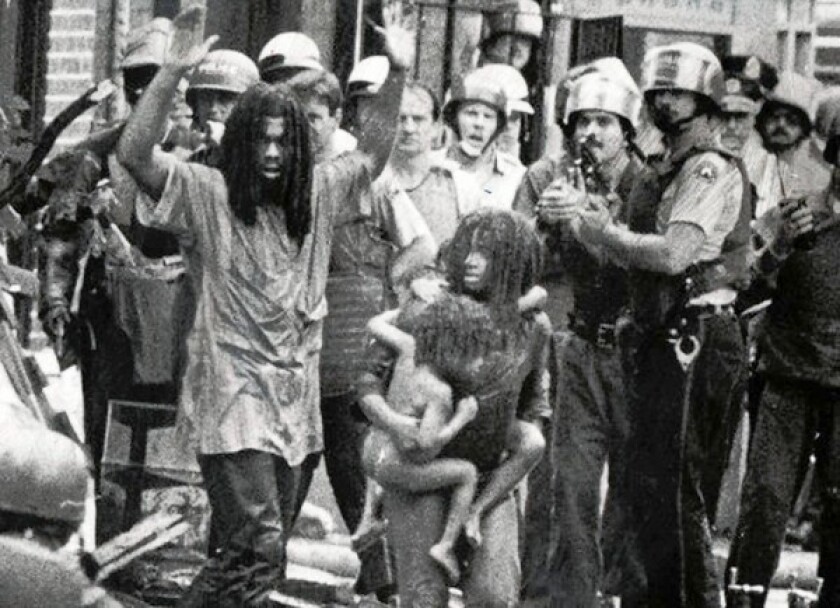
Let the Fire Burn(2013)– While obscured in public memory by the (relatively) more “recent” 1993 Branch Davidian siege in Waco, the eerily similar demise of the Philadelphia-based MOVE organization 8 years earlier was no less tragic on a human level, nor any less disconcerting in its ominous sociopolitical implications.
In this compelling documentary, director Jason Osder has parsed a trove of archival “live-at-the-scene” TV reports, deposition videos, law enforcement surveillance footage, and other sundry “found” footage (much of it previously unseen by the general public) and created a tight narrative that plays like an edge-of-your-seat political thriller.
Let the Fire Burn is not only an essential document of an American tragedy, but a cautionary tale and vital reminder of how far we have yet to go to completely purge the vestiges of institutional racism in this country. (Full review)
The Trials of Muhammad Ali (2013)– There have been a number of films documenting and dramatizing the extraordinary life of Muhammad Ali, but they all share a curious anomaly. Most have tended to gloss over Ali’s politically volatile “exile years” (1967-1970), during which the American sports icon was officially stripped of his heavyweight crown and essentially “banned” from professional boxing after his very public refusal to be inducted into the Army on the grounds of conscientious objection to the Vietnam War.
Director Bill Siegel (The Weather Underground) fills in those blanks in his documentary. As you watch the film, you begin to understand how Ali the sports icon transmogrified into an influential sociopolitical figure, even if he didn’t set out to become the latter. It was more an accident of history; Ali’s affiliation with the Nation of Islam and stance against the Vietnam War put him at the confluence of both the burgeoning Black Power and anti-war movements. How it all transpired makes an absorbing watch. (Full review)
All occupations resemble one another in some way, and it is striking to read descriptions and accounts of the occupation of Boston in light of events in Minnesota. “Having to stomach a standing army in their midst, observe the redcoats daily, pass by troops stationed on Boston Neck who occupied a guardhouse on land illegally taken it was said from the town, and having to receive challenges by sentries on the streets, their own streets, affronted a people accustomed to personal liberty, fired their tempers, and gnawed away at their honor,” writes the historian Robert Middlekauff in “The Glorious Cause: The American Revolution, 1763 to 1789.”
“Harrison Gray, a prominent merchant and a member of the council, told soldiers who challenged him one evening that he was not obligated to respond,” writes Richard Archer of the same period in “As if an Enemy’s Country: The British Occupation of Boston and the Origins of Revolution.” “They retaliated by thrusting their bayonets toward his chest and detained him for half an hour.”
Consider the language of occupation authorities as well. Stephen Miller, the White House deputy chief of staff and an architect of the administration’s immigration policies, has called protesters violent agitators and accused Minnesota state officials of fomenting an “insurgency” against the federal government. In the same way, the British general who oversaw the Boston occupation, Thomas Gage, described Bostonians as “mutinous” — “desperadoes” who were guilty of “sedition.”
It is also hard not to hear the echo of the Boston Massacre in the killing of Good.
Bouie’s historical allusions are spot on and you can’t help but think about the astonishing fact that Trump is not only acting like a tyrannical imperialist monarch by putting troops in the streets to subdue the population, he actually plans to hold a UFC cage match on the White House lawn to celebrate the country’s 250th anniversary. He’s beyond a British king — he thinks he’s a Roman emperor.
The Minneapolis Star Tribune compiled a chilling recap of multiple incidents showing ICE agents escalating aggression toward innocent bystanders including detainments, threats of violence, and physical abuse.
I’ve been wondering what the numbers show about the viral ICE videos that show their police state tactics. Peter Hamby took a look at it:
At this point, it seems rather obvious that viral videos are inflicting enormous damage on ICE’s standing with the public. Americans are bearing witness—almost in real time—to their behavior and the human anguish on the other end. Most political stories don’t come with visceral, real-world images that bring them to life for Americans who don’t closely follow the news; meanwhile, ICE’s enforcement actions are constantly playing and replaying on the small screen in everyone’s pocket.
But it’s not just Minnesotans documenting this. Everyday citizens all over the country are racking up hundreds of millions of views with on-the-ground videos, and seem increasingly willing to film ICE agents on job sites, at traffic stops, and even on their doorsteps—even while being threatened at gunpoint. It’s a scrappy, diffuse content campaign against the Trump media machine, which likes to turn ICE arrests into highly produced hype videos that look as if they were produced by an SEC football program.
Indeed, in light of the polling, it seems possible the White House might even be hurting their cause by endlessly promoting ICE. After all, the data suggests that the more Americans see, the less they like. Progressive content creators I spoke to this week reported a surge in views on their posts, and at Crooked Media, home to Pod Save America, YouTube content on ICE overperformed their typical engagement after the Minnesota shooting, staffers told me. At MeidasTouch, the progressive media outfit, co-founder Ben Meiselas also said that views on ICE-related content are surging, thanks in part to a partnership they launched with Status Coup, an independent reporting outlet that’s been livestreaming protests on the ground in Minneapolis.
Magnitude Media, a Democratic media-tracking firm, also found that social media posts on left-leaning pages that mentioned the Minnesota shooting overperformed their usual engagement by 72 percent, dramatically outpacing content on right-leaning pages, which jumped by only 5 percent relative to usual performance. The right caught up in views over the weekend after Ross’s cellphone footage of the encounter—which, in the eyes of ICE supporters, validated his decision to shoot—was leaked to a reporter. But overall, the initial footage of Good’s death had a larger impact, with an estimated 230 million views compared to 170 million for the second angle, according to Magnitude.
I think these videos are making it into the mainstream even if people aren’t on social media. Needless to say, they aren’t reaching those who are exclusive Fox viewers or cult members who post stupid memes on Truth Social all day. But there are plenty of people who are only peripherally aware of politics and these vids are being passed around at work, on email and finding their way onto local news. They are breaking through and that’s going to be very important as we confront what Miller and his henchmen are trying to do.
Imitando la vestimenta de un oficial de las SS, el jefe de la Guardia Fronteriza racista de Trump, Gregory Bovino, apareció hoy rodeado de esbirros en las protestas de Minneapolis, ordenando más represión.
Please explain why these agents attacked this person without giving any verbal warning whatsoever, or how any of this relates to immigration enforcement.pic.twitter.com/7xUEZE8l60
And this is what’s happening locally. They are scenes taking place all over America.
Buttigieg: I don’t know how you can have ever heard the slightest bit of scripture and not wonder about the judgement that comes for anyone who is involved in treating people like that pic.twitter.com/yX2Px4yjhr
It’s a lie and the only people who see this country the way Miller does are brainwashed cultists. There are a lot of them but they aren’t a majority and the rest of us think this stuff is insane.
I highly recommend signing up for Philip Bump’s newsletter. It’s interesting and unique because he’s not only a good essayist, he’s also a numbers guy with a flair for making charts. (The newsletter is called “How To Read This Chart”) It comes out on the weekend and is very comprehensive. Bump is obviously one of those super prolific journalists I can only envy.
Anyway, here is one excerpt from today’s newsletter that I found most interesting because I haven’t seen very much discussion of this:
The U.S. population is in decline
Speaking of grim analysis, the Congressional Budget Office reported earlier this month that the country’s population is likely to start shrinking by 2030 without immigration. Luckily for us, we’re doing everything we can to encourage immigrants to come to this country. Right? I haven’t checked the news for about 13 months, so let me know if something’s changed.
Sometimes people suggest that population decreases are not a big deal. Those people are wrong, for a lot of reasons. Google it.
This possibility reflects how two important patterns are intertwined — an interlacing that’s important for reasons beyond just the raw population numbers.
Consider how state-level population has changed over the past 15 years. A lot of growth in the West and Southwest, stagnation in the Midwest and Northeast.
Now I know some of you are going to be frustrated that the vertical axes here are not labeled. Well, it doesn’t really matter for our purposes. Just know that up-and-to-the-right means more population growth. If you want to email me about it to complain anyway, you can reach me at i.am.obsessive.about.axes@nowhere.bananas.
The reason it doesn’t matter is because I’m going to use the same axes to show the difference in growth between the native-born (non-immigrant) and foreign-born (immigrant) populations over that same period.
See how in nearly every state the rate of immigrant population growth is higher than the rate of growth among native-born Americans? In some cases, states have only grown because they’ve welcomed immigrants — a preview of the challenge that is looming for the whole country.
That challenge derives from the changing demographics of the population (and particularly the native-born population). I talk about the baby boom a lot, in part because I wrote a whole goldarn book about it.
But the combination of the baby boom getting older (its oldest member turned 80 on Jan. 1 of this year) and the advent of the coronavirus pandemic means that a number of states have seen negative natural population change — that is, more deaths than births — since 2000.
Fifteen states had more deaths than births in 2024 alone.
While I was still at The Washington Post, I wrote about how Trump’s attack on immigration (I read the news just now) comes at a historically bad time demographically. If for no other reason than that the increasingly large elderly population needs caregivers, the ratio here matters.
Oh well!
I’m pretty sure that we’re not yet in a place where robots can pick our strawberries, garden, raise our kids, cook our food or watch over our elderly. And there just aren’t enough native born Americans to do that work. It’s yet another sign of a society committing suicide for no earthly reason.