If you happen to be tuning into this alleged blockbuster revelation of childcare fraud in Minnesota, you are probably missing a lot of important context. It is, as you might have guessed, another MAGA outrage fest designed to create more racist, culture war animosity. Dave Weigel posted this the other day on BlueSky:
I feel like “attention hacking” is most of politics now. The Minnesota aid fraud story is becoming a perfect example.
Recap: In 2022, the Biden DOJ filed the first charges against dozens of fraudsters, many of them Somali-American, who’d fleeced a state food aid program.
This happened right as early voting began in state elections; voters re-elected Gov. Walz and gave Democrats a trifecta. It was a damaging scandal, but hardly covered up. Rs whacked at it when Walz became VP nominee, but it didn’t become a decisive issue.
I actually agree w conservatives who think this insane scandal didn’t become a huge national story in 2022 because of newsroom choices, desire not to inflame racial tensions, etc. But the Biden-era DOJ was all over it.
The Minnesota press did cover it extensively and Walz was re-elected easily in spite of it, mainly because people didn’t blame him for the problem.
Let’s face it. This is only now a big story because of Trump’s new racist, xenophobic jihad against Somali immigrants largely based upon his and his base’s hatred for Ilhan Omar. (You’ll notice that the most vociferous, grotesque attacks on immigrants have been against those who happen to be Black — Haitians and now Somalis.) The right wing media is running with it and the MSM follows. We’ve been here before.
Naturally the Trump administration is responding by pulling all federal funding for child care in Minnesota. That’s how we do things now. All children must suffer so that Trump and his cult can take onanistic pleasure in their suffering.
This year’s surge in cases and prolonged outbreaks could cause the U.S. to lose its globally recognized measles “elimination status” for the first time in decades by the end of January 2026.
The outbreaks come amid Health Secretary Robert F. Kennedy Jr.’s efforts to downplay the risks of measles and spread misleading claims about the vaccine, while suggesting other alternatives without evidence.
There were 2,012 measles cases reported nationwide as of Dec. 23, per the CDC. Of those cases, 1,988 were reported across 44 jurisdictions.
The CDC says 87% of those cases came from 50 different outbreaks, and some 93% of those infected were either unvaccinated or have an unknown vaccination status.
Texas has reported the highest number of cases this year (803), followed by Arizona (187) and South Carolina (156).
Only 285 confirmed measles cases were reported in 2024.
Gee, I wonder what’s happened?
I’ll just leave this famous piece from Roald Dahl here. I just wish some of the fools who are refusing to vaccinate their kids would read it:
My eldest daughter caught measles when she was seven years old. As the illness took its usual course I can remember reading to her often in bed and not feeling particularly alarmed about it. Then one morning, when she was well on the road to recovery, I was sitting on her bed showing her how to fashion little animals out of coloured pipe cleaners, and when it came to her turn to make one herself, I noticed that her fingers and her mind were not working together and she couldn’t do anything.
“Are you feeling all right?“ I asked her. “I feel all sleepy,” she said.
In an hour, she was unconscious. In 12 hours she was dead.
The measles had turned into a terrible thing called measles encephalitis and there was nothing the doctors could do to save her. That was 24 years ago in 1962, but even now, if a child with measles happens to develop the same deadly reaction from measles as Olivia did, there would still be nothing the doctors could do to help her.
On the other hand, there is today something that parents can do to make sure that this sort of tragedy does not happen to a child of theirs. They can insist that their child is immunised against measles. I was unable to do that for Olivia in 1962 because in those days a reliable measles vaccine had not been discovered. Today a good and safe vaccine is available to every family and all you have to do is to ask your doctor to administer it.
It is not yet generally accepted that measles can be a dangerous illness.
Believe me, it is. In my opinion, parents who now refuse to have their children immunised are putting the lives of those children at risk.
In America, where measles immunisation is compulsory, measles, like smallpox, has been virtually wiped out.
Here in Britain, because so many parents refuse, either out of obstinacy or ignorance or fear, to allow their children to be immunised, we still have a hundred thousand cases of measles every year.
Out of those, more than 10,000 will suffer side effects of one kind or another.
At least 10,000 will develop ear or chest infections. About 20 will die.
LET THAT SINK IN.
Every year around 20 children will die in Britain from measles.
So what about the risks that your children will run from being immunised?
They are almost non-existent. Listen to this. In a district of around 300,000 people, there will be only one child every 250 years who will develop serious side effects from measles immunisation! That is about a million-to-one chance. I should think there would be more chance of your child choking to death on a chocolate bar than of becoming seriously ill from a measles immunisation.
So what on earth are you worrying about?
It really is almost a crime to allow your child to go unimmunised.
The ideal time to have it done is 13 months, but it is never too late. All school children who have not yet had a measles immunisation should beg their parents to arrange for them to have one as soon as possible.
Incidentally, I dedicated two of my books to Olivia, the first was “James and the Giant Peach.” That was when she was still alive. The second was “The BFG,” dedicated to her memory after she had died from measles. You will see her name at the beginning of each of these books. And I know how happy she would be if only she could know that her death had helped to save a good deal of illness and death among other children.
He wrote that in 1986. You’ll notice that he says in America measles was nearly eradicated because everyone got vaccinated. Sadly, not anymore. And it’s all because of this nonsensical “wellness and wingnut” coalition of antidiluvian fools who follow destructive know-nothings like RFK Jr and refuse to get their kids vaccinated.
That’s what the Trump administration is pushing next year. No, it’s not for the impending war with Venezuela. (That’s probably a whole other massive expense.) It’s for ICE. And just look at what they’re planning to recruit. Gift link:
U.S. Immigration and Customs Enforcement officials are planning to spend $100 million over a one-year period to recruit gun-rights supporters and military enthusiasts through online influencers and a geo-targeted advertising campaign, part of what the agency called a “wartime recruitment” strategy it said was critical to hiring thousands of new deportation officers nationwide, according to an internal document reviewed by The Washington Post.
The spending would help President Donald Trump’s mass-deportation agenda dominate media networks and recruitment channels, including through ads targeting people who have attended UFC fights, listened to patriotic podcasts or shown an interest in guns and tactical gear, according to a 30-page document distributed among officials in this summer detailing ICE’s “surge hiring marketing strategy.”
The only bright spot in all this is that most of these “gun enthusiasts” and UFC fans are the usual out-of-shape cosplayers who are far from the Spartan warriors they think they are. There may be a few who have the discipline to be cops and soldiers but most of them are just posers.
Here is one final NYT gift link for this incredible story about the unraveling of the U.S. Ukraine relationship under Donald Trump. I don’t think the world could be any more threatened than it is by this president.
An excerpt:
The next morning, the president posted his own announcement, on Truth Social. He had just finished a “highly productive” call with Mr. Putin; their teams would start negotiations immediately.
On the call, according to two U.S. officials, Mr. Putin had praised Mr. Witkoff. He would lead Mr. Trump’s team, along with John Ratcliffe, the C.I.A. director; Marco Rubio, the secretary of state; and Mr. Waltz. The post did not mention the special envoy for Ukraine and Russia, Mr. Kellogg.
In Germany on Feb. 14 for the Munich Security Conference, unsure whether he still had a job or what it entailed, Mr. Kellogg encountered European and Ukrainian leaders in their own storm of confusion. “Do we still have an alliance?” the Polish deputy prime minister, Radosław Sikorski, asked. Mr. Kellogg sought to reassure them, describing himself as “your best friend” in the administration.
A Hegseth loyalist at the conference, though, rendered it differently in messages to Washington, accusing Mr. Kellogg of claiming, “I’m holding the line against these isolationists in the administration.” This only cemented the envoy’s outsider status, as did a Fox News item juxtaposing his latest social media post about Mr. Zelensky (he was “the embattled and courageous leader of a nation at war”) with one from Mr. Trump (he was “a dictator without elections”).
When Mr. Kellogg visited the Oval Office soon after, the president pounced.
“So you call Zelensky embattled and courageous?” he snapped, according to two officials.
“Sir, he is,” Mr. Kellogg responded. “It’s an existential fight on Ukrainian soil for his nation’s survival. When was the last time an American president faced that? It was Abraham Lincoln.”
Recounting the episode later to other advisers, Mr. Trump grumbled, “He’s an idiot.”
There is only one leader who can compare to Abraham Lincoln and we know who that is, don’t we? And let’s just say that Lincoln doesn’t really compare favorably.
That’s the tip of the iceberg. We are led by morons, greedheads and warmongers. But you knew that.
People ask this question all the time: if Trump really were a Russian asset, what would be the difference?
Read the whole thing when you have time. If this is the first draft of history I hesitate to think what we’re going to find out as time goes on. It’s much worse than I thought.
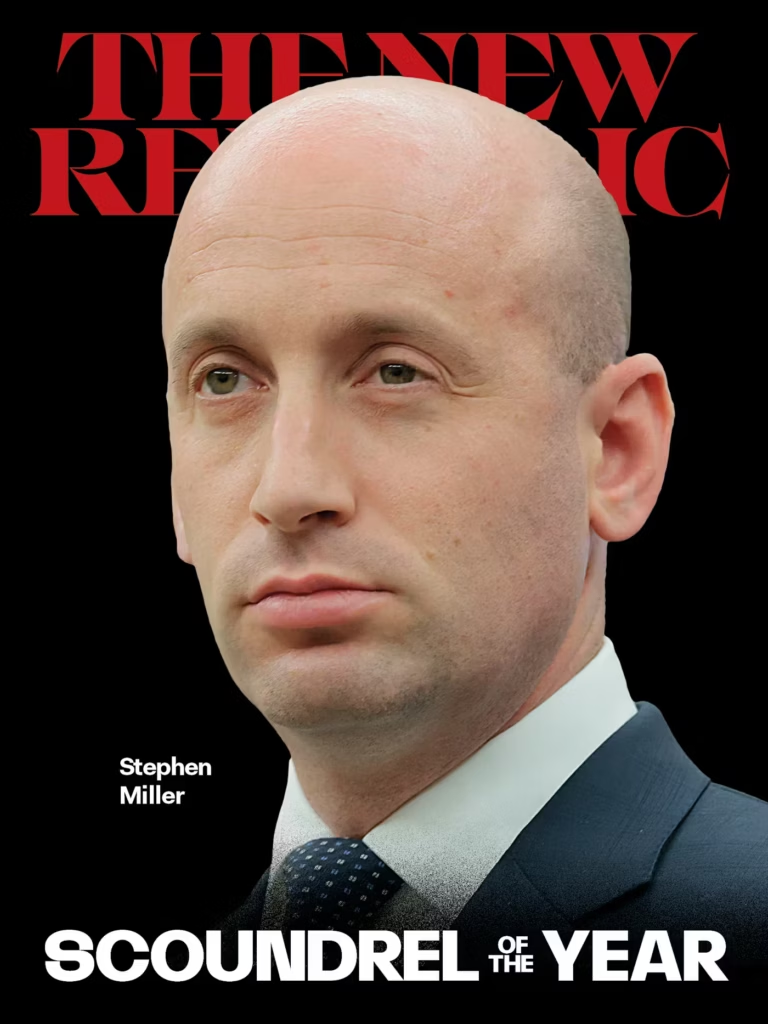
“Scoundrel of the Year” is a moniker someone as vile as Stephen Miller likely adds to his trophy wall. We know the type. One local Republican here once proudly displayed on his office wall political cartoons lampooning him. He took liberal condemnation as a sign that he was doing his job. He targeted locals the way Trump targets the left nationally.
Men like Donald Trump and Miller assume others are motivated by impulses just as base as theirs. What Miller did not count on, Greg Sargent argues in The New Republic, is that Americans on the whole really are better than them. The deputy xenophobe-in-chief’s efforts to ethnically reengineer America has provoked widespread backlash from coast to coast. Miller’s plans for arresting 3,000 non-citizens a day and deporting one million per year will fall far short in Trump’s first year back in office.
Still, Miller has other goals he has helped Trump pursue since January 20:
He has stated plainly that he wants to functionally end due process for migrants entirely. He also appears to envision Trump assuming the authority to simply decree that undocumented immigrants are criminal gang members—or terrorists, or members of a hostile invading army—all by presidential fiat. He wants Trump to assume an unreviewable, quasi-unlimited power to remove people regardless of what any court says.
Miller has done extensive damage to the rule of law, and he and Trump have consigned some migrants to a netherworld beyond the law entirely. But broadly speaking, the courts have continued to function. Trump has not assumed the unchecked authorities Miller wants him to. Miller’s biggest test case for getting Trump to exert such unconstrained powers—that of the wrongfully deported Kilmar Abrego Garcia—has thus far failed.
Trump, Miller, and Trump lackeys have turned the Department of Homeland Security’s X feed into “a white nationalist sewer pit,” Sargent writes. “Miller hoped the combination of brutal police-state tactics plus relentless state propaganda would shock the American people into embracing—or accepting—a semi-conscious ethnonationalism.” But, surprise. Americans are not having it, “and the public backlash to Miller’s masked storm troopers only grows.”
We may yet survive Miller’s nightmarish plan for remaking America as a white ethnostate (albeit with our national image tarnished perhaps permanently). But emerging on the other side of Trumpish disruption will likely not be at the hands of us geezers.
Jon Grinspan, a curator of political history at the Smithsonian’s National Museum of American History, offers a possible path forward drawing on how America emerged from the first Gilded Age. Out of that freewheeling period came one in which Americans saw need for restraint. Early reformers’ vision of reform, he writes, “usually meant returning to an older way of life, dimly recalled from before the Civil War. As long as reform meant going backward, it lost at the ballot box, the stock exchange and the corner saloon.” Most generations double down, Grinspan argues and “few truly innovate.”
What Grinspan describes from the period of progressive reform is not entirely the sort we would embrace today. His framing of restraint as a “core value” of the 20th century feels forced. What doesn’t is his argument that it is likely Gen Z or Gen Alpha that will turn away from a present “so saturated in its era, so sick of its recklessness” to innovate anew and clean up the mess we’ve made of the country.
Let it be so in 2026. I tell my younger activists that I’m now an adviser. They are the doers. They have the tools. They have the talent.
L-R: Rep. Delia Ramirez (D-IL), Rep. Max Frost (D-FL), NC Dems state chair Anderson Clayton, digital strategist Annie Wu Henry, Rep. Ayanna Pressley (D-MA), TN state Rep. Justin Jones (D).
I don’t do this often, but on this New Year’s Eve I’m reposting Thank God For Readers from September 2021:
Heather Cox Richardson reminisces about how her Letters from an American newsletter came to be two years ago. She has persisted through the turmoil and scandal of the last two years buoyed by the kindness of her readers as we all watch to see whether government of the people, by the people, for the people, shall (or shall not) perish from the earth.
If you are tired, you have earned the right to be.
And yet, you are still here, reading.
I write these letters because I love America. I am staunchly committed to the principle of human self-determination for people of all races, genders, abilities, and ethnicities, and I believe that American democracy could be the form of government that comes closest to bringing that principle to reality. And I know that achieving that equality depends on a government shaped by fact-based debate rather than by extremist ideology and false narratives.
And so I write.
But I have come to understand that I am simply the translator for the sentiments shared by hundreds of thousands of people who are finding each other and giving voice to the principles of democracy. Your steadfast interest, curiosity, critical thinking, and especially your kindness—to me and to one another—illustrates that we have not only the power, but also the passion, to reinvent our nation.
Richardson speaks for me. Thank you for coming back, day after day, to listen to us rant.
Another Heather, this blog’s proprietor, began writing here New Year’s Day 2003 after attracting a following at Atrios’s blog. She wrote that being invited to write by Atrios was “kind of like having Eddie Van Halen invite you up on stage to join him in a guitar solo.”
That’s how I felt when Digby invited me to join her in August 2014. (We’d met at a conference in 2009.) I began writing occasional commentaries for the Asheville Citizen-Times in mid-September 2003, got named an official (unpaid) “community columnist” in 2005, and finally started up my own blog in March 2006. (It’s still out there gathering electrons.) Eventually, a local rabble-rouser invited me to join Scrutiny Hooligans (R.I.P.) before Digby asked me to fill in over a weekend. The weekend never ended. The Citizen-Times’ then-editorial editor, a Digby fan, greeted me at an event, smiled broadly, shook my hand and said, “My friend, you have arrived.”
And so I write.
Rising early to write each day, three time zones ahead of Digby, is not only a matter of passion “to reinvent our nation.” It is a matter of mental health (as much as daily exercise). In such times, I suspect it is for Richardson as well. The platform allows me to play the inside-outside game. Inside Democratic Party politics and outside throwing occasional rocks. As I told a cynical friend recently, it beats feeling like political road kill:
Sometimes in politics you get run over. But being in the fight means I stopped feeling like road kill decades ago. The antidote to cynicism and despair is stepping back into the fight the way Rick Blaine does at the end of Casablanca. I told him it’s empowering especially when you feel powerless.
Also, the struggle must bring out the Irish in me, I said.
Trump reposted that and I’m sure you will see why if you listen to the whole thing. Newsmax’s Greg Kelly defends the renaming of the Kennedy Center and then articulates Trump’s real goal:
“There’s one small thing I don’t like about this. The Donald J. Trump Center for the Performing Arts — get rid of the Kennedy name! … We have to have an honest conversation about the 35th president of the United States…”
I don’t think the president or any of his dim followers understand that the venue was called the John F. Kennedy Memorial Center For The Performing Arts because Kennedy is dead, killed by an assassin’s bullet. You don’t have a memorial to someone who is still alive! By adding his name to it, it indicates that Trump too is dead which, I suppose, is true in one respect. He is brain dead, after all.
Be that as it may, I suspect Trump’s plan all along is to just remove the Kennedy name — maybe all the presidents names, from any building he wants to name for himself. Don’t be surprised if he does it.
There are thousands of small acts of defiance happening throughout our country during this dark time. This is one:
President Donald Trump had a pretty good run in 2025 when it came to confirming judges. Republicans control the Senate and rubber-stamped most of his court picks, confirming a total of 26 lifetime federal judges. That’s more than Trump got by this point in his first term (19), though not as many as former President Joe Biden (40).
But the president was also hampered by a surprising new trend among sitting judges: They’re not retiring when they’re eligible to do so, and in effect, they’ve been denying Trump the ability to fill more vacancies with his picks.
Since Trump won reelection, only 30 court vacancies have been announced, says John Collins, an associate professor at The George Washington University Law School who specializes in judicial nominations. Of those, 27 are on district courts and just three are on appeals courts, a more powerful tier of courts that often has the final say in federal lawsuits. Compare those numbers to the roughly 70 court vacancies that opened up during this same period in Biden’s first year in office — more than twice as many.
Part of the reason there aren’t as many vacancies to fill is because Trump and Biden both appointed huge numbers of judges over the last eight years, leaving a smaller pool of retirement-eligible judges. But another reason is almost certainly that some judges simply don’t trust Trump to replace them with a qualified pick, given his record of putting far-right ideologues, loyalists and otherwise unqualified people onto the federal bench.
[…]
Russell Wheeler, a nonresident senior fellow in the Brookings Institution’s Governance Studies program and a longtime judicial nominations expert, has also been watching this trend unfold all year. He noted that the vacancy creation rate under Trump has been “way below” that of his predecessors, dating back to former President George W. Bush.
Good for them. I’m sure some of them would really like to retire.
The courts generally, with the exception of the Supremes, have performed admirably during this first year, even some of those appointed by Republicans, including those Trump himself put on the bench. It is one of the more hopeful signs that our system might be resilient enough to resist this extremist onslaught. We’ve all had our doubts about the idea of lifetime appointments but I suspect that it’s that (along with patriotism and personal integrity) which is allowing many of these judges to adhere to the rule of law without fear or favor. They are being threatened with violence by Trump’s followers so they are operating under the same pressures as members of congress. But they’re not buckling the same way.
It makes you wonder if it might not be the threats of violence that has the GOP congress cowed after all. Maybe it’s just the $$ and the power after all.
Paul Waldman makes an excellent point about the wealthy whiners who are threatening to leave California if the state passes a 5% wealth tax. (Poor widdle boo-boos…)
The efficacy of wealth taxes compared to other ways of taxing the super-rich is a topic we’ll set aside for another day; for the moment, I want to focus on the predictable but utterly irrational freak-out happening among those who would be subject to such a tax. And it isn’t just in California; billionaires are making the same (mostly empty) threats in Seattle and New York as well. But the California measure is the big one, because the tax it would impose are higher and there are so many tech billionaires in the state. The initiative is being pushed by the Service Employees International Union; if it succeeds, 90% of the revenue will go toward health care and the remaining 10% to education. Naturally, the billionaires are up in arms:
Billionaires including Peter Thiel, the tech venture capitalist, and Larry Page, a co-founder of Google, are considering cutting or reducing their ties to California by the end of the year because of a proposed ballot measure that could tax the state’s wealthiest residents, according to five people familiar with their thinking.
Mr. Thiel, 58, who owns a home in the Hollywood Hills and operates a personal investment firm from Los Angeles, has explored opening an office for that firm, Thiel Capital, in another state and spending more time outside California, three of the people said.
Let’s consider Larry Page, who is less of a public person than some of his peers. Page is currently worth $257 billion, making him the second-wealthiest person on Earth after Elon Musk. That means that as of today, 5% of Page’s wealth is a little under $13 billion.
Which is a lot of money — you could fund the salaries of a couple hundred thousand home health aides with just what this one guy would have to pay. But it’s not a lot of money to Larry Page. In fact, he regularly loses or gains that much money in a matter of days, and it has zero effect on anything he chooses to do or how he chooses to live.
That’s because the vast majority of his wealth, like that of almost all the super-rich, is held in stocks, which go up and down. An illustration: This April, Donald Trump unveiled a ludicrous set of tariffs on what he called “Liberation Day,” and over the next two days, the S&P 500 lost 10% of its value. But I didn’t see billionaires saying they were going to take all their money and put it in some other country’s stock market, let alone pick up and leave the place they live. They knew that things would probably turn around, and they did.
They certainly did for Larry Page. About half of his wealth is in shares of Alphabet, Google’s parent company. Just three years ago, his Alphabet holdings were worth one-third of the $122 billion those shares are worth today.
They lose 5% of their wealth all the time and don’t have temper tantrums over it. It’s couch cushion money for people like him. So why does the idea of a tax turn them into chicken littles running around screaming “the sky is falling?”
I suspect it’s just another chance for them to paint themselves as victims as virtually every rich person somehow feels the need to do these days. These Techbros, who are actually even worse than other rich people, are not only the most arrogant people on the planet, they also feel that they’re treated very unfairly by the plebes who should be worshiping them. They believe they got their billions because they are superior people who work harder and deserve to keep every last penny to do with as they choose — and nobody gives them any credit for it.
As Waldman points out, they don’t really live in California in the first place. They live everywhere and in a state of such exalted uniqueness that they no longer have the vaguest idea about the world around them. And then there’s this, which is really galling to those of us who live here:
There’s one more important thing to remember as they whine about the horror of paying a 5% wealth tax: All these tech moguls are exponentially richer than they would otherwise have been because of California, a state that incubated the tech industry, where they were able to take advantage of resources and an expansive community of innovators, entrepreneurs, and funders unavailable elsewhere. If Page and his Google co-founder Sergey Brin had met not at Stanford but at the University of North Dakota, would Grand Forks now be the headquarters of one of the most profitable and influential companies the world has ever seen? Almost certainly not.
Of course, these guys would all say, “California isn’t the same anymore! It’s choking us!” But that’s baloney. Silicon Valley and San Francisco are still the center of the tech world, because innovation still depends on having lots of people interested in the same things in the same place where they can develop ideas together. California is also beautiful and the weather is nice, so people will keep coming there, especially if they can solve the housing affordability problem.
This is correct. They’ve made these threats for years and maybe they’ll follow through this time. But I doubt it. There are reasons why people want to live here that have nothing to do with taxes. I’m sure they’ll keep whining about it though. Complaining about unfairness for the rich man is their new mantra. (And guess who’s made it his brand?)
Trump and his throwback henchmen have set scientific research back for decades. This piece from the Atlantic (gift link) spells it out and it’s just so depressing:
Some of those losses are straightforward: Since the beginning of 2025, “all, or nearly all, federal agencies that supported research in some way have decreased the size of their research footprint,” Scott Delaney, an epidemiologist who has been tracking the federal funding cuts to science, told me. Less funding means less science can be done and fewer discoveries will be made. The deeper cut may be to the trust researchers had in the federal government as a stable partner in the pursuit of knowledge. This means the country’s appetite for bold exploration, which the compact between science and government supported for decades, may be gone, too—leaving in its place more timid, short-term thinking.
So much of scientific discovery is research for research’s sake and these weirdos are either biased toward snake oil nonsense or committed to short term profits. It will slow down progress significantly.
Of course these crackpots don’t care about that.
In an email, Andrew Nixon, the deputy assistant secretary for media relations at the Department of Health and Human Services, which oversees the NIH, disputed that assertion, writing, “The Biden administration politicized NIH funding through DEI-driven agendas; this administration is restoring rigor, merit, and public trust by prioritizing evidence-based research with real health impact while continuing to support early-career scientists.”
I think you can see what their priorities are.
I thought this was particularly poignant:
Pursuing scientific creativity can be resource intensive, requiring large teams of researchers to spend millions of dollars across decades to investigate complex questions. Up until very recently, the federal government was eager to underwrite that process. Since the end of the Second World War, it has poured money into basic research, establishing a kind of social contract with scientists, of funds in exchange for innovation. Support from the government “allowed the free play of scientific genius,” Nancy Tomes, a historian of medicine at Stony Brook University, told me.
The investment has paid dividends. One oft-cited statistic puts the success of scientific funding in economic terms: Every dollar invested in research and development in the United States is estimated to return at least $5. Another points to the fact that more than 99 percent of the drugs approved by the FDA from 2010 to 2019 were at least partly supported by NIH funds. These things are true—but they also obscure the years or even decades of meandering and experimentation that scientists must take to reach those results. CRISPR gene-editing technology began as basic research into the structure of bacterial genomes; the discovery of GLP-1 weight-loss drugs depended on scientists in the late ’70s and ’80s tinkering with fish cells. The Trump administration has defunded research with more obvious near-term goals—work on mRNA vaccines to combat the next flu pandemic, for instance—but also science that expands knowledge that we don’t yet have an application for (if one even exists). It has also proposed major cuts to NASA that could doom an already troubled mission to return brand-new mineral samples from the surface of Mars, which might have told us more about life in this universe, or nothing much at all.
We won’t be doing that anymore because it doesn’t prioritize “evidence-based research with real health impact.” In other words, pure scientific research is worthless to these cretins. And even within their narrow parameters, they will not be looking at anything that might be considered DEI, which means health issues that might impact certain populations that aren’t white and male. (I’m not kidding, they even told the NIH to eliminate all research that contained the words gender and female — and obviously anything that applied specifically to populations like LGBTQ, African Americans etc.)
The funding can be restored but as with everything else having to do with our government, the trust is gone. Now that we know that cranks, charlatans and theocratic extremists can wreak such havoc in record time, scientists will no doubt think twice about pursuing long term basic research.
There’s just so much of this to reckon with that I truly wonder if our political system is capable of dealing with it all. I suspect more of it will be permanent than we might think and that’s just sad. All because too many people couldn’t stand the idea that others might just be entitled to an equal place in our society.
The reaction to “woke” and “DEI” has been so extreme that it’s shaken my faith in the progress I thought we had made in this country. It seems that rather than 2 steps forward, one step back, it’s actually one step forward two steps back. I hope I turn out to be wrong about that but I’m afraid I’ll be long gone before we find out.