Low bar, for sure
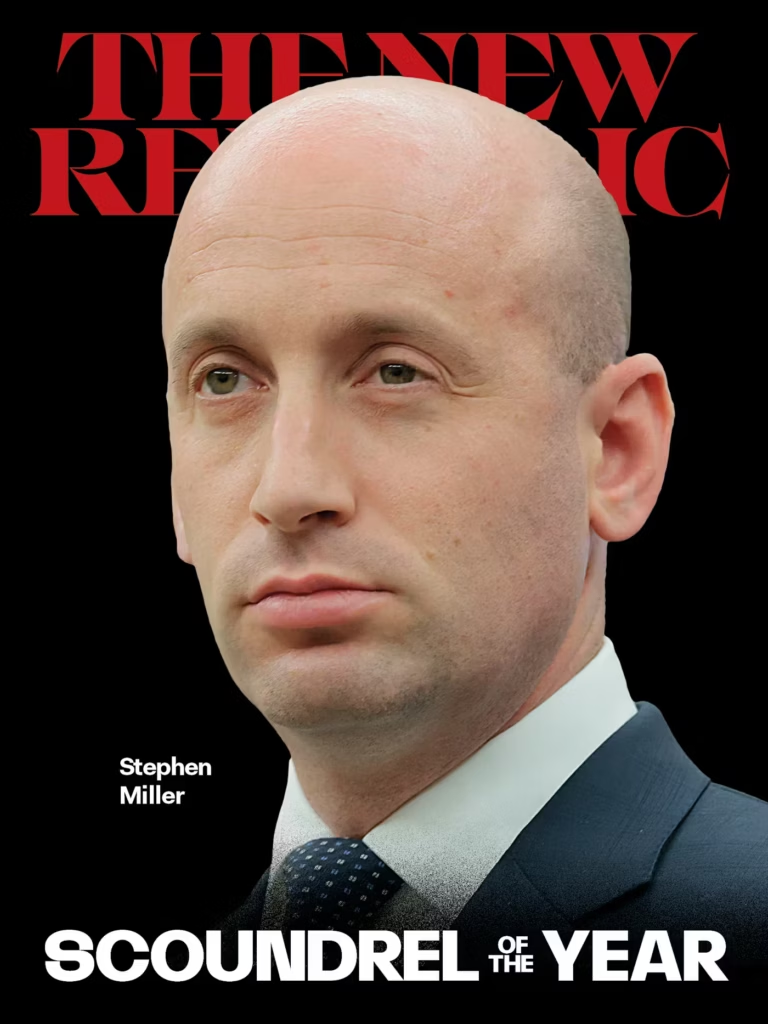
“Scoundrel of the Year” is a moniker someone as vile as Stephen Miller likely adds to his trophy wall. We know the type. One local Republican here once proudly displayed on his office wall political cartoons lampooning him. He took liberal condemnation as a sign that he was doing his job. He targeted locals the way Trump targets the left nationally.
Men like Donald Trump and Miller assume others are motivated by impulses just as base as theirs. What Miller did not count on, Greg Sargent argues in The New Republic, is that Americans on the whole really are better than them. The deputy xenophobe-in-chief’s efforts to ethnically reengineer America has provoked widespread backlash from coast to coast. Miller’s plans for arresting 3,000 non-citizens a day and deporting one million per year will fall far short in Trump’s first year back in office.
Still, Miller has other goals he has helped Trump pursue since January 20:
He has stated plainly that he wants to functionally end due process for migrants entirely. He also appears to envision Trump assuming the authority to simply decree that undocumented immigrants are criminal gang members—or terrorists, or members of a hostile invading army—all by presidential fiat. He wants Trump to assume an unreviewable, quasi-unlimited power to remove people regardless of what any court says.
Miller has done extensive damage to the rule of law, and he and Trump have consigned some migrants to a netherworld beyond the law entirely. But broadly speaking, the courts have continued to function. Trump has not assumed the unchecked authorities Miller wants him to. Miller’s biggest test case for getting Trump to exert such unconstrained powers—that of the wrongfully deported Kilmar Abrego Garcia—has thus far failed.
Trump, Miller, and Trump lackeys have turned the Department of Homeland Security’s X feed into “a white nationalist sewer pit,” Sargent writes. “Miller hoped the combination of brutal police-state tactics plus relentless state propaganda would shock the American people into embracing—or accepting—a semi-conscious ethnonationalism.” But, surprise. Americans are not having it, “and the public backlash to Miller’s masked storm troopers only grows.”
We may yet survive Miller’s nightmarish plan for remaking America as a white ethnostate (albeit with our national image tarnished perhaps permanently). But emerging on the other side of Trumpish disruption will likely not be at the hands of us geezers.
Jon Grinspan, a curator of political history at the Smithsonian’s National Museum of American History, offers a possible path forward drawing on how America emerged from the first Gilded Age. Out of that freewheeling period came one in which Americans saw need for restraint. Early reformers’ vision of reform, he writes, “usually meant returning to an older way of life, dimly recalled from before the Civil War. As long as reform meant going backward, it lost at the ballot box, the stock exchange and the corner saloon.” Most generations double down, Grinspan argues and “few truly innovate.”
What Grinspan describes from the period of progressive reform is not entirely the sort we would embrace today. His framing of restraint as a “core value” of the 20th century feels forced. What doesn’t is his argument that it is likely Gen Z or Gen Alpha that will turn away from a present “so saturated in its era, so sick of its recklessness” to innovate anew and clean up the mess we’ve made of the country.
Let it be so in 2026. I tell my younger activists that I’m now an adviser. They are the doers. They have the tools. They have the talent.

View this post on Instagram
Resolve to not be political roadkill in 2026.