Plus ça change, plus c’est la même chose.
This reminded me of the Samuel Alito interview in Politico Magazine in which he talks about his mentor the late Justice Antonin Scalia who is described like this in the article:
Around 6 p.m., after a bus packed with lawyers had barreled down the Jersey Turnpike, the man of honor arrived: Antonin Scalia, the Trenton native freshly sworn in as the 103rd justice of the United States Supreme Court, with his wife Maureen. Smiling and shaking hands as he clutched his pipe, Scalia, still black of hair and slender of frame at 50, embodied the American Dream: the son of a Sicilian immigrant father and first-generation Italian American mother who vaulted, through innate genius, hard work, devout Catholicism and Tri-State charm, to the top five at Harvard Law; senior legal positions in the Nixon and Ford administrations; law professorships at the University of Virginia and the University of Chicago; the appellate bench; and finally, the pinnacle of his profession, the Supreme Court, where he was the first Italian American justice.
[…]
One of the Tri-State lawyers who waited in line that night was a 36-year-old fellow Trentonian and Italian American, a graduate of Princeton and Yale Law with brown, frizzy hair, and taller than the justice. He wore a grey suit, maroon-striped tie and a lapel sticker, white with blue trim, reading: SAMUEL ALITO.
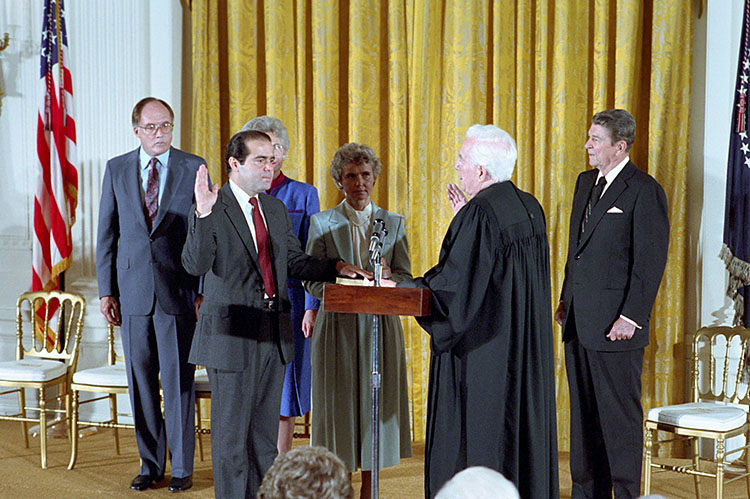
And?
Rosen: Was it at all a thing for you when [Scalia] was nominated to the Supreme Court, the fact that he was the first Italian American?
Alito: Yes, it was. And it was for millions of Italian Americans. And you can see that in the reaction within the Italian American community to his nomination. Italian Americans, unlike, let’s say, the Irish, were never a particularly cohesive voting bloc. … But everyone was united behind this because it really did represent the opening of a door, symbolically. … He was the antidote to the stereotypes about Italian Americans … prevalent at the time, and [which] continue to this day. If you look at the Italian American characters in, let’s say, movies and on TV, you’ve got the gangsters and the criminals, and then you have kind of the low — the dumb buffoons. So you look at the character that John Travolta played when he was in that — what was the TV show?
Rosen: “Welcome Back, Kotter.”
Alito: Yeah, “Welcome Back, Kotter.” Or Tony Danza in —
Rosen: “Taxi.”
Alito: “Taxi.” Or Henry Winkler in — what was it?
Rosen: “Happy Days.”
Alito: “Happy Days.” You know, that’s the way people, a lot of people, thought about Italian Americans. You know, maybe they could sing and Joe DiMaggio was a good athlete. … But somebody who was a serious intellectual, that was something. And that was a real antidote.
What a wonderful American story, eh?
Of course Italian-Americans are different, right? They aren’t like those Haitians or Laotians or Venezuelans we have today. Except, at the time of the great migration to America from Italy, the right wingers of the day certainly believed they were, didn’t they?
The lack of self-awareness among the avatars of the American right is a thing to behold.